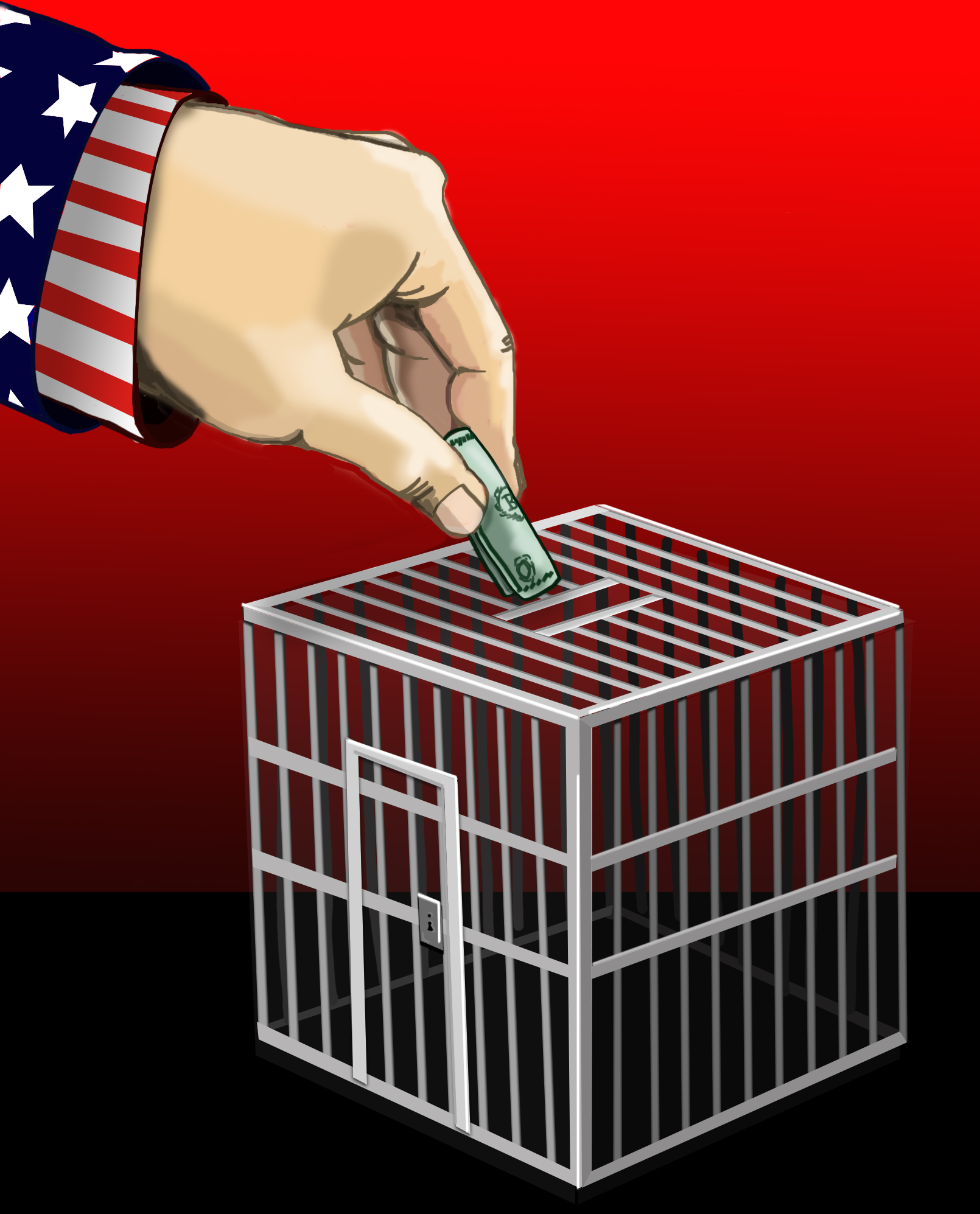
Mass incarceration in the land of the free is a problem that is only getting worse.
In 1999, Sharanda Jones began her life sentence for her first non-violent criminal offense for the conspiracy to traffic cocaine. Forgotten and without a voice, Jones adapted to life in prison for 17 years until President Barack Obama pardoned her in December 2015.
Jones is just one example of half of the U.S. prison population who are behind bars because of drug-related crimes with drawn out sentences. In an overcrowded incarceration system, policies need to take place to reverse a system that disadvantages large portions of the American population.
However, there needs to be a system in place to punish those who break the law. We need a system that is built on the presumption of innocence, not a system that disproportionally targets groups of people in America.
America’s “war on drugs” mentality and “tough on crime” politics contributes to U.S. prisons holding 25 percent of the world’s inmates, while U.S. population only makes up 5 percent of the world.
In the early ’70s, President Richard Nixon announced that the “war on drugs” and the imprisonment rate grew rapidly by 6 to 8 percent every year, according to the National Academic Press. During this time, Nixon demanded federal funding for drug-controlled agencies and strict measures for drug offenses like mandatory prison sentences. In 1973, Nixon created the Drug Enforcement Agency (DEA) that now has 5,000 agents and a budget of over $2 million to control usage and smuggling of drugs.
But, in 1994, John Ehrlichman, Nixon’s former domestic policy chief, revealed in an article published in Harper’s magazine that the “war on drugs” witch hunt was not directed at drugs. Instead, Ehrlichman said Nixon used war on drugs to target his major enemies in becoming re-elected –– anti-war advocates and black Americans.
“We knew we couldn’t make it illegal to be either against the war or black, but by getting the public to associate the hippies with marijuana and blacks with heroin, and then criminalizing both heavily, we could disrupt those communities,” Ehrlichman said to journalist Dan Baum in 1994. “We could arrest their leaders, raid their homes, break up their meetings, and vilify them night after night on the evening news. Did we know we were lying about the drugs? Of course, we did.”
Today, we are still living in a society that disproportionally targets black and Hispanic Americans in arrests than any other race.
In 2016, The Guardian found that black Americans are incarcerated for drug offenses five times more than whites. Although black Americans and Hispanic Americans make up about 32 percent of the U.S. population, NAACP reported that they made up 56 percent of the incarcerated people in 2015.
According to NAACP, if black and Hispanic Americans were arrested at the same rates of white Americans, the incarceration rate would decrease by 40 percent.
Immigration-related arrests and mass incarceration have a relationship that has grown since the Trump administration.
With President Trump’s promise of a crackdown on immigration, the Houston Chronicle reported that there has been a 10 percent increase in the arrests of immigrants since 2016. The increase of detainees and arrests demands more beds and room to round-up these people. That is where private prisons come in.
Private for-profit prison companies like the GEO Group and CoreCivic benefit from the increase in federal spending of U.S. Immigration and Customs Enforcement. Trump administration proposed increasing their budget by 1.6 million dollars for 2018 and GEO Group and CoreCivic group own all the largest ICE detainment centers.
Large companies and private prisons benefit from an increase in arrests and longer prison sentences. There is no rush to limit America’s plague of mass incarcerations when so many are profiting financially and socially by reinforcing stereotypes of black Americans beings thugs and troublemakers.
Mass incarceration damages families and, in turn, generations. Seven percent of all children in the U.S. have a parent who was or is currently incarcerated. Studies show that children with incarcerated parents have an increase of potentially negative life effects like economic and psychological impacts such as the trauma of losing a parental figure. Children of incarcerated parents are five times more likely to be incarcerated themselves than their peers.
Along with the social and economic impacts, mass incarceration touches politics. In 34 states, those on parole or probation cannot vote, and, in 12 states, felony convictions prevent those from voting ever again. Voting influences who will be policy makers and make laws that decides who will be arrested, for what and for how long.
Mass incarceration continues to be a problem. In the words of Kanye West’s “New Slaves” song, we need change now.