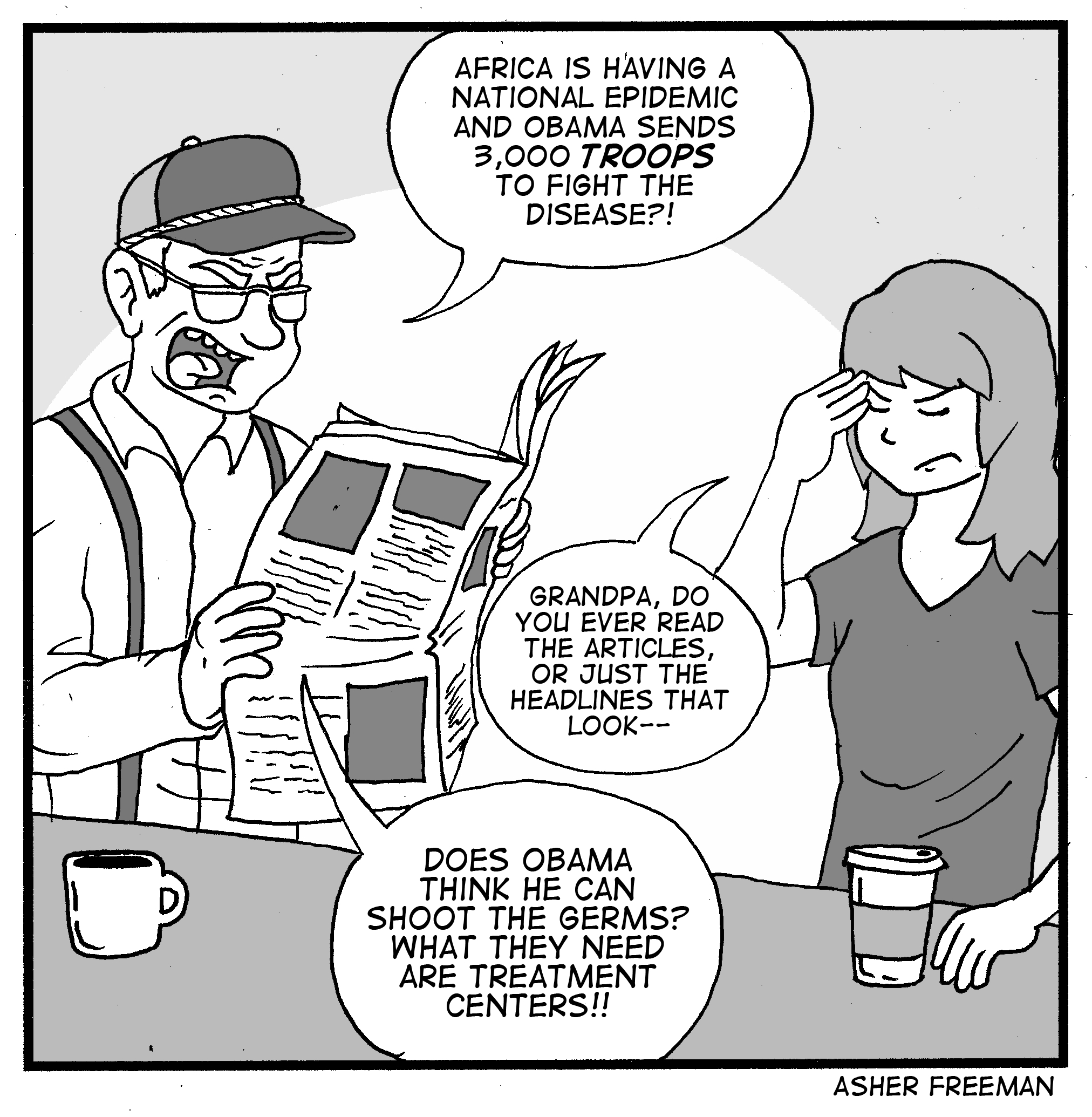
 Currently, the U.S. is sending up to 3,000 troops to Liberia to help stop the spread of the deadly Ebola virus, and that is a good thing. West Africa is experiencing the worst Ebola outbreak ever recorded, with approximately 5,000 infections and 2,500 fatalities. According to the World Health Organization and the Centers for Disease Control and Prevention, the disease is spreading at an exponential rate and has the potential to spread to other continents beyond Africa, and even to North America. Speed of action; equipment and supplies; and trained health care providers are essential to stop an outbreak of this proportion.
The U.S. military is good at a lot of things, but logistics and expeditionary field medicine are at the top of the list. The U.S. military is very well suited to assist the CDC and WHO in West Africa.
On Sept. 19, Pentagon spokesman Rear Adm. John Kirby said U.S. troops will not be interacting or coming in contact with any patients infected with Ebola. The U.S. military is being sent to support the current health care workers and train approximately 500 more.
The Army Corps of Engineers will provide some of the troops sent to Africa. The engineers will help build Ebola treatment facilities where non-U.S. military health care workers will operate. The Department of Defense is also coordinating significant logistical support through U.S. Africa Command to ensure health care workers in West Africa have enough equipment and supplies to treat patients and protect themselves from the virus.
Despite reassurances from the White House, Pentagon and DOD that U.S. service members will not have any direct contact with patients infected with Ebola, the Obama administration has taken criticism since announcing it will send service members to Liberia. Some critics feel U.S. troops are being put at unnecessary risk or that they are not adequately trained or equipped to handle an Ebola outbreak.
The U.S. military is a diverse organization with tasks, missions and capabilities far beyond just combat arms. In fact, the U.S. military frequently provides humanitarian relief all over the globe. Part of the military’s responsibilities for protecting national interests is humanitarian efforts to stabilize regions after disasters such as tsunamis. Examples of this can be seen in situations such as the aid provided to Indonesia in 2004 under Operation Unified Assistance and to Haiti in 2010.
U.S. service members also go through extensive training in case of a Chemical, Biological, Radiological, Nuclear or Explosive attack, also known as a CBRNE attack. An Ebola outbreak has the same basic protocols as a CBRNE attack. The U.S. military has entire units dedicated to CBRNE and preventative medicine, and they are very equipped to handle this situation.
Then there is the security situation on the ground. Liberia is certainly not Benghazi, Libya. However, there is a real threat of panic and rioting if the Ebola virus keeps spreading. On Sept. 16, President Obama said that the CDC already sent hundreds of people to West Africa in the largest international response in the history of the CDC. The WHO, U.S Agency for International Development, Department of State, Department of Health and Human Services and other international organizations also have relief workers in West Africa who need security. Along with the engineers and health care workers, the DOD is also sending troops to secure medical facilities and ensure the safety of relief workers.
The White House is also receiving criticism from people who think military resources, and tax dollars, could be used for other causes more specific to the U.S. To date, the Obama administration has spent $100 million from the Pentagon’s budget on efforts to stop the spread of Ebola in West Africa and will divert $500 million total. The total budget for the U.S. military is $756.5 billion for fiscal year 2014. Congress set this money aside so that our military can react to situations like this. The funding for this operation was already available and is truly a small fraction of the overall budget, for a very worthy cause.
Other critics say that this is not an American problem and the U.S. should simply stop intervening in world affairs all together. The nation probably should have a conversation about how much it wants U.S. troops to intervene in world affairs. However, this is not one of those situations. It is also true that this is not a U.S. problem, because it is a global problem. It affects everyone, and everyone is at risk. The U.S. should send help to West Africa, and so should the rest of the world powers.
The U.S. military is more than equipped to handle this situation and those who say otherwise either don’t know much about the military’s capabilities or maybe have another agenda. In fact, many of the criticisms about sending troops to West Africa are coming from people who don’t like the president’s politics and a lot of the praise is coming from people who support the president. That is wrong. Preventing a virus from killing thousands of people should not be about politics. This is no time to draw party lines and start bickering. This is about fathers, mothers and children dying of an awful disease and our responsibility to help them as compassionate human beings.
The world’s major expert organizations on diseases, outbreaks and pandemics are either applauding President Obama for sending help or calling on the president to send more. U.S. citizens should trust that the experts on this one because the stakes are high and the consequences could be severe if the Ebola virus continues to spread.