
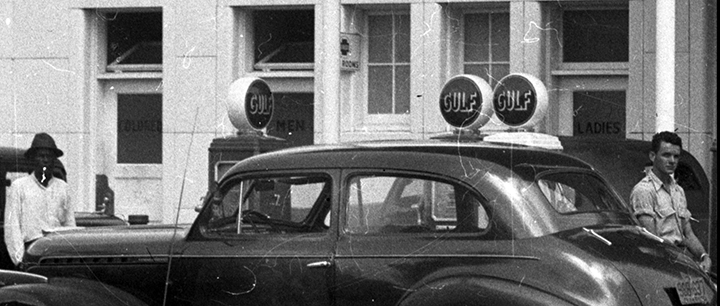
Photo courtesy of the Texas Collection
Reporters and Staff Writer
Fifty years ago, Baylor’s campus was transformed as the Board of Trustees voted to integrate the student body. That same year, the first black student enrolled.
In discussions prior to the November 1963 vote, students expressed feelings about integrating. In a letter to the Lariat in 1957 one student wrote, “It is the place of Baylor as a Christian institution to take a lead in integration.” Another student said, “I think a Negro should stay with his people, and we should stay with ours.”
The Supreme Court’s decision in Brown v. Board of Education in 1955 instructed all public schools to integrate as soon as possible. However, Waco’s history of desegregation was a slow and arduous process in the 1960s.
A June 1963 issue of the Waco Times-Herald reported integration of Waco’s public school systems would not begin until later that same year. However, the school board voted to integrate in phases, a slow process that would not see completion until five years later. Waco ISD saw full integration in 1968 — 13 years after the 1955 court ruling. The move toward integration that started in the 1960s at Baylor and in Waco has now been amplified. What was once a separate campus and city is now an integrated community.
Today, while laws of the past no longer control segregation, separation among different groups of people has become a choice.
Dr. James SoRelle, professor of African-American history and published author of articles pertaining to racial tensions in Waco, said Waco did not show any urgency to integrate after the Supreme Court ruling.
“It read, ‘with all deliberate speed,’” SoRelle said of the Supreme Court ruling. “If Waco is still working this out in the ‘70s, that’s not my definition of speedy. There’s a level of frustration that begins to build up. Even though you have the law on your side, there is continued resistance.”
Built-up frustrations were evident when then recently-integrated black students at La Vega High School conducted a walkout in 1971, upset they had to leave their former school, G.W. Carver High School. The group walked five miles to Carver Park Baptist Church, where they stayed for hours.
“There wasn’t much in the way of desegregation until the early ‘60s,” SoRelle said. “By the time I was in high school, there were a few blacks at Waco High. There were no African-Americans in Richfield, which is where I went to school. I graduated in ’68.”
Unlike the slow-moving Waco school district, Baylor was quick to implement integration on campus and allow all races to attend the Baptist college.
Abner McCall, Baylor’s president from 1961 to 1981, had a hand in the decisions that helped desegregate Waco and Baylor.
McCall was part of the Inter-Racial Sub-Committee, a group that worked quietly to desegregate Waco’s public facilities. This committee later became the Community Relations Committee of the Waco Chamber of Commerce, on which McCall also served.
In 1963, McCall took over implementing the Board of Trustees decision to integrate. A report presented by the integration committee headed by Earl C. Hankamer said “neither race nor color be a factor to be considered in the admission of qualified students to Baylor University.”
SoRelle, who knew McCall, said the president was feeling pressure from both sides of the matter.
McCall and the Board of Trustees eventually chose to integrate.
In 1963, Robert Gilbert became the first black Baylor Bear, graduating four years later with a bachelor’s degree in history.
Though Gilbert did complete his undergraduate education at Baylor, he said his time as a student was not easy. He suffered many experiences typical of the time, including being called the “n-word” by professors and being ostracized by his peers.
In an oral memoir for Baylor’s Institute of Oral History, Gilbert detailed his experiences at Baylor, including his encounter with a professor who used derogatory names when addressing him.
“I recall going to him when I saw that my grades were slipping, and I had a talk with him,” Gilbert said. “He told me, first of all, after talking to him for a while, that I didn’t talk like a n—– and he used that word.”
Gilbert described his experience with his professor saying he was told he didn’t use “ain’t” and sounded more like a Mid-Westerner. Gilbert found the conversation unsettling, saying it resulted in a biased view of Baylor professors since that was his first experience with one.
“If I would give you an entire view overall of what Baylor was like when I was there, I would say that I felt as a person who is on a plantation, or a slave on a plantation, not exactly doing slavery work; but it was the atmosphere of a southern belief type situation whereby I was just in the midst of it,” Gilbert said.
Not only was Gilbert taken aback by his professor’s stereotypes, he also felt isolated from the rest of the student body. In his oral memoirs he described his social life as being non-existent.
“There was no social life as such, I mean for me,” Gilbert said. “I would be considered maybe one of the pioneers as far as the blacks were concerned.”
SoRelle said he assumes race could have played a role in Gilbert being isolated.
“Gilbert might have been persecuted in the sense of being ignored,” SoRelle said. “I’m sure that he and his African-American classmates had a sense of isolation. I suspect they went to class and went home.”
While Gilbert inevitably faced professors with traditional Southern mindsets of the time, he also came across professors who were sensitive to his situation, describing them as “philosophical leaders on the Baylor campus.”
“I think I had an interest in–or Dr. McGee had an interest in me, I think, which was unusual,” Gilbert said. “He was another guy I would consider somewhat liberal in his views. I don’t like to throw these labels around, liberal and conservative, so much because you can’t just stereotype people. But the people that I deal with mostly, or have had dealings with, are people who are a little maybe left of center or something, and these are the people that I have been able to maybe get along with in this respect.”
Gilbert, who passed away in 1993, said he understood what he was experiencing was a part of the time, but did not believe it was okay and would dedicate a large part of his life’s work to end segregation in Waco.
“Gilbert came to be viewed by the white power structure as a trouble-maker because he kept insisting on a real commitment to end segregation of public facilities in the city,” SoRelle said. “Gilbert didn’t like operating behind the scenes. He was a little more activist than a lot of people were comfortable with.”
On the opposing side of integration was the Citizens Council of Waco, a group formed by residents and chartered by Secretary of State Al Mudrow and dedicated solely to the task of stopping integration in the city.
A brochure distributed by the council described the integration as an objective of Communist Russia. In order to be a member of the Citizens Council, an applicant had to check off a statement reading: “I hereby certify that I am a member of the Caucasian race. I further certify that I am not a member of the Communist Party nor have I ever been a member of any organization advocating the violent overthrow of the United States Government or the destruction of the Caucasian race.”
Despite the initial resistance and a decade of turmoil, Waco was on its way towards integration of its public facilities and school systems. Segregation officially became illegal across the nation through the Civil Rights Act of 1964, though people continue to separate themselves based on color.
Pastor Ronald English was a student at Baylor in the ‘70s and is an academic support adviser on campus. He said he’s seen changes in attitudes and diversity during his time in Waco.
“There are Asians and there are other minorities, but really where the true rift is and the historical problem comes between African-Americans and whites,” English said. “But I’ve heard conversations, I’ve seen people really desire for there to be a lot more collaboration between races. I see a big willingness on the part of the university now. What I would desire or hope is that as the university continues to carry out its traditions, is that its traditions would then be painted in a light that includes the various ethnic backgrounds into the traditions of the university.”