By Alexia Finney | Staff Writer
The number of Baptist students at Baylor is dropping, but students and faculty say this trend is bringing unity rather than division.
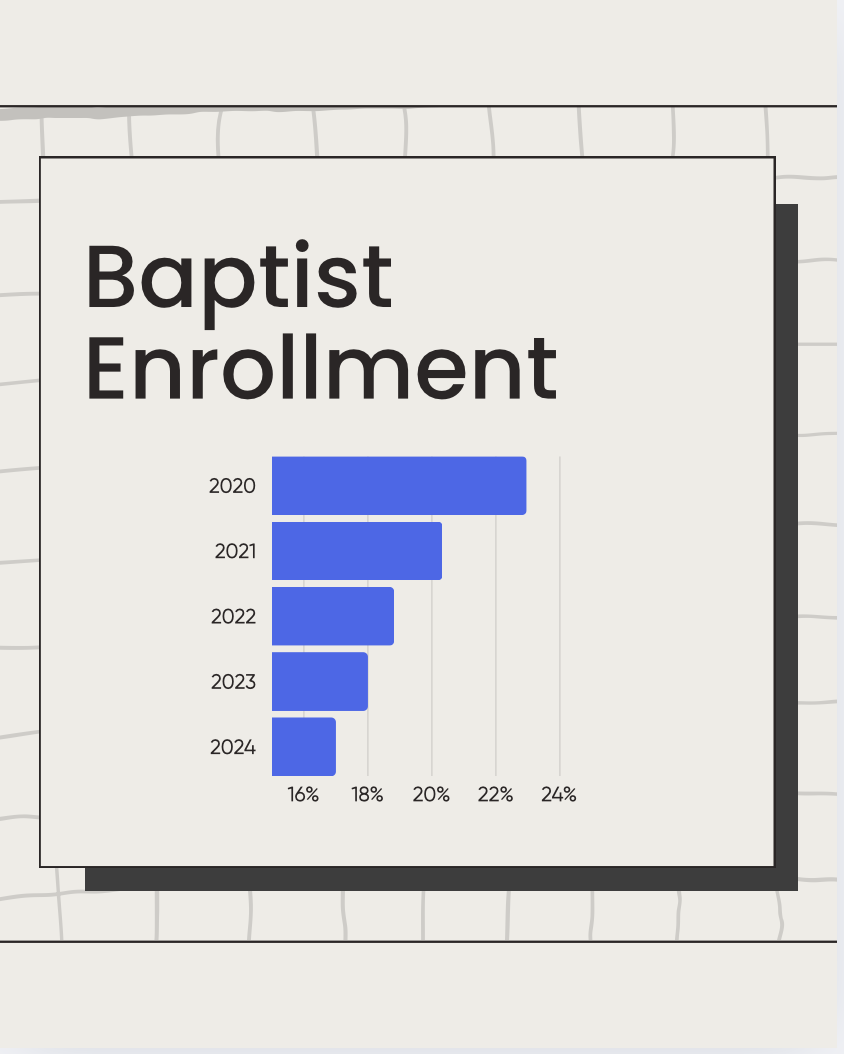
From fall 2018 to fall 2024, the number of Baptist students at Baylor declined by 10.1%. By contrast, the number of nondenominational students increased by 28.5%, according to Baylor’s Office of Institutional Research.
Associate Professor of Higher Education and Student Affairs Dr. Rishi Sriram said Baylor’s religious shift aligns with larger cultural patterns among college-aged Christians.
“When students come to college, they’re aware there are lots of ways of acting out the Christian faith,” Sriram said. “They are aware there’s different ways to conduct sacraments and Christian practices.”
Sriram said shifting religious demographics represents both challenges and opportunities for Christian universities.
“I think the next decade will present a unique opportunity for Baylor to fill a gap that most universities don’t want to touch,” Sriram said. “I think our younger students who are entering higher education are hungering for a deeper life … spiritual answers. Most colleges and universities are hands-off with those questions.”
Although Baylor’s student denomination has shifted, Sriram said he didn’t see a large difference working in Student Affairs. Moreover, he said he witnessed connection rather than division.
“This is a great opportunity to exercise uniformity,” Sriram said. “We can be reconciled and not believe all of the same things.”
Waco senior Elijah Bonow has witnessed the rise of nondenominational Christianity firsthand. Bonow grew up attending Antioch Church in Waco before his family moved to Houston when he was 10. In Houston, Bonow’s father served as a pastor at Antioch in Houston. When his family moved back to Waco at the start of his freshman year, Bonow reconnected with Antioch in Waco and now serves as a life group leader and part of his church tech crew.
Bonow said his beliefs as a nondenominational Christian are not fundamentally different from those of other Christian denominations.
“It’s easy to view a nondenominational church as rejecting tradition,” Bonow said. “For me, that’s not the case because it’s just the tradition and norms I am used to.”
Bonow said he views nondenominational Christianity as a different style, not a different belief, meaning all denominations honor the same God.
“I think the point of a nondenominational church is to follow Jesus rather than affiliate with the connotations of a denomination,” Bonow said. “I see plenty of friends in my circle who resonate with styles that are different from my own.”
As Baylor’s faith diversifies, students like Bonow see the change not as a loss of identity, but rather a step toward a more inclusive expression of Christianity on campus.
“I would love for the church to continue to grow toward less of a denominational split and more interdenominational unity,” Bonow said.