By Joana Karoshi | Staff Writer
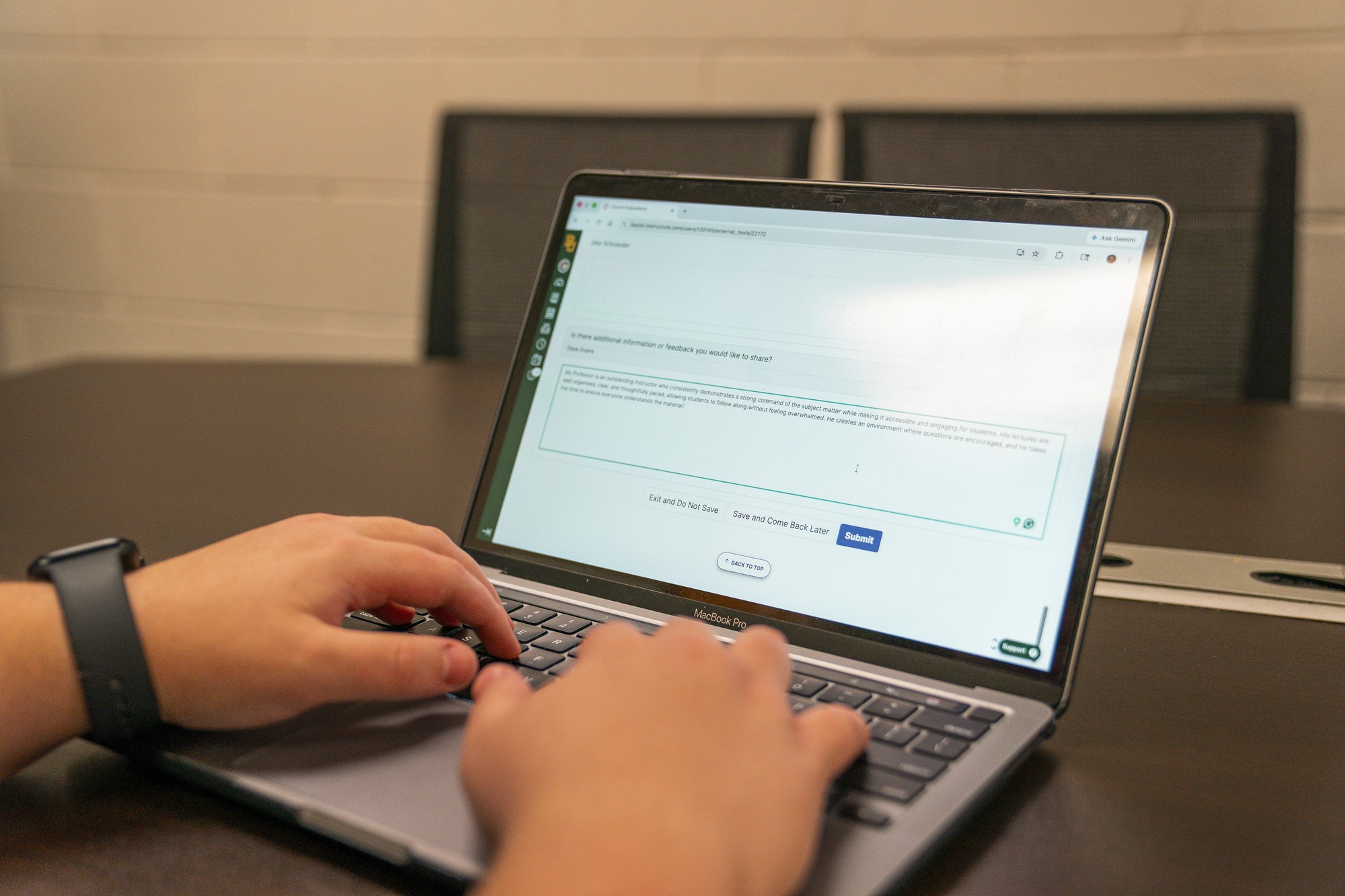
As May approaches, students are met with the familiar pop-up request when they open Canvas — course evaluations.
Behind those evaluations, administrators and faculty describe a system that uses student feedback as one piece of a broader process, not a standalone measure of teaching quality.
Dr. Toby Brooks, director of the Academy for Teaching and Learning, said faculty development opportunities exist to help improve teaching, but participation is optional.
Brooks said the way course evaluations are used and implemented changes across faculty.
“Using course evaluations and the training a faculty member might have received regarding them will vary tremendously from faculty member to faculty member,” he said.
He emphasized that evaluations are not interpreted in isolation.
“Student course evaluations are an important piece, but not the only piece we should be relying on,” Brooks said. “And one outlier in either direction is not really what supervisors are trained to look for. It’s themes or trends.”
Evaluators look for patterns over time rather than single extreme responses when navigating course evaluations and actions to take.
Brooks said faculty often engage deeply with negative feedback in particular.
“I keep all my evaluations,” he said. “I might have 100 that were glowing and one that just leveled me. I don’t spend as much time processing the good ones. I pore over a bad one to try and figure out where it went wrong.”
For Brooks, evaluations aren’t just suggestions, but have led to direct changes in his teaching.
“I’ve completely revamped or scrapped projects from courses based on student feedback,” Brooks said. “I have shuffled the schedule in the syllabus. I have added or minimized the number of tests and assignments.”
At the same time, he said student perceptions during a course do not always match long-term outcomes.
“I taught a strength and conditioning and therapeutic exercise course at a prior institution for more than a decade,” he said. “Students frequently called one assignment ‘busywork’ in the course evals.”
Brooks said the gap between short-term perception and long-term usefulness is a recurring challenge.
“You might not see the value in something during the moment,” he said. “But I’m doing my best to stretch you and form you.”
He also said interpreting feedback has become more difficult due to tone. He recalled examples of extreme comments, including, “You’re an OK person, but you suck as a teacher. Go do something else.” He said anonymity protects students, but also removes accountability for tone.
But he also warned that students should remember their words are read by faculty.
“Consider how you would feel if the words you wrote were meant for and ultimately landed on your computer screen about you,” he said.
Brooks added that course evaluations are widely circulated within academic structures.
“I still have anonymous course evaluation data from students from two decades ago,” he said. “My program director at the time read it. My department chair at the time read it. My dean at the time read it.”
He also said faculty across departments may sometimes have access to aggregated feedback. Brooks said evaluations can also carry consequences beyond classroom reflection, and students don’t always realize the weight their evaluations carry.
“Actions like scoring a professor low for a decision a student made to take an online section can have consequences that students might not fully appreciate,” Brooks said.
Dr. William Sterrett, professor and chair of Educational Leadership, said the average course evaluation response rate has remained steady at 67% for several years.
For faculty evaluation, Sterrett said course feedback is only one component of a larger review system.
“I review course evaluations every year for both full-time and part-time faculty,” Sterrett said. “It is an important piece, though not a complete whole, of how we look at our teaching.”
He said faculty evaluation includes multiple sources of evidence.
“In my own teaching, I look at both quantitative data and qualitative comments,” Sterrett said. “I encourage faculty to consider student perspective and peer feedback.”
Dr. Kathleen Morley, assistant vice provost for institutional research, said course evaluations are integrated into faculty review, promotion and tenure processes, but are never used alone.
“Faculty share their student course evaluations as one piece of their overall picture of teaching effectiveness,” Morley said. “Other pieces include syllabi, peer reviews of teaching from other faculty, course enrollment numbers and a personal report by the faculty of their own continuing development.”
She said faculty reflection and mid-semester feedback are also sometimes included.
Dr. DeAnna Toten Beard, vice provost for faculty affairs, said teaching evaluation is a holistic process.
“Those evaluating the faculty member for review, promotion or tenure look at his or her teaching holistically using several pieces of evidence,” she said.
She added that consistent low evaluations are taken seriously but not in isolation.
“Consistent low course evaluations are one sign — but not the only one — that more attention in the area of teaching is needed,” she said. “The chair or dean may recommend teaching development or peer mentorship.”