By Hannah Webb | Opinion Editor
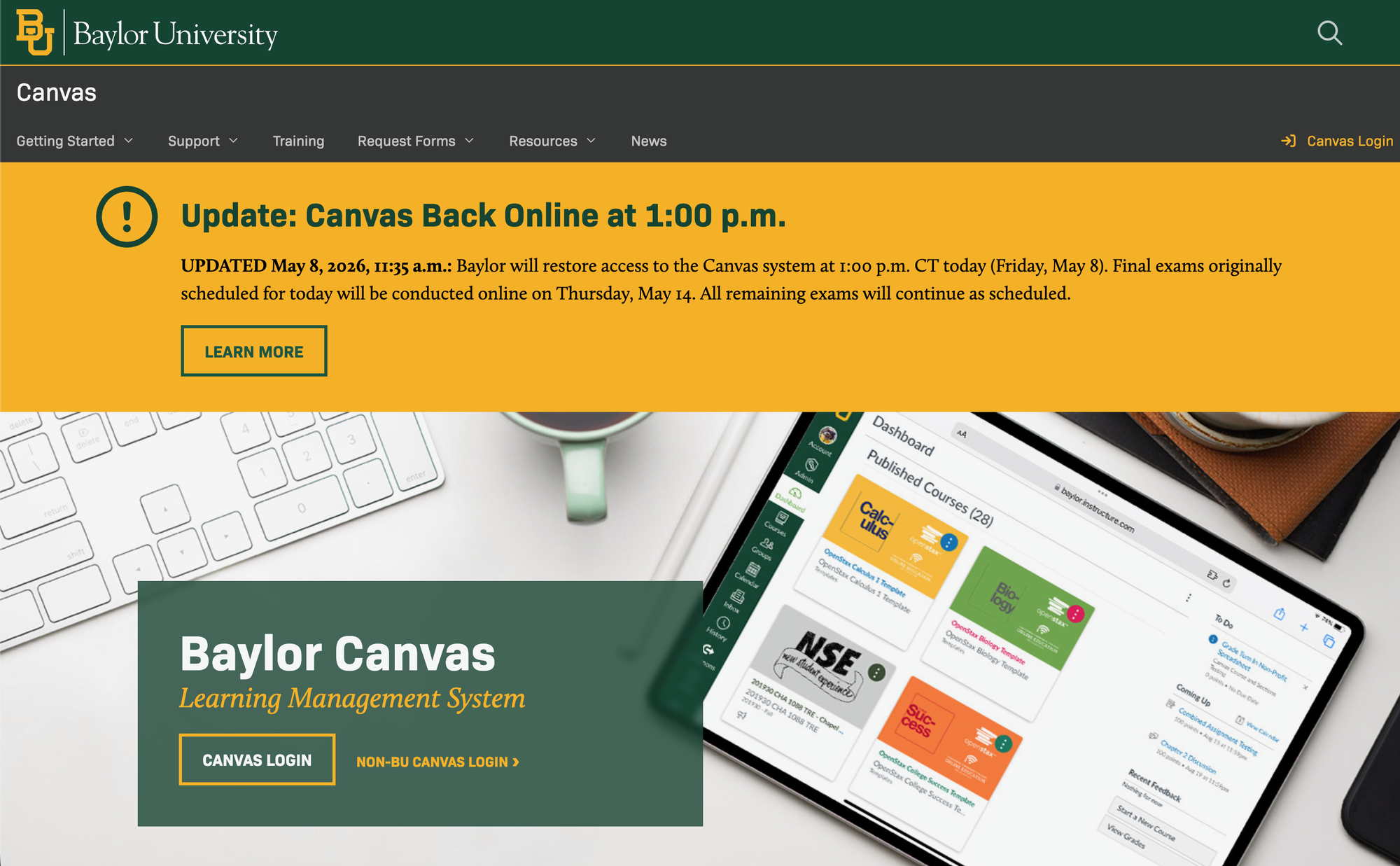
Baylor announced this morning that all final exams scheduled for today would be moved to next Thursday and administered online after a nationwide Canvas outage disrupted studying and caused confusion across campus.
The announcement came after students and faculty spent much of Thursday uncertain about how finals would proceed following the cyberattack on Instructure, the company that operates Canvas.
In an email sent this morning, Provost Nancy Brickhouse clarified that “final exams currently scheduled for today will be conducted on Thursday, May 14, and all exams will be administered online.”
The outage, reportedly linked to hackers known as ShinyHunters, affected K-12 schools, colleges and universities nationwide during one of the busiest academic periods of the semester.
Brickhouse said that all access to Canvas will be restored by 1 p.m. today. Students should not attempt to access the platform until this time.
Several students attempting to log in said they received an error message stating that “Canvas doesn’t have an account for user.” It is unknown at this time if this will resolve with the restored Canvas status.
The outage created significant stress for students preparing for finals, many of whom rely on Canvas to access study guides, lecture slides, assignments, practice tests and review materials. The uncertainty surrounding the exam schedule added to the confusion as students scrambled to determine whether travel plans, move-out schedules and online coursework would need to change.
For Bernardsville, N.J., junior Madi Molinaro, the outage disrupted her preparation even though her exams were not originally scheduled for today.
“I would say even though my finals are all later in the following week, it still completely messed up my studying,” Molinaro said. “Most of my finals are cumulative, so it took a toll on my ability to thoroughly study course material.”
Molinaro also expressed concerns about the reliability of the system moving forward, saying she was unsure “how well Canvas will be up and running.”
“If [the hackers] could get into Canvas so easily, it’s clear they won’t have trouble accessing it again,” she said.
Baylor administrators acknowledged the disruption and urged flexibility from faculty members as exams transition online.
“When administering exams online, we ask faculty to build in flexibility so that students who are traveling or have other post-semester commitments can complete their exams when their schedules permit,” Brickhouse wrote.
The university also addressed concerns about academic integrity, reminding faculty that Respondus could be used to proctor online exams.
Officials said there are currently “no anticipated changes” to commencement ceremonies scheduled for May 15-16 or to the start of the May minimester on May 18.
As part of the university’s cybersecurity response, Baylor instructed students, faculty and staff to update their operating systems and browsers and avoid accepting suspicious downloads. Faculty members were encouraged to export gradebooks and download course materials in case Canvas experiences additional outages.
“Should Canvas be compromised again, we will be in touch rapidly to discuss next steps,” Brickhouse wrote.
Baylor said university IT teams “worked through the night” to back up gradebooks before the system came back online.
Students in Office of Access and Learning Accommodation programs who now face scheduling conflicts because of travel arrangements were directed to contact its director, Danny Hernandez, for assistance.
The outage has drawn attention to the growing dependence universities place on digital learning platforms and the challenges campuses face when those systems suddenly become unavailable during high-stakes periods like final exams.