


By Abby Rathburn | Staff Writer
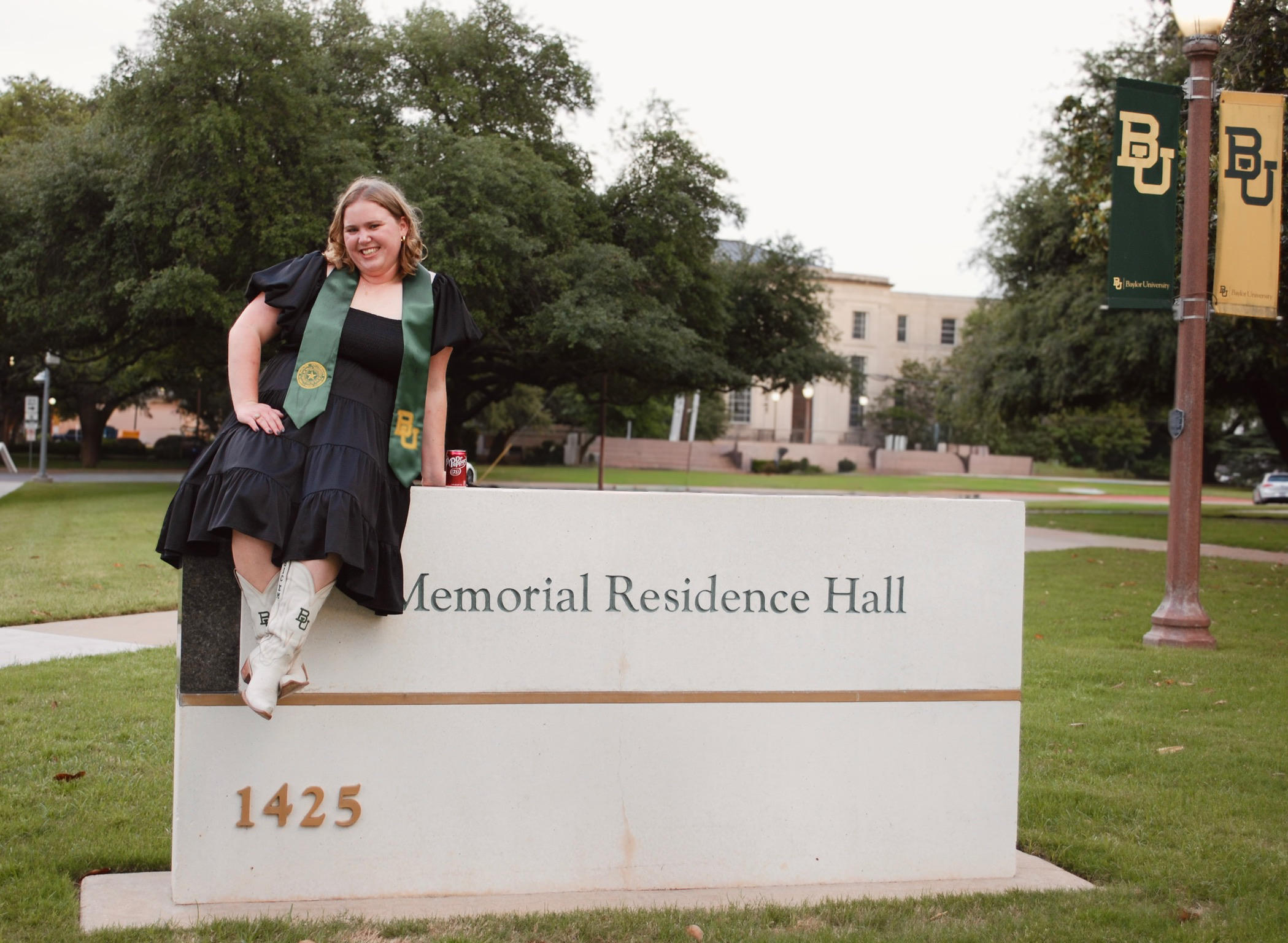
Four years after freshman move-in, the Honors Residential College dorms remain home to many graduating seniors today.
While many students started looking for off-campus housing for their freshman or sophomore years, some seniors found the community of Memorial and Alexander Residence Halls worth sticking around for.
Plano senior Mary Dickinson said the community was what kept her on campus for all four years of college.
“[It’s] really important to me to have people surrounding me who, not necessarily are like-minded, but are like-minded in the sense that they’re pursuing God through intellectual means,” Dickinson said.
While Dickinson was drawn to the HRC for academic similarities, Los Angeles senior Samuel Koo said he enjoyed the diversity of people he met through living in the HRC.
“I think the unique part about the HRC is that you become friends with people that you probably would not have been friends with in the past,” Koo said. “For me, I’m very much a city kid, but now I have friends who are from the country, you know, from rural areas, who have different interests than me.”
While many seniors stayed for the community and friendships that surrounded them, some also stayed for convenience. Climax, Mich., senior Lydia Allabaugh said it was far more convenient for her to continue living on campus past the two-year contract.
“A big part of the reason I wanted to stay on campus was because I didn’t have a car, so I knew that unless I lived in an apartment right off campus, I would need to get a car, and that wasn’t an option,” Allabaugh said.
San Angelo senior Becca Lui echoed the convenience. While the cost for off-campus housing can vary compared to on-campus prices, Lui’s decision to stay on campus was more economical than the alternative.
“Usually it’s more expensive to stay on campus, and I know that rates for apartments can be a lot cheaper, but the HRC does give their scholarship for leadership, so that helps a lot,” Lui said.
The Honors Residential College, with its recent renovations, also offers its students more shared items for cooking, hanging out and studying. Fort Worth senior Rylee Robertson said these qualities of the HRC made her want to stay.
“I think it’s big, especially being honors, and with the amount of work that we do with our program and how specific it is, it gives us the opportunity to have more study spaces,” Robertson said.
Even so, these seniors aren’t oblivious to the difficulties of living on campus versus off.
“When I want to use the kitchen, I have to go down two flights of stairs and through a bunch of doors,” Dickinson said. “I want to do laundry, I have to use these janky machines, and I’m not sure if they’ll work and fight other people for space in the laundry room, so definitely there are inconveniences to it.”
Due to these inconveniences, Dickinson said she is ready to have her own kitchen and space after graduation. Nevertheless, she said she is still happy with her decision to live on campus because of the care from the people around her.
Norman, Okla., senior Joshua Browder said living in the HRC has shown him more about the source of his identity.
“Something that I learned very quickly my first year is that people genuinely did not care at all about whatever I was doing, academically or what I’d done in high school,” Browder said. “The thing is that people cared about me for, first of all, [was] who I was in Christ, and they showed me that by trying to take the time to get to know me and hang out with me and invest in me without some kind of prerequisite.”

