

Close Menu
The Baylor Lariat
    Facebook X (Twitter) Instagram YouTube LinkedIn
    Trending
    • Baylor track and field stacks wins, PRs and national marks in Baylor Invitational
    • Lariat TV News: Willie Nelson will be back on campus, new mural highlights monumental women, Track & Field preparation
    • When politics enter the classroom, learning takes a back seat
    • Why Baylor should have never been an option for me
    • Stop being annoyed by seniors taking photos on campus
    • Senior must-do’s before graduation
    • Barnes returns from season-ending injury to reinvigorate linebacker group
    • Dr. Walter ‘Sparky’ Matthews selected for Collins Outstanding Professor Award
    • About us
      • Spring 2026 Staff Page
      • Copyright Information
    • Contact
      • Contact Information
      • Letters to the Editor
      • Subscribe to The Morning Buzz
      • Department of Student Media
    • Employment
    • PDF Archives
    • RSS Feeds
    Facebook X (Twitter) Instagram YouTube LinkedIn
    The Baylor LariatThe Baylor Lariat
    Subscribe to the Morning Buzz
    Saturday, April 11
    • News
      • State and National News
        • State
        • National
      • Politics
        • 2025 Inauguration Page
        • Election Page
      • Homecoming 2025
      • Baylor News
      • Waco Updates
      • Campus and Waco Crime
    • Arts & Life
      • Wedding Edition 2025
      • What to Do in Waco
      • Campus Culture
      • Indy and Belle
      • Leisure and Travel
        • Leisure
        • Travel
          • Baylor in Ireland
      • Student Spotlight
      • Local Scene
        • Small Businesses
        • Social Media
      • Arts and Entertainment
        • Art
        • Fashion
        • Food
        • Literature
        • Music
        • Film and Television
    • Opinion
      • Editorials
      • Points of View
      • Lariat Letters
    • Sports
      • Football
      • Basketball
        • March Madness 2026
        • Men’s Basketball
        • Women’s Basketball
      • Soccer
      • Baseball
      • Softball
      • Volleyball
      • Equestrian
      • Cross Country and Track & Field
      • Acrobatics & Tumbling
      • Tennis
      • Golf
      • Pro Sports
      • Sports Takes
      • Club Sports
    • Lariat TV News
    • Multimedia
      • Video Features
      • Podcasts
        • Don’t Feed the Bears
        • Bear Newscessities
      • Slideshows
    • Sing 2026
    • Lariat 125
    • Advertising
    The Baylor Lariat
    Home»Featured

    New law puts bulk of Medicaid costs on Feds

    Baylor LariatBy Baylor LariatNovember 27, 2012 Featured No Comments4 Mins Read
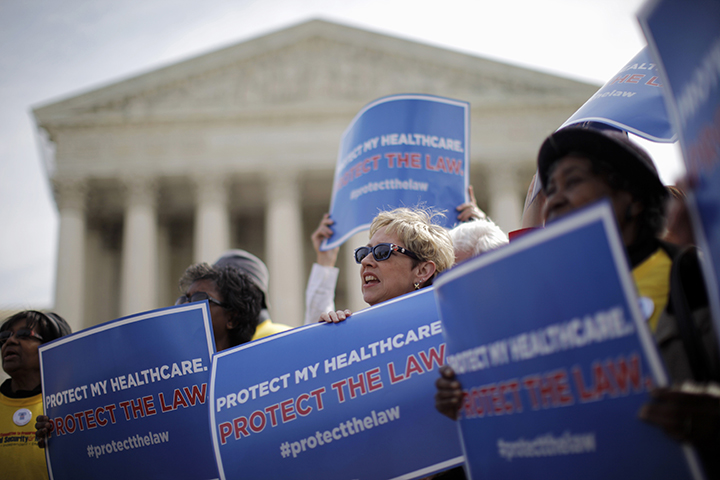
    Supporters of health care reform rally in front of the Supreme Court in Washington on March 28. Associated Press
    Share
    Facebook Twitter LinkedIn Pinterest Email

    Supporters of health care reform rally in front of the Supreme Court in Washington on March 28.
    Associated Press
    By Ricardo Alonso-Zaldivar

    Associated Press

    WASHINGTON — States will receive more than $9 in federal money for every $1 they spend to cover low-income residents under President Barack Obama’s health care law, according to a nonpartisan analysis released Monday.

    Expanding Medicaid to cover about 20 million more low-income people will cost more than $1 trillion nationally from 2013 to 2022, said the joint report from the Kaiser Family Foundation and the Urban Institute. But the analysis found that states will pay just $76 billion of that, a combined share of roughly 7 percent. The feds will pay the other $952 billion.

    Republican governors have resisted the Medicaid expansion, saying it adds an unacceptable burden to already strained budgets. And the Supreme Court handed the governors a victory this summer, ruling that states are free to reject the Medicaid deal.

    Medicaid is one of the two main ways that Obama’s law expands coverage to most of the 50 million uninsured U.S. residents. As a broader Medicaid safety net picks up more low-income people, new health insurance markets called exchanges will offer subsidized private coverage to the middle class. Both parts of the strategy take effect in 2014, at the same time that most Americans will be required to carry health insurance or pay a fine.

    The new analysis was unlikely to change the minds of state leaders who have already rejected the Medicaid expansion, but it may help shape the debate in a majority of states still on the fence.

    Among those refusing are Texas Gov. Rick Perry, South Carolina Gov. Nikki Haley, and Louisiana Gov. Bobby Jindal. For most others, the choice will come into sharp focus early next year as state legislatures meet.

    “It’s hard to conclude anything other than this is pretty attractive and should be pretty hard for states to walk away from,” said John Holahan, head of the Urban Institute’s Health Policy Research Center and the main author of the study, which used computer models of population, income and insurance coverage.

    Under the law, Medicaid will be expanded to cover people up to 138 percent of the federal poverty line, or about $15,400 for an individual. It’s mainly geared to low-income adults with no children at home, who currently cannot get Medicaid coverage in most states. Washington pays all of the cost for the first three years, gradually phasing down to 90 percent.

    Some of the main findings:

    — States that reject the expansion could still face a substantial increase in their Medicaid costs, as people already eligible for the program but not currently enrolled are prompted to sign up.

    — States will save $18 billion from no longer having to offset the cost of charity for low-income uninsured people.

    — Some states will actually come out ahead. New York, Massachusetts, Wisconsin and others that already cover low-income childless adults will be able to reap a more generous federal matching rate than they currently get.

    — Texas, the state with the highest percentage of uninsured residents, would see a 6 percent increase in Medicaid spending. About 2.4 million residents would be added to the Medicaid rolls.

    Medicaid is a federal-state partnership that varies from state to state. So the consequences for state budgets will be different in each case.

    Not so for the uninsured, said Alan Weil, executive director of the National Academy for State Health Policy, an independent research and policy group. “This is more than a fiscal exercise,” said Weil. “There is a human dimension that needs to be part of the discussion far beyond just the dollars.”

    Baylor Lariat

    Keep Reading

    Lariat TV News: Willie Nelson will be back on campus, new mural highlights monumental women, Track & Field preparation

    When politics enter the classroom, learning takes a back seat

    Senior must-do’s before graduation

    Dr. Walter ‘Sparky’ Matthews selected for Collins Outstanding Professor Award

    Alternative TPUSA event ‘All Are Neighbors’ approved by Baylor

    Setting the pace: Zeta Phi Beta stands as Baylor’s first multicultural sorority

    Add A Comment

    Comments are closed.

    Recent Posts
    • Baylor track and field stacks wins, PRs and national marks in Baylor Invitational April 10, 2026
    • Lariat TV News: Willie Nelson will be back on campus, new mural highlights monumental women, Track & Field preparation April 10, 2026
    About

    The award-winning student newspaper of Baylor University since 1900.

    Articles, photos, and other works by staff of The Baylor Lariat are Copyright © Baylor® University. All rights reserved.

    Subscribe to the Morning Buzz

    Get the latest Lariat News by just Clicking Subscribe!

    Follow the Live Coverage
    Tweets by @bulariat

    Facebook X (Twitter) Instagram YouTube LinkedIn
    • Featured
    • News
    • Sports
    • Opinion
    • Arts and Life
    © 2026 ThemeSphere. Designed by ThemeSphere.

    Type above and press Enter to search. Press Esc to cancel.