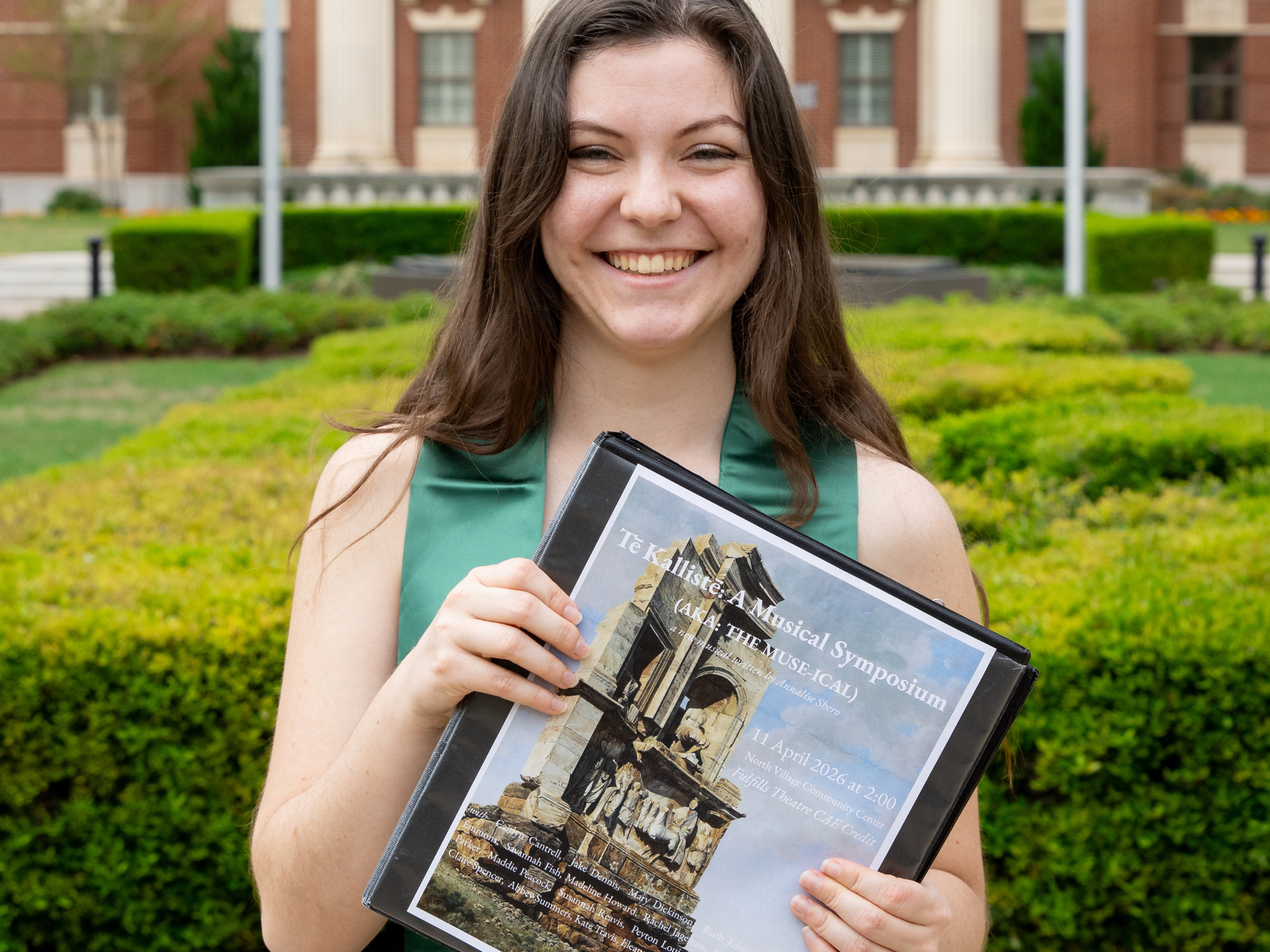
By Stacie Boyls | Arts & Life Writer
What began as a half-joking comment about “majoring in ‘Hadestown’” has evolved into a three-year creative undertaking for North Richland Hills senior Annalise Shero — one that blends Greek mythology, philosophy and music into a fully realized original production.
Shero, a University Scholars major, will debut her honors thesis, “Tē Kallistē: A Musical Symposium,” at 2 p.m. on April 11 in the North Village Community Center.
The staged reading, which has been approved for CAE credit, reimagines a well-known mythological moment through a distinctly interdisciplinary lens.
“I was joking with my roommate that I was majoring in ‘Hadestown,’” Shero said. “And then I thought, maybe I should write a musical at some point in my life.”
That idea solidified during a trip to Greece at the end of her freshman year. Standing before the Temple of the Muses, Shero said she felt an unexpected emotional pull.
“I just started tearing up,” Shero said. “I was like, ‘OK, I guess I’ll write a musical about the Muses.’”
From there, the project took shape over several years. Sophomore year was dedicated to research — studying the nine Muses across mythology, literature and philosophy.
Junior year focused on structure and thematic development. Now as a senior, Shero has completed the compositional work and is preparing for performance.
The musical centers on the myth of the “Apple of Discord,” in which Eris, the goddess of strife, sparks a rivalry among the gods that ultimately leads to the Trojan War. In Shero’s retelling, however, the apple is not presented to Hera, Aphrodite and Athena, but to the nine Muses.
“What if I completely reimagined how that event went down?” Shero said. “What if the question of ‘Who is the most beautiful’ was given to the Muses instead?”
The result is a musical symposium in which each Muse offers her own perspective on beauty. Through a series of solo numbers, the Muses explore different philosophical interpretations — from unity and desire to eternity and transcendence — culminating in a final ensemble that synthesizes their ideas.
“It’s like a Greek dialogue,” Shero said. “Each Muse takes the floor and presents her perspective, and by the end, the audience has a more holistic view of what beauty could be.”
To distinguish each character, Shero assigns a unique musical style to each Muse. The Muse of comedy sings jazz, while another channels 1980s rock. Others incorporate choral elements, liturgical influences and contemporary musical theater.
“I’ve been calling it ‘musical philosophy,’” Shero said. “You can hear a character’s ideas in the structure of the music itself.”
Despite the project’s scope, the production will be intentionally minimal. Performed as a staged reading, the show will feature limited dialogue, no formal set and simple, self-sourced costumes.
“Even performing it is above and beyond the requirements of the thesis,” Shero said. “But what’s the point of writing something if it only lives on paper?”
For Cypress junior Madeline Howard, the project offered an unexpected entry point into musical performance.
“I don’t have any background in music,” Howard said. “I’ve never been in a choir, I don’t really read music — but I said yes, and it’s been amazing.”
Howard plays Urania, the Muse of astronomy, whose song reflects awe at the cosmos and a desire to “pattern oneself after nature.” She said the experience has been both challenging and transformative.
“Music is just counting — there’s so much counting,” Howard said. “But it’s also incredibly moving. There are moments where we’re all singing together, and it just feels like you’re surrounded by sound.”
Howard pointed to one ensemble piece as a highlight, describing it as emotionally overwhelming even in rehearsal.
“The first time I heard it, I almost cried,” she said. “There’s this line — ‘beauty is home returning’ — and it just sticks with you.”
Beyond the music, Howard said the production’s collaborative atmosphere has been a defining feature.
“It’s not competitive or rigid at all,” she said. “It’s very warm. Everyone is just excited to be part of something that Annalise created.”
That enthusiasm has been one of the biggest surprises for Shero, who initially worried the cast might see the project as a favor rather than a shared passion.
“I thought people were just humoring me,” she said. “But they keep telling me how much they love the music. It’s taken on a life of its own.”
The musical also reflects Shero’s wide-ranging academic influences, drawing from her concentrations in Great Texts, Greek, music, theater and creative writing. Faculty across multiple departments contributed to the project’s development, reinforcing its interdisciplinary foundation.
As opening day approaches, Shero said she is most excited to finally share the work after years of development.
“I’m excited for people to peek inside my brain for a second,” she said.
While “Tē Kallistē” will debut as a staged reading, Shero hopes it may one day grow into a fully staged production.
For now, the April 11 performance offers audiences a first glimpse into a project that merges ancient myth with modern musical storytelling and asks a timeless question in the process: “What is beauty?”