By Jackson Posey | Sports Editor
It was 5:43 a.m.
The city, hushed by a global pandemic and shut in by the January frost, was still asleep. Aside from the distant rush of cars on Auraria Parkway, the only sound within earshot was 17-year-old Obi Agbim’s soft footsteps crunching on the still-falling snow.
Right, left. Right, left. One foot in front of the other.
The freshman trudging five blocks to basketball practice had no idea what would come next.
“Man, it’s really just a real-life testimony,” said Agbim, now the starting point guard at Baylor. “Going to one of the lowest levels of college basketball, and just somehow finding a way to make it up, it can’t happen on my own. It’s all just on faith.
“From day one, I knew I was capable. It was just whether or not I would ever get the opportunity.”
Today, Agbim is playing at his fifth school in the past six years, including two Division II programs and a junior college. He’s benefitted from a spree of major NCAA rule changes in recent years: extra eligibility for athletes that played during the COVID-19 pandemic, JUCO seasons not counting against eligibility, unlimited free transfers, the advent of NIL payments and the pay-to-play ramifications of the House settlement.
It all started at Metro State, a Division II school in Denver. Rooming with a high school teammate just 20 minutes from home, Agbim’s experience should’ve felt warm and familiar. Instead, the atmosphere around town was eerie.
Pandemic-era restrictions turned campus to a ghost town. Practice time was limited. Players were forced to wear restrictive masks on the court, making everyone look like, in his words, “Bane in Batman.” The world turned upside down in 2020, and Agbim’s life flipped with it.
“It was a weird season,” Agbim said. “Imagine you’re in high school, going to experience college, and you’re just thinking, ‘Oh, I need to get all this for the room,’ or ‘Oh, there’s going to be a whole bunch of classes’ — [but there] was nobody on campus. Literally nobody.”
Much of his freshman season was spent with Christian Speller, a high school teammate also recruited by Metro State. The pair stayed up late in a revamped hotel-turned-dorm room, playing Call of Duty and listening to what Agbim’s roommate called “good music” — mostly a mix of Drake and Chief Keef. (“Obi is probably Chief Keef’s No. 1 fan,” Speller said, laughing.)
“Seeing what he’s been able to accomplish, and his basketball ability now, it’s amazing that everyone else finally gets to see it,” said Speller, who later transferred to play basketball and football at Colorado Mesa. “Seeing him be able to be around in a spotlight where his basketball ability is broadcast and is recognized, it’s special.”
During one high school practice, the pair butted heads: Agbim spun out of control on a drive and konked his teammate on the noggin. Speller woke up a minute later with a nasty knot and a splitting headache.
Speller speaks highly of Agbim’s basketball talent, but he’s more friend than teammate. And what are friends for if not to keep each other humble?
“He’ll deny it, but I was dunking on him back in the day,” Speller said. “I was. He’ll say no, but we both know.”
After playing in half the Roadrunners’ games as a freshman, Agbim transferred down to Northeastern Junior College, a “dog-eat-dog world” where he battled injuries and faced plenty of adversity. It was a decision that thrust him out of his comfort zone and into the heat of battle.
And he loved every second of it.
“It was one of the best decisions of my life to go JUCO, see what it feels like to just have fun playing basketball again,” Agbim said. “I feel like a lot of people sleep on JUCO. And it’s different now, because NIL’s a thing now. But if there wasn’t NIL, and JUCO was four years, it’d be hard for me [to leave]. I’d like to stay at JUCO a long time, it was so fun.”
Every day was competition, featuring grand battles between Division I pushbacks and ambitious players from lower levels. With little incentive to develop players, junior college coaches experiment with lineups to find the best possible combinations. With rosters sometimes stretching beyond 40 names, it can be difficult to stand out from the crowd.
Junior colleges don’t have limited practice hours the way Division I teams do. A coach can keep players in the gym for as long as he wants “until he gets what he wants.” The trials brought the team closer off the court. Agbim recalls game nights, group classes and an ill-fated kickball tournament that ended in verbal sparring.
When the season came to a close, Agbim spurned Division I offers for a guaranteed role at Division II Fort Lewis.
“I wanted to go D1, but I felt like Ty [Danielson]’s plan was just so intriguing,” Agbim said. “I was just so invested into it, so I kind of just took a leap of faith there.”
Danielson, the associate head coach, wanted to build the boat out of Obi Agbim. It worked to perfection. The Skyhawks won the RMAC regular-season and tournament championships with Agbim starring as the sixth man.
For the first time, Agbim stuck around for an encore. He captained the offense from the spotlight, averaging 15.5 points, 4.0 rebounds and 2.9 assists per game on 44.3/35.5/83.6 shooting splits in his second season. The Skyhawks won another conference tournament title and finished the two-year run 58-8.
“Imagine you’re in high school, [and] the two years that you’re actually playing varsity, you’re winning. You’re just winning. And then the first two years of college, you lose,” said Agbim, who led Rangeview High School to a state championship in 2019 and a 26-0 record in 2020 before the COVID-19 shutdowns. “Then you get to Fort Lewis, and somehow you start winning again. That winning culture — you get a little greedy at winning.”
He almost left Fort Lewis after the first season, but weeks of reflection brought him back. It’s hard being a nomad. The moving takes a toll.
“Just thinking really deeply whether or not you want to go and start over, build your relationships again, build the trust again,” Agbim said. “It was a really thoughtful process, but I thank God just for making that decision.”
A one-year stint at Wyoming culminated a lifetime of Division I hoop dreams. It also ended with the hardest goodbye yet.
“I’m not going to lie to you, it was hard,” Agbim said. “When you get that type of relationship with a coaching staff, and the year was so good for you, why leave it?”
Baylor had competitive advantages — more NIL money, greater TV exposure, the opportunity to play at the highest level. But it was draining to leave another place that felt like home.
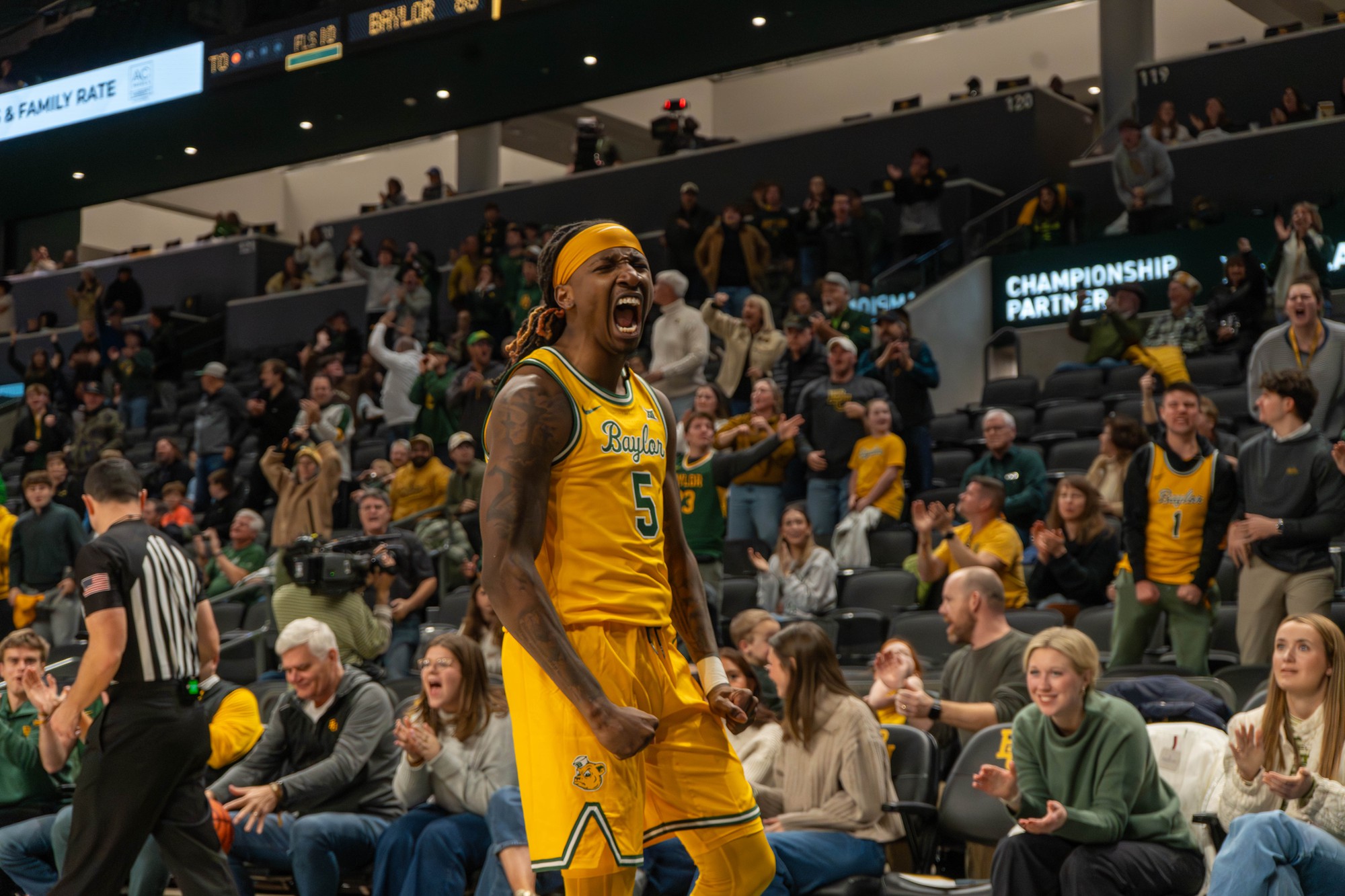
Agbim immediately made his presence known in Waco, taking on a leadership role for a transfer-heavy team with no returning players. He scored 16 points and drained four 3-pointers in the Bears’ season-opening win over UTRGV.
“I thought Obi was a lot more aggressive than he was in the first two scrimmages, which was great to see,” head coach Scott Drew said after the game. “He’s adjusting, too, because he’s never really had a season at this level being a point guard.”
While adjusting to the reins, Agbim made a series of highlight-reel plays in transition. The typically reserved guard keeps untapped athleticism in his back pocket.
“We’ve seen him do some crazy things in practice,” senior wing Dan Skillings Jr. said in November after Agbim blocked a dunk in the open court. “He doesn’t want to bring them out in games; he wants to just lay it up. I don’t get it.”
Amid a series of injuries that have decimated the Bears’ depth, Agbim has stepped into an even larger role. He played all 40 minutes in a Feb. 7 road loss to Iowa State and leads the team in assists, despite fitting more cleanly into a combo guard role. Somehow, the overlooked high schooler has become the captain of a top-30 offense in America.
Right, left. Right, left. One foot in front of the other.
One more step in an inexplicable journey.
“I wish I could have seen it coming,” Agbim said. “I don’t think you could really script this happening, or any of the schools … [It’s] a testimony. I can’t really look in the mirror and be like, ‘Oh yeah, I made all this happen, I made all these opportunities come to the table.’”
“Everything happens for a reason. I’m definitely thankful to God for the way it happened, and how he’s still making a lot of miracles happen for me now.”
Five blocks from his car, glittered with snowflakes, Agbim slows to a stop in front of the door. He can feel the warmth glowing from inside the gym, hear the chatter and clamor of teammates getting early shots up. It’s been a long journey. But he’s finally home.