By Camille Kelly | Intern
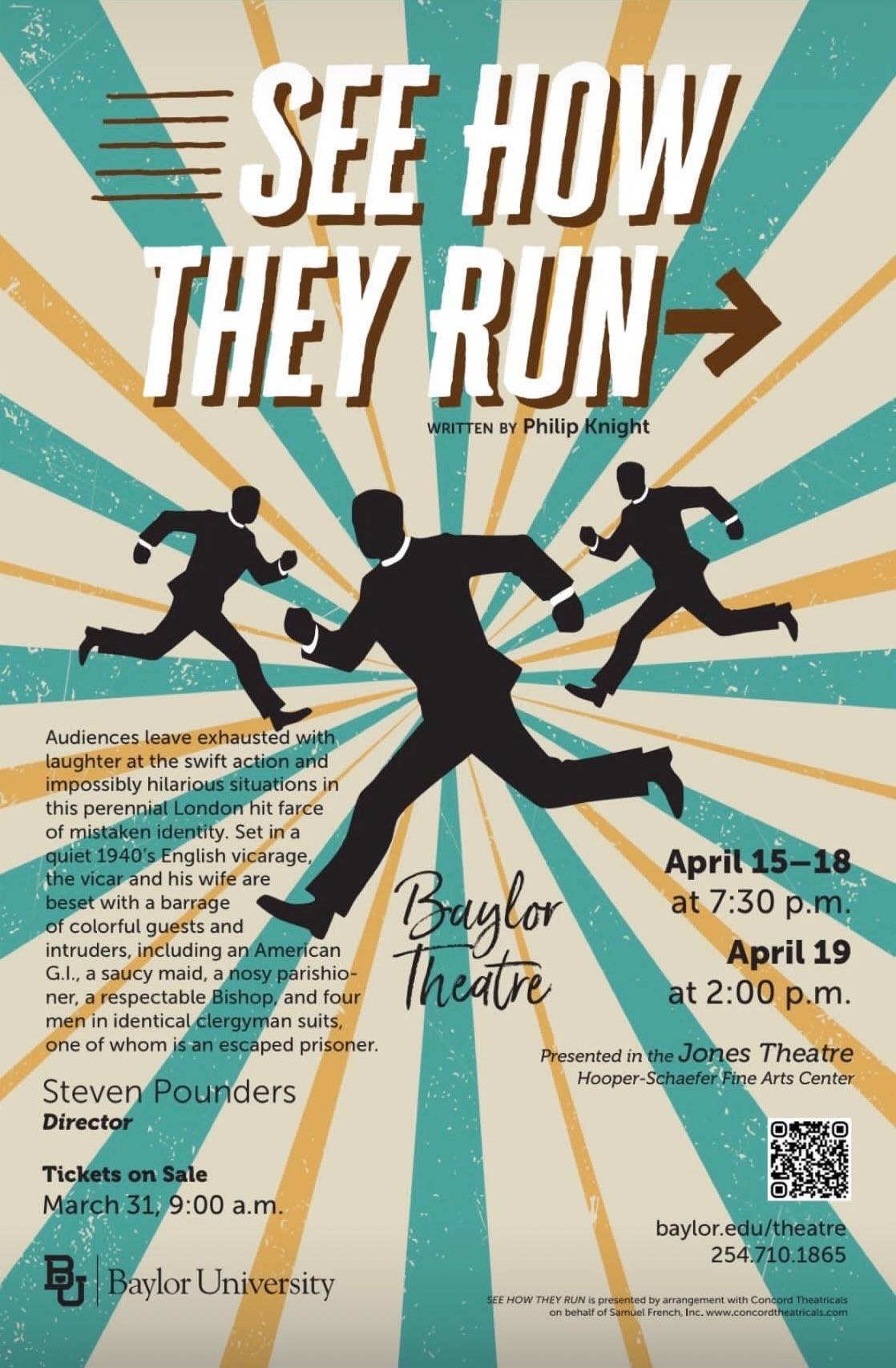
The Department of Theatre Arts is preparing for their upcoming, fast-paced comedy, “See How They Run.” This British farce is set in the 1940s and is filled with silly stunts, climactic fight scenes and comical cases of mistaken identity.
Shows will have evening performances at 7:30 p.m. April 15-18 and a matinee at 2 p.m. on April 19 in the Jones Theatre at the Hooper-Schaefer Fine Arts Center.
Tampa, Fla., junior Chloe Baker plays Penelope Toop, an American actress who has married the British vicar in the show. According to Baker, the comedy throughout the play is heavily reliant on physicality and the action in each scene.
“I already thought that the script was hilarious when I first read it, but now putting it on its feet has made it just 10 times funnier,” Baker said. “I think that’s very characteristic of farces, especially British farces, is just the physicality of it.”
Baylor Theatre has not included a farce in its production lineup in a long time.
A farce is defined as “a light dramatic composition marked by broadly satirical comedy and improbable plot,” according to Merriam-Webster.
Prosper junior Noah Smith, who plays the vicar, Lionel Toop, said this show is truly unique compared to some of the performances Baylor has put on in previous years.
“The physical gags that we’re doing are a lot of silly fight choreography and mistaken identities,” Smith said. “It’s really silly and awesome that we get to do something super lighthearted.”
Another aspect of the show that makes it high energy is the amount of comedic fight scenes. Newnan, Ga., senior Maggie Robbins, who plays Miss Skillon, said she gets knocked out a few times, shoved in a closet and performs a number of other skits throughout the show.
“We started staging some of the fight scenes, and at one point, I get punched,” Robbins said. “That was definitely a hard thing, but hilarious at the same time to try and figure out the exact positioning. We had to do it probably tons of times to make sure that the punch looked realistic from every sort of vantage point of the audience.”
The play was first written during World War II and was put on stage while London itself was getting blitzed. According to Smith, a common misconception is that people only watch comedy when life is good. However, Smith said this production is a good example of how comedy is often used as an escape from the world.
Smith said he hopes that in the same way, students who come to see the production can escape the stress of their own lives.
“The best thing we can do sometimes is to add a little levity to people’s lives; give them about 90 minutes to just laugh and enjoy themselves,” Smith said. “I hope most people come to the show and leave with a smile on their face … So, I hope students can take a break when they’re seeing it and get some enjoyment out of their day.”
According to Robbins, maintaining the momentum in a show that demands so much of the cast’s energy is not an easy feat. However, relying on her other castmates and their support for one another has gotten them through, Robbins said.
“It is a collaborative thing, as we all sort of lean on each other, and especially with the show that’s so fast paced and has a lot of different moving parts,” Robbins said. “It’s a team effort for all of us to come together and get to complete it.”
Tickets to the shows can be found online, and students can receive CAE credit for attending a performance.
“I will make this a personal guarantee that you will be laughing by the end of the show, just because it is so funny,” Baker said. “I don’t think I’ve ever seen something or been a part of something that is as hilarious as this, and touches on so many different aspects of comedy. I think that everyone should see it, because it is an evening of laughter, and everyone can use that in their lives.”