By Olivia Turner | Arts & Life Editor
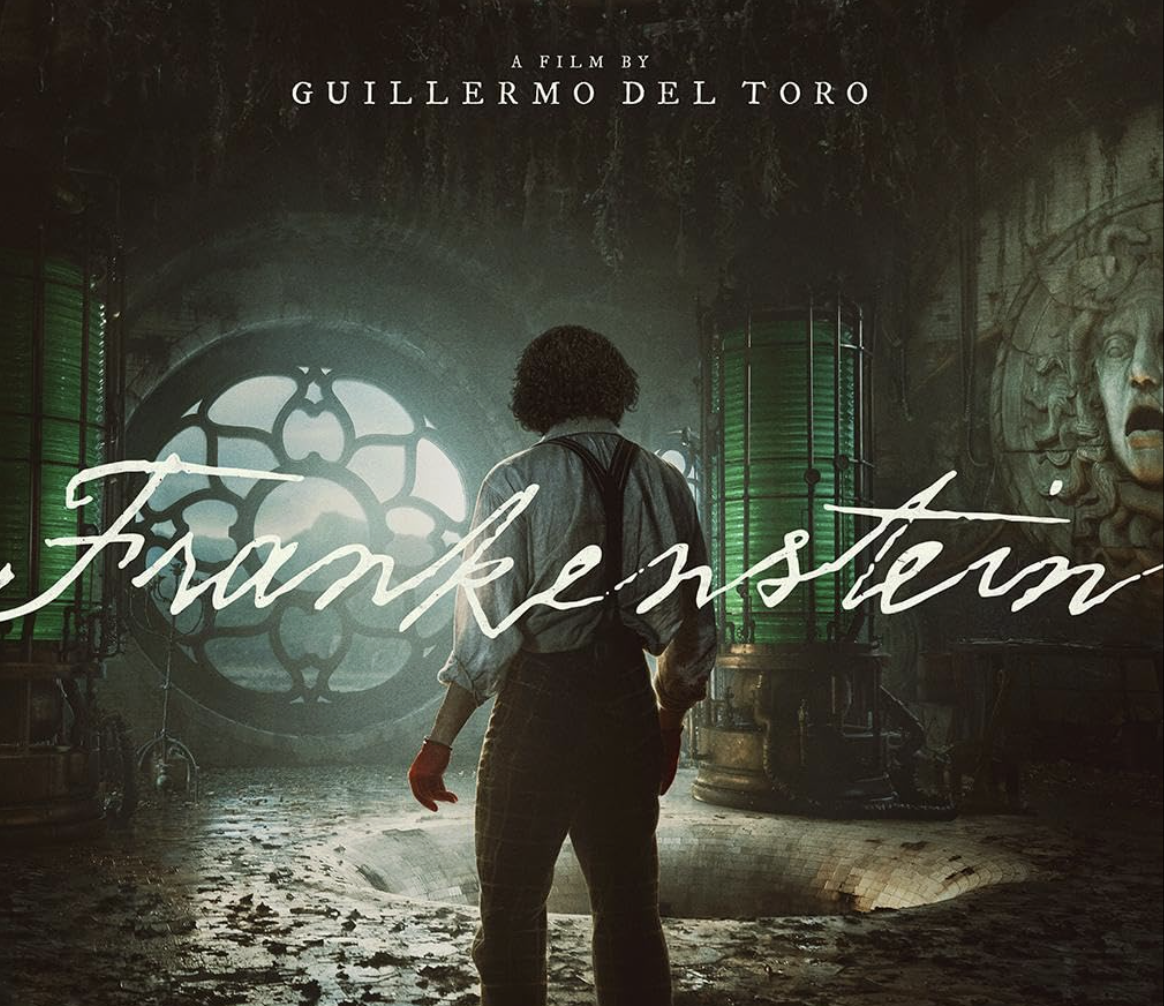
Leading up to its Netflix release on Friday, Guillermo del Toro’s “Frankenstein” was highly anticipated among many pop culture fanatics due to its celebrity cast and acclaimed director. Teasers promised lavish, colorful visuals, frightening effects and phenomenal acting performances, all the makings for the hit horror film most fans were likely expecting to see.
However, instead of a mere modern recreation of the classic monster movie that filmmakers have put out again and again since the first movie directed by J. Searle Dawley in 1910, viewers received an artfully crafted film that will break hearts bit by bit with each passing scene. Or at least, that’s what I experienced.
Here, del Toro tells a tale of yes, man vs. monster and man vs. nature, but also man vs. man — or better said — man vs. his own selfish ego. In this movie, Frankenstein’s creature is the victim, a monster brought into a world that could never accept him by an unloving maker. Consequently, Victor Frankenstein is the villain. He is the real monster of the movie, a creator without any regard for the created.
Beware! Spoilers ahead.
In this heartfelt but heavily modified retelling of Mary Shelley’s classic novel, Oscar Issac convincingly takes on the role of the death-obsessed Victor Frankenstein, and Jacob Elordi gives an encore-worthy performance as Frankenstein’s hindered creature.
None other than horror icon Mia Goth plays both (and all) major female roles — Frankenstein’s mother and Elizabeth, the story’s damsel and love interest. While I thought Goth’s double appearance was necessary to show how Victor’s love for his dearly departed mother caused Elizabeth to catch his eye years later, I also found it hilarious how costume design basically just changed her color scheme and filled in her eyebrows to differentiate the two.
I do have many nice things to say about the costuming in this movie. I loved the deep jewel tones used by costume designer Kate Hawley, mainly seen in Elizabeth’s dramaticized Regency era dresses. I’m sure del Toro had some influence on Victor’s common red theme throughout the film, a signature element of his filmmaking style also seen in similar hits like “Crimson Peak,” “Pan’s Labyrinth” and “The Shape of Water.” These colorful garbs might not be historically accurate to the era, but they certainly commanded attention and added to the gothic drama of each scene.
The musical score was equally as transfixing. Composer Alexandre Desplat, as heard in other del Toro films, such as “The Shape of Water” and “Pinocchio,” created a soundtrack that was both haunting and heartbreaking through the strategic use of the violin and other emotional strings. The music captured both the gentle and the terrifying moments of the creature, Victor’s all-consuming fits of rage and Elizabeth’s undying tenderness for the creature.
All creativity considered, I must admit I was thrown off by the liberties del Toro took with the storyline in his film. The director implements several significant changes. Victor’s backstory entails an abusive father and a mother who died in childbirth. Del Toro’s creature kills out of self-defense, not the vengeance signature of Mary Shelley’s creature. Elizabeth is William Frankenstein’s betrothed, not Victor’s. When the creature demands a companion, Victor doesn’t even attempt to create one in this version. Del Toro even goes as far as to add a completely new character played by Christoph Waltz, Heinrich Harlander. I could go on.
The biggest change is likely that the novel provides little to no reconciliation for either party at the story’s conclusion, but the 2025 film ends with a touching scene of forgiveness between Victor and the creature.
While the changes are unarguably controversial, at least they aren’t made without reason. These modifications serve to further the plot of the original story and introduce a complexity that shows the true dangers of man playing God. Del Toro intentionally highlights elements of the story that other visual retellings do not showcase, such as the monster’s intelligence, sensitivity and gentleness when shown love.
He also shows that real monsters are often created by cycles of generational trauma and neglect, rather than being inherently evil. The very love Victor lacked from his father carries over to his feelings for the creature, an unfortunate but inevitable pattern when one is unable to let go of the past.
While I can’t say I was blown away by “Frankenstein,” I was pleasantly surprised. The 86% Rotten Tomatoes and 7.6 rating on IMDb ring true with me based on what I saw, heard and learned. If “Frankenstein” is on your watch list, don’t come expecting a gory horror movie when you sit down to watch. Know this film will probably break you in ways you aren’t expecting and leave you equally disappointed and hopeful in what the human race is capable of.