By Arden Berry | Staff Writer
Though it may not feature feats of physical skill, the Baylor Language Olympics puts participants’ modern language skills to the test.
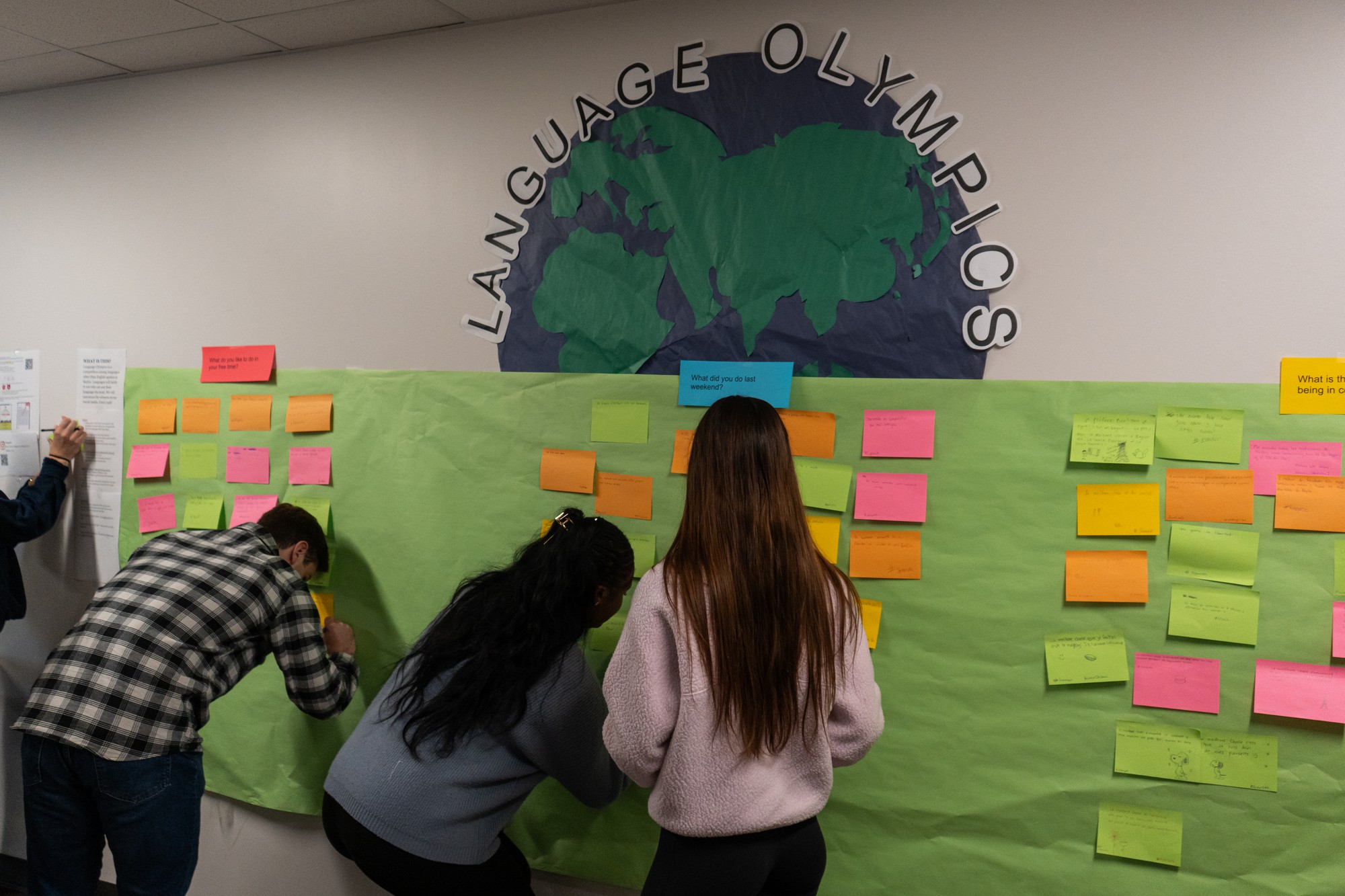
For International Education Week, the interactive Media and Language Center is hosting its annual Language Olympics Nov. 10–14.
Dr. Hajime Kumahata, director of the iMLC and senior lecturer in Japanese, said the Language Olympics is a platform for students to use their language.
“We teach 11 different foreign languages at our department, but we’re encouraging everybody to use whatever language they use,” Kumahata said. “Some students come with stuff like Hindi, some students grow up using Vietnamese. Those are languages we don’t teach, but those students already know, and [with] this platform, they get to use the language.”
To participate, Kumahata said students can make a post responding to any of the three prompts posted each day in person by placing sticky notes on the wall outside the iMLC on the Draper Academic Building third floor, online by responding to iMLC Instagram posts or by submitting spoken-word videos to Padlet. He said each prompt reflects a different level of knowledge.
“So the easy one is like, ‘Describe your family,’ ‘What is your favorite season and why?’” Kumahata said. “And then, ‘What will you do after you graduate?’ So if you graduate, what will happen? So it gets more difficult.”
Kumahata still has sticky notes from past years stuck to his office door. He said one of his favorite prompts was, simply, “Post a joke.”
Last year, according to the iMLC website, posts were written in 21 different languages. Kumahata said they had words ranging from a Cherokee language to others around the globe.
“Norwegian, Swedish, Hawaiian — you know, a lot of these, we don’t even teach,” Kumahata said.
The iMLC website details how both languages and participants can win the Language Olympics, keeping the competition alive throughout the week.
“There are four categories to win: most posted language, most posted overall (individual), most posted of the day (individual) and random post drawings (individual),” the website reads.
Kumahata said French won the most posted language last year with 526 posts, with Spanish coming in second and Swahili in third.
“It’s really interesting because Spanish has the most student population, but French has less student population, but they love to use it,” Kumahata said. “And Swahili [is] only taught by one teacher and a very small population, yet they have exploded last year.”
Among individuals last year, Houston junior Hanna Al Hayek made the most posts overall, with 81 different posts in three different languages, according to the iMLC Instagram.
“I feel like I’m a competitive person, and I was in one French and one Korean class, and I was tutoring for Arabic,” Al Hayek said.
In middle school, Al Hayek said she made it a goal to learn 10 languages. She grew up learning Arabic, started learning French in middle school and into college, then finally added Korean. Al Hayek joked that many of Baylor’s language professors wondered when she would finally take their class.
“I know a lot of the language professors, and they’re like, ‘So are we next?’” Al Hayek said.
Al Hayek said learning different languages has helped her learn about and connect with other cultures — something the iMLC emphasizes.
“We get to learn the uniqueness of the cultures and how un-uniquely unique they are,” Al Hayek said. “I’ll be talking to some of the Koreans, and they’ll be talking about their childhood, and I’m like, ‘I had the same one, and I grew up on the other side of it.’ We all have very shared experiences.”
The prompts, Instagram posts and Padlet submissions opened at 9 a.m. Nov. 11, and will close on Friday.
“All in all, we want students to have a platform where they can express themselves in the language they’re learning,” Kumahata said. “Because a lot of times language study is within the classroom and you just answer — but we’re trying to give students a platform to have fun.”