By The Editorial Board
Do not agree. Do not disagree. Do not post. Do not speak out. Do not choose a side. Do not stand out.
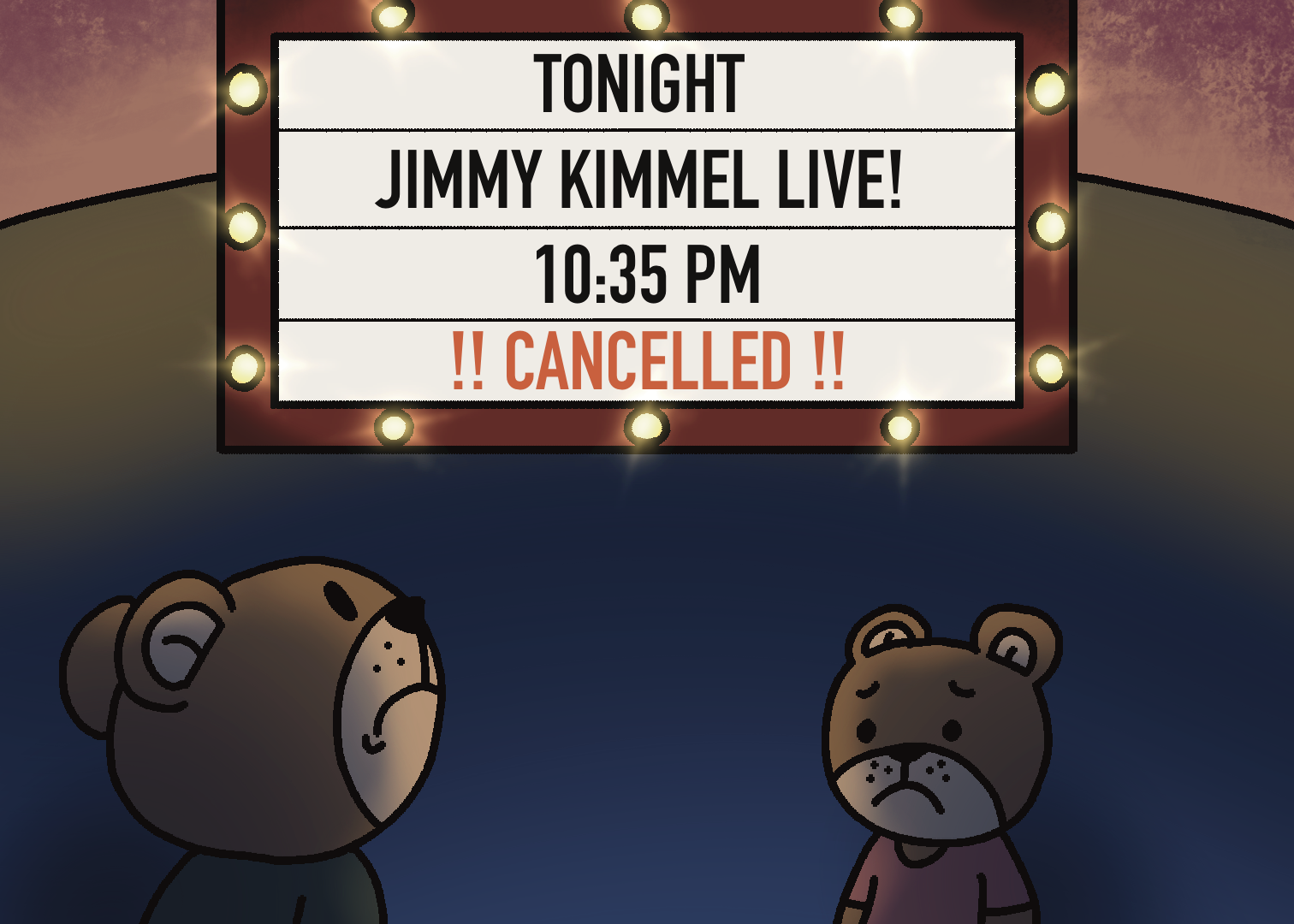
In the hours following Charlie Kirk’s assassination, the world shattered into a million pieces of emotion, tragedy and confusion. On Sept. 15, “Jimmy Kimmel Live!” aired at its regular time. However, little did everyone know that a few-minute-long monologue would spark outrage. Following the controversy, on Sept. 17, ABC made the decision to pull the plug on the show.
Kimmel said in his opening segment that Trump and his allies were “desperately trying to characterize this kid who murdered Charlie Kirk as anything other than one of them” and trying to “score political points from it.” He also stated Trump’s reaction to Kirk’s death as “how a four-year-old mourns a goldfish.”
In the script, Kimmel discussed how right-wing supporters were politicizing the tragedy, and also emphasized Trump’s rather nonchalant response when asked how he was holding up.
“I think very good,” Trump said. He quickly veered off topic with a statement about construction, stating that “By the way, right there you see all the trucks, they just started construction of the new ballroom for the White House.”
While it’s fair to say that Kimmel jumped the gun prematurely in an overall sensitive and emotional situation, the bigger press comes from the media’s reaction to this comment.
Challenging viewpoints has been a foundation of the constitution, and while some saw Kimmel’s comment as distasteful, the rise of cancel culture has created a society blind to the persuasion of groupthink.
A study done by Pew Research Center on how political parties view cancel culture showcased that “36% of conservative Republicans who had heard the term described it as actions taken to hold people accountable, compared with roughly half or more of moderate or liberal Republicans (51%), conservative or moderate Democrats (54%) and liberal Democrats (59%).”
We have created a society that is a guillotine for truth. A filter bubble posing as justice, per se.
The truth is that the current climate of censorship or cancel culture only helps celebrities and hurts middle and lower-class America.
For many celebrities and influencers, being “canceled” only boosts their significance in the algorithm; what many people forget is that the innocent bystanders are also affected by this censorship.
Sure, Kimmel underwent a six-day hiatus from his spot on late-night television; however, it’s plausible to claim he still would have been able to create income for himself. As for the behind-the-scenes workers for his show, they most likely had to scramble to replace those finances.
What we can take away from the Jimmy Kimmel censorship is that it ultimately reinforces the overrun attention economy that our society has created. This should make us nervous.
On June 29, Paramount paid Trump $16 million to settle a lawsuit because of a “60 Minutes” interview with then-Vice President Kamala Harris. Shortly after this, the FCC approved an $8 billion merger between Paramount and Skydance, ultimately showcasing the political influence of the current administration on our media consumption.
As of 2021, Trump had been banned, at one point or another, from Amazon, Apple, Discord, Facebook, Google, Pinterest, Reddit, Shopify, Snapchat, TikTok, Twitch, X and YouTube for violating platform policy.
Recently, Trump sued YouTube over his account suspension following the Jan. 6, 2021, riot at the Capitol. YouTube proceeded to temporarily suspend the president’s account, and in response, the lawsuit was settled for $24.5 million.
The majority of censorship could be prevented if the media didn’t become a partisan game of hurt feelings and accusations.
The First Amendment is supposed to protect freedom of speech. However, the takeaway from the Kimmel situation is that indirect pressure from the government or lawsuits appears to continue holding the hierarchy in place.
After Kimmel’s show returned to ABC on Sept. 23, he opened with a lengthy monologue hitting on a variety of topics from Tylenol to Stephen Colbert. Towards the middle, commented on his hiatus.
“Thanks to (all) who supported our show, cared enough to do something about it, to make your voices heard so that mine could be heard … people who I never would have imagined like Ben Shapiro, Clay Travis, Candace Owens, Mitch McConnell, Rand Paul, even my old pal Ted Cruz, who, believe it or not, said something very beautiful on my behalf,” Kimmel said.
Notable figures, celebrities and politicians around the world were beaming with support of Kimmel, not because of what he said, but because of the shocking censorship he received.
Republican politician Ted Cruz spoke out by saying “if the government gets in the business of saying, ‘We don’t like what you, the media, have said, we’re going to ban you from the airwaves if you don’t say what we like,’ that will end up bad for conservatives.”
The biggest lesson we can learn from this is that publicly supporting messages, regardless of their controversy, is critical.
The top priority is understanding that it takes courage to speak up in a government-created society of censorship. Cancel culture is not doing anyone favors. Stand firm in your opinion and be loud in your delivery, and as Dr. Martin Luther King Jr. said, “In the end, we will remember not the words of our enemies, but the silence of our friends.”