By Arden Berry | Staff Writer
For the Book Arts and Letterpress Lab, zines or small creative booklets are the newest phenomenon. And there is now a club specifically for zine-making.
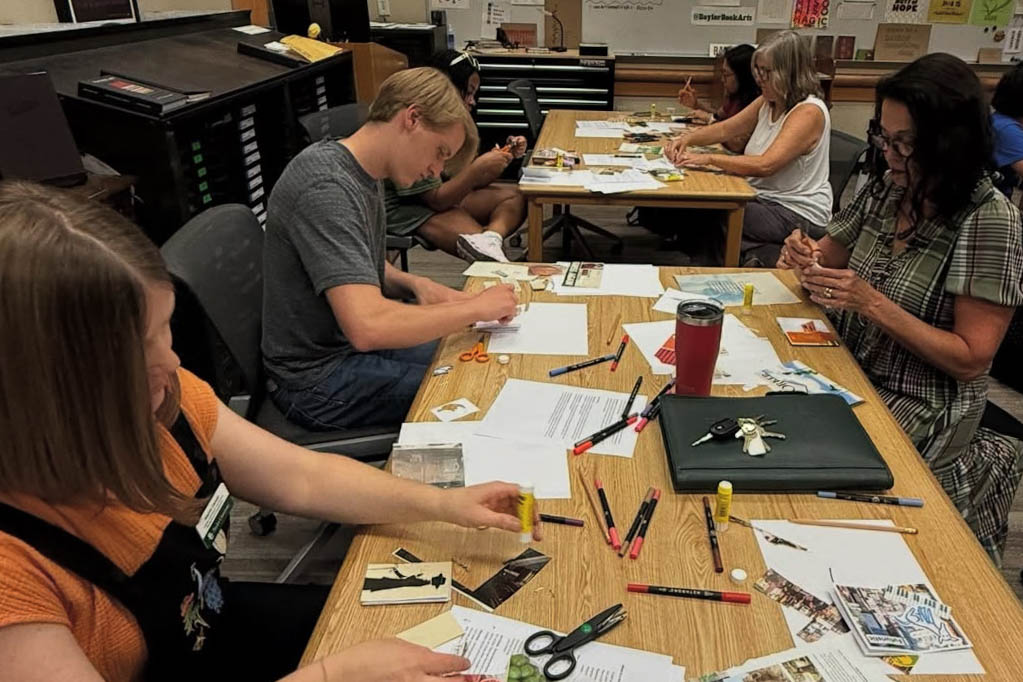
The Book Arts and Letterpress Lab hosts Baylor Zine Club meetings on the first Tuesday of every month for students who want to create something both informative and unique.
According to the University of Texas Libraries website, a “zine” (short for “fanzine”) is a compilation of text and images. Historically, zines were underground publications with roots in social activism and punk rock.
Waco junior Naomi Canale, Baylor Zine Club’s organizer and Moody Library information coordinator, said while Baylor Zine Club may not be fighting the power, creating any kind of zine is a deviation from the norm.
“It’s kind of this non-traditional media,” Canale said. “It’s usually like DIY culture. Nowadays, I feel like zines are still very much that, but they’re morphing into this idea of coming away from mainstream culture as far as social media, so it’s a way to kind of rebel against the algorithm in a lot of ways.”
Canale said she began making zines as an ambassador for the Book Arts and Letterpress Lab, which opened in fall 2024.
“We have been developing zines over there and trying to learn how to integrate them into academia,” Canale said. “So I started making them full steam ahead over the summer.”
Canale said she created small zines with information about Moody Library to place on the first-floor circulation desk. Waco freshman Journey Connor attended the first Baylor Zine Club meeting.
“They have a zine that’s the history of Moody Library and stuff on there. So I’ve looked at those, and I found it pretty interesting,” Connor said.
However, Canale said zines can be about anything. Zines frequently cross between different disciplines and can even “bridge cultures.”
“Say you’re a neuroscience major and you want to teach people about sleep studies or how sleep is so good for your brain, you could create a little bite-sized piece of information on a zine and share it with everyone as a part of your discipline,” Canale said.
For the first meeting, Canale said attendees had to draw a pet, then create a zine about the pet joining a rock band.
“I had a blue fish named Velveeta, like the cheese,” Connor said. “It’s very fun.”
Though attendees only used basic materials such as paper, glue and scissors for the first meeting, Canale said they will use more advanced materials in the future.
“As the club goes on, we will try what’s called a risograph,” Canale said. “That’s almost like a copy-printer and screen-printing crossover. We’ll also probably integrate our presses a little bit.”
Whatever material they use, Canale said making zines would be a good opportunity for students to take a break from social media and make something real.
“It’s actually really good for our brains to just unplug digitally, cut something out, make it, share it and build community,” Canale said.