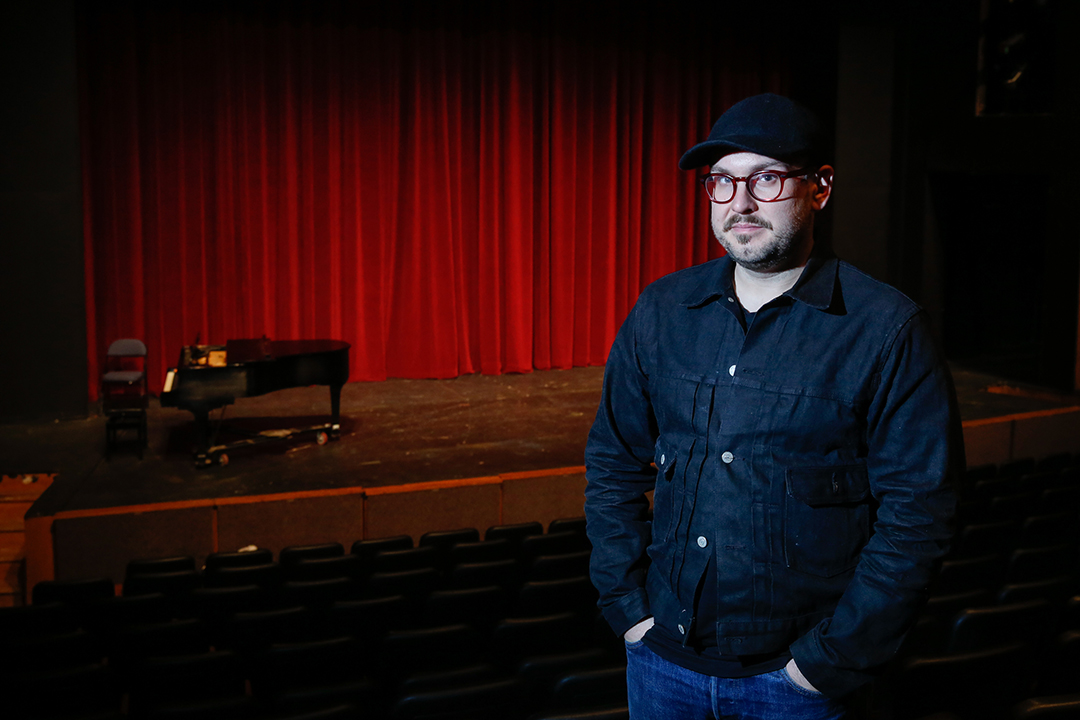
Rob Askins graduated with a degree in theater from Baylor in 2004, leaving Hooper-Schaefer Fine Arts Center and years of misbehavior behind him or New York City. Since then, he has joined the Ensemble Studio Theatre and written a series of irreverent plays there. many of which reference his Texas upbringing. The most successful of these was “Hand to God,” a darkly comic take on Christian puppetry in suburban Texas that received five Tony nominations. According to The Hollywood Reporter, Askins is also currently working on a show for HBO called “Brotherhood,” which follows the misadventures of a secret society at the largest Baptist university in the world.
In the midst of his writing and New York lifestyle, Askins will come back to his large Baptist university to speak at 6 p.m. Thursday in 101 Marrs McLean Science Building on “Getting it Out: Ego, Inspiration and the Changing Audience.”
Before he makes his appearance, Askins reflected with the Lariat on his misspent youth, southern living and working at Poppa Rollo’s.
The show you’re working on right now, “Brotherhood,” sounds like it takes place somewhere a lot like Baylor, with a secret brotherhood that we all actually know and sometimes love. Could you talk about your own experiences at Baylor and why they’re so ripe for comedy?
I love Baylor. I loved my time at Baylor as well, but it was also sort of the place I met the world. I had been raised in the same place my entire life, and it was not entirely rural. We were sort of the further out suburbs of Houston, so there was a fair mix of people. But Waco is a strange place. It’s a pretty bizarre crossroads of Texas, you know? I had never dealt with extreme wealth in the way that you do sometimes at Baylor. I had never dealt with extreme poverty in the way you sometimes do in Waco.
It seems to me the most interesting part of college is how groups [who are] absent of adult supervision in a way that they’ve never experienced before tend to define themselves. They tend to define themselves in extremes. Whether it be some of the life groups at Antioch, or some of the shenanigans of some of the older men’s groups on campus, you find big behaviors. People try to find the limits. I absolutely was trying to find those limits. That leads well-meaning people to behave in outrageous ways.
I think there’s a lot of comedy in people that you like behaving badly. Part of the essence of comedy is like, “Oh no, it’s not going to go well.” Then it doesn’t go well, but it doesn’t go well in a really sick way. They stub their toe, so they hold their toe, which knocks into the broom, then the broom knocks a pail of water off, and then they get wet. It’s like, you did it to yourself.
I just think young folks in search of who they are are both sweet and hilarious.
So what would your advice be to Baylor students who are trying to define themselves and find their way?
Don’t do anything I did, but do everything I did. I knew I wanted to be some sort of creative artist and I knew I wanted to do something performative, so I came into the university as an actor. Through other means, like a summer program I did at Harvard, I wrote some chapters of a novel. Then I came back and started writing comedy. At some point, I wrote a 10-minute play at the 10-minute festival that the theater had. That turned into a larger play because of the festival the theater was hosting, and that turned into my first residency with a theater summer program in upstate New York, which was facilitated by professors in the graduate department of theater. That started my journey.
My advice would be to go after it. To go after your impulses, but also be aware of when those impulses change. Know yourself well enough to feel the change in your interest, and then follow that. Listen to your impulses. I didn’t really know anything about myself when I got to Baylor. I learned so much from running into walls and falling on my face. Literally falling on my face. But that’s how I found out, not who I thought I was, but who, brass tacks, was really lying in wait.
What is the process like for bringing fact to fiction? How much do you leave out, and how much do you add or amplify?
A lot of the time I start with something that’s too sincere, especially because, at least for me, a lot of comedy comes from the harder things in life to deal with. Especially if it’s your story, I feel like a lot of people [it] with a lot of genuine fragility. Then, for me, there’s always a moment where I step outside that story. Then I’m like, “The way you lived it felt kind of mythological, but in fact the texture of it is slightly more mundane, but 100 percent more ridiculous.”
Usually for me that happens when the audience is introduced. Especially in a play, you can be as sincere as you want, but then the audience comes in, and they sort of tell you more about who you are outside yourself. In that moment you can step back and you can be like, “Oh, right. I thought this was the hero’s journey, but actually it’s the story of me doing silly things.” One of the benefits of that is that you get this thing that’s very personal, and in some ways very sad, but you also have that added perspective. You dilate out, and you can see why sadness moves these humans, but you can also see it moves them to doing fairly ridiculous things.
You said in an interview that there are all kinds of weird things in American society, and maybe especially southern society, that fascinate you and inspire you to write things like “Hand to God” or “Brotherhood.” Could you talk about some of those things, and some other ideas that might be percolating for you right now?
My family is full of weirdos. My brother does tattoos in Beijing, and my sister raises chickens in Austin. A lot of the time what will happen is they’ll be like, “Hey, have you heard about this?” And then they’ll send me some sort of link. I’ll follow that rabbit hole down, and I’ll be like, “Oh my God.” The internet is one of the biggest gifts that a playwright has ever had.
One of the phrases they use is micro-reformations. There are like five people on the internet that convince themselves that this is the will of God. There’s a group of people called Christian swingers, people who are using their swinging, non-monogamous marriages to minister to people. They have these sex parties to try to minister to people who go to sex parties.
That’s not necessarily for me, but I was like, “Oh my goodness.” There are four or five of these humans, and you’re like, “How? How did you people happen?” But then you can go back to the actual Reformation and the English Reformation, and you see these strains of utopian thought that oftentimes resulted in sexual anarchy. They are marvelous, strange things for what it means to be human.
There’s something I’m working on right now, something that didn’t come to me through somebody else. It was an idea I thought about, and then all the sudden I started seeing articles about it all over the place. There are these kids at a tattoo parlor in Philly where these body modifiers are taking it up a notch. Instead of just piercing themselves or getting tattoos, they’re sewing LED lights into their arms, so there are lights under their skin. There was a recent body modification convention in Austin where these guys were putting microchips into their hands so that they could unlock their cellphones. The only way they could get into their iPhones is by having this chip in their hands.
I think a lot of these bubbles of, let’s say, creative living, are harbingers of things to come. I think things are going to get weirder, not less weird, and telling these stories is exciting to me. I like newness, and I really like to confront the audience in the theater.
When I wrote “Hand to God,” so many people came up to me and were like, “How did you come up with Christian puppet ministry?” And I was like, “Oh, boo. You have no idea.” It’s the fact that people in New York have no idea that that’s something that people in the South do. Or, you know, mums. Nobody knows what a mum is. Do you know what a mum is?
Yeah, I do.
But nobody outside of Texas knows what a mum is. That was one of the really interesting things when I started writing about Texas. All people understand, especially in fiction or films, is Sam Shepard westerns or even older westerns, like straight cowboy stuff.
But most of Texas now looks like suburbs, strip malls, Wal-Mart, and then Neiman Marcus in Dallas and the big aquarium in Houston. Those stories don’t hold together. Those stories still inform who we are, but they do it as an echo. That’s the stuff that, not even your grandfather, but that your great-grandfather lived. And that’s still what America’s fiction consciousness thinks of my home.
So part of the job, I think of all artists, is to correct the incorrect notions that a civilization has about the humans that live in a place. With “Hand to God,” it’s not about riding out all the rage and going to shoot an Indian, or going on a cattle drive. It’s about eating fast food and going to the Christian puppet ministry. In a lot of ways, I’m not trying to fetishize the weirdos, but trying to get people to understand the strange pockets outside the city.
What do you think some of the more fundamental reasons for the disparity between these southern suburbs and the big city are?
It’s a lot of things. I think the first one is car culture. You get in a car, and you go from one place to another place, and you go to a place that’s pre-selected. I remember growing up in Houston. We would go from our house, to school, to church, to the movie theater. We would go to the mall. Those places felt selected for the same kind of person. There was a certain kind of middle-class white person at our church, at our movie theater and at our mall.
When I moved to New York, you go to that Starbucks or you go to that coffee shop, and even though you sort of selected by neighborhood, if you go into Midtown, you’re going to bang up against a whole different kind of human. In some way, that provides a corrective for what you think about your world, and for what you’ve decided about your world.
It also makes it more difficult to create community. There are positive and negatives to both ways of living. There was something about growing up in the church, because, especially in the first church I went to, it was sort of like extended family. It was cousins. It was aunts and uncles. There were these sort of celebrations around confirmation, and the uncles would cook brisket. We’d have these big celebrations on card tables in Grandma and Grandpa’s garage. it was not necessarily idyllic, but it was definitely a community. In New York, it’s much harder to generate that community.
But, for example, when I was working at restaurants and bars in Texas, I never had to learn a word of Spanish.When I got to New York, I started working at a fine-dining Greek restaurant in Midtown and I immediately started picking up Spanish, partially because there were busboys. I worked at Cheddar’s and I worked at Poppa Rollo’s, and you didn’t have a busboy at Poppa Rollo’s for sure. You only had a busboy at Cheddar’s on Sunday brunches after church, but that was two folks. When I got to fine dining in Midtown, you have 12 or 13 guys on the floor. And what’s interesting about it is, these guys can afford to work in Midtown because of the train, because the subway takes them from whatever the more affordable housing is into the city. That’s $2.50 a ride, as opposed to having to buy a car and then get insurance for the car. The access or opportunity is a little more equitable. . .
I also think there’s less of a connection to the land. There’s something about New York where you’re walking on pavement and the buildings stretch out so high, you kind of forget that everything isn’t manmade. You’re looking out over the water and you see the Statue of Liberty, and you’re like, “That is an amazing feat.” But then you go to Texas and you’re driving from Houston to Waco, and you see those huge stretches on Highway 6. There’s just rolling hills and this huge open sky, and you get a sense of smallness in the face of creation, as opposed to smallness in the face of man’s achievement.
There’s an interesting spot on 5th Avenue, where St. Patrick’s Cathedral is on one side, and immediately across the street is Rockefeller Center. The big statue that you’ve seen of Atlas holding up the world is standing right across the street from St. Patrick’s. I don’t know Rockefeller’s religious politics, but it’s an interesting balance of this colossal idea of commerce versus a church. All of that to say, it’s a lot different.