By Addison Gernenz | Intern
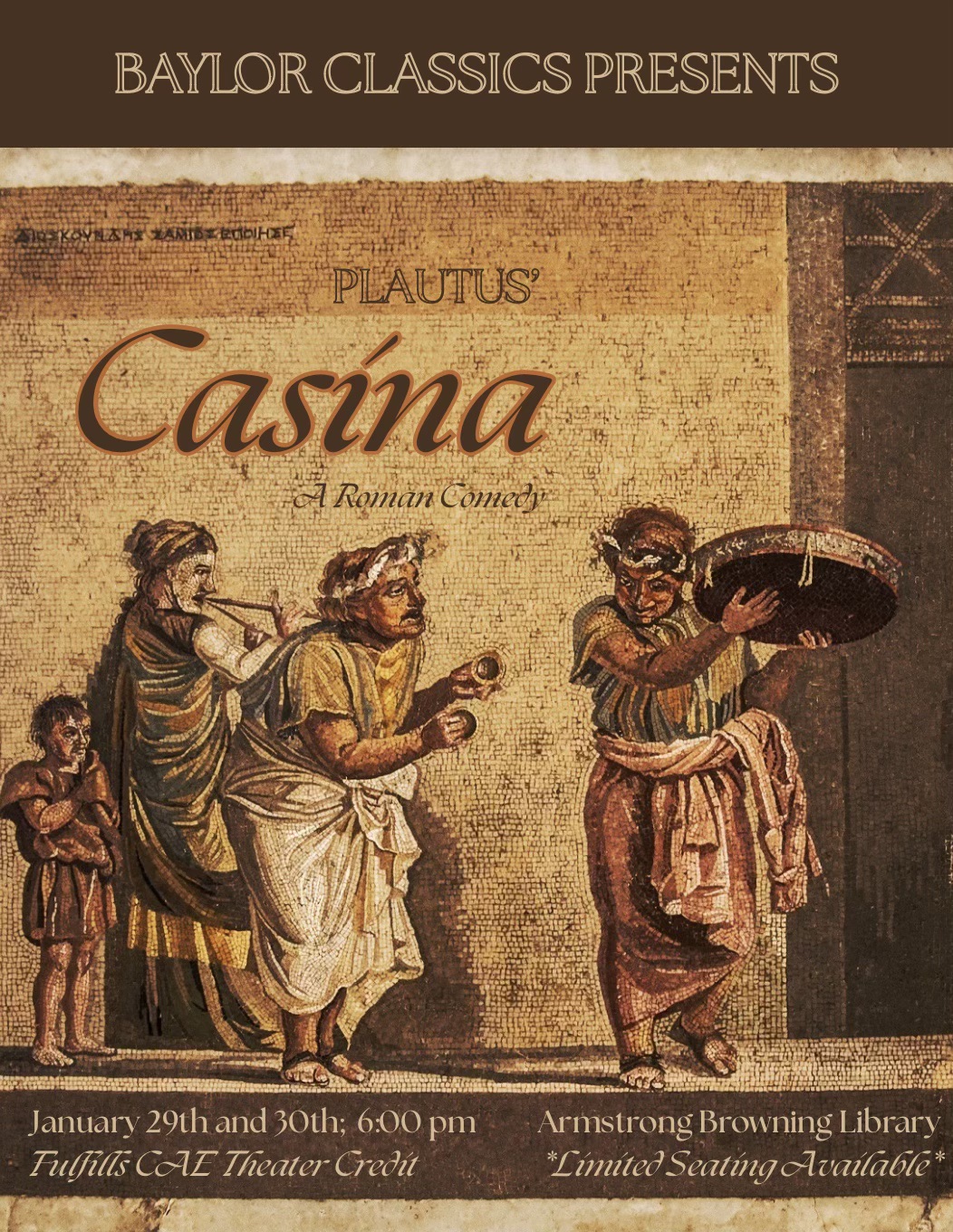
Baylor’s Classics Department will present performances of Plautus’ “Casina” for Creating Arts Experience theater credit at 6 p.m. on both Jan. 29 and 30 in the McLean Foyer of Meditation at Armstrong Browning Library. A group of 10 students, along with two professors serving as directors, will be performing Plautus’ “Casina” in its original Latin.
“Casina” is a Roman comedy written around 184 B.C. The play follows the protagonist, Lysidamus, a bumbling old man who is in love with Casina, his young slave girl. The play takes the audience through a humorous sequence of twists and turns as Lysidamus schemes against his wife.
In typical Roman fashion, Lysidamus’ wife is suspicious and sends her male servant to interfere while dressed as the beautiful Casina.
Wake Forest, N.C., junior Isaac Bostic was cast as Lysidamus and said the play’s importance lies in allowing viewers to delve into historical times.
“This is a community-facing event that we put on, where people can come in and see the same sights and hear the same sounds that they would hear in ancient Rome,” said Bostic. “It is such a unique experience for us to take part in Roman drama and to put ourselves in the shoes of ancient Roman actors.”
While what the audience sees will not be exactly the same as what an audience in ancient Rome would see, the cast will use the raw material of the Latin language.
“We’re the only undergraduate program in the country that still puts these plays on in their original language,” said Mary Dickinson, Plano senior and president of the Classics Honor Society, Eta Sigma Phi.
Dickinson said she spent a lot of time thinking about the art of translation and wants to stay as true to Plautus’ original script as possible.
“The comedy transfers well, even though it’s being performed in Latin,” Dickinson said. The performances the classics department puts on are part of an effort to understand ancient drama, according to Dickinson. To understand what they meant to the ancient Romans, thus performing the play with the original word choice, rhythm and cultural context.
Dickinson said that ‘Casina’ is an interesting reversal of typical Roman power dynamics, challenging the stereotypical image of Rome as a misogynistic culture and showing one example of a social critique of the time.
“It seems like this older male character holds the cards, but then these younger female characters one-up him,” Dickinson said.
This is a common trope in Roman comedies. Several tropes and comedy bits in “Casina,” the audience will recognize from Shakespeare, who came over 1,000 years later and was highly impacted by Plautus’ works.
Ultimately, the classics department has put on a multitude of ancient plays such as Cyclops, Menaechmi and Antigone — which featured a surprise cameo from First Gent, Brad Livingstone.