By Arden Berry | Staff Writer
The First Council of Nicaea convened 1,700 years ago to discuss and create the Nicene Creed. Today, religious, historical and literary scholars continue to discuss the document and how it has shaped faith today.
Just before the lecture, the Institute for Faith and Learning was still adding chairs to the Hankamer Treasure Room to accommodate the number of people in attendance, and some attendees had to stand.
In honor of the First Council of Nicaea’s anniversary, the Institute for Faith and Learning held three public lectures Tuesday and Wednesday on topics ranging from the literary merit of the Nicene Creed to the council’s impact on modern Christianity.
According to the Christian History Institute, the First Council of Nicaea convened to address controversies regarding Christ’s divinity compared to God’s. The council concluded that Christ’s divine nature was equal to God’s and wrote the Nicene Creed to affirm this.
Dr. Nadya Williams, a classicist, author and the books editor for Mere Orthodoxy, gave the first lecture, titled “The Nicene Creed as a Literary Masterpiece.”
“A lot of times [when] we think about theology, doctrines are very important,” Williams said. “Doctrine is important, but we forget sometimes that it’s also really beautiful literature because the people who assembled at the Council of Nicaea were all extremely well-educated people who cared about beauty in the words that they put together.”
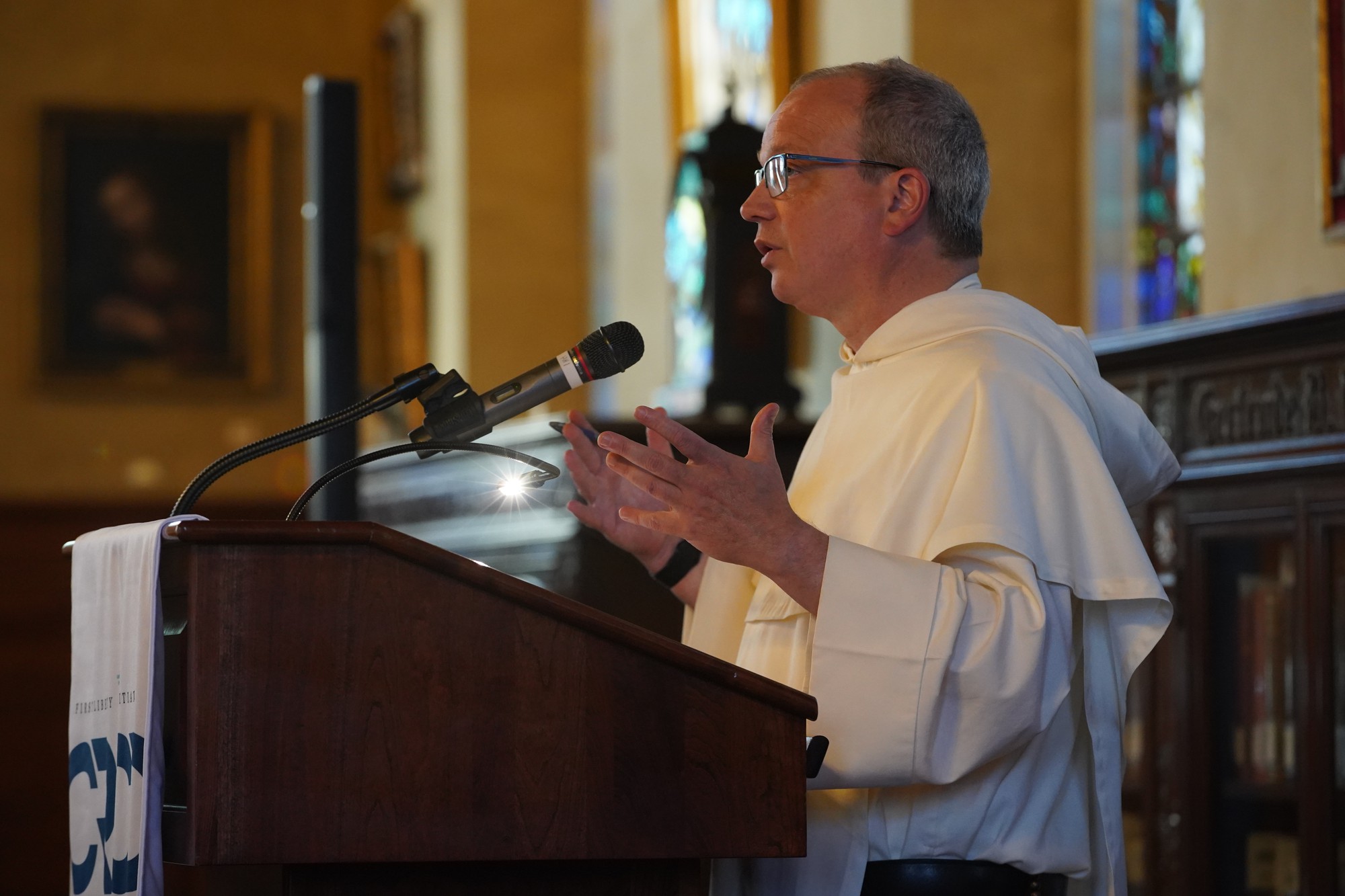
Rev. Thomas Joseph White, rector magnificus of the Pontifical University of St. Thomas and banjo player for the Hillbilly Thomists, gave a lecture titled “‘Who Do Men Say That I Am?’ On the Christological Promise of the Council of Nicaea.” White discussed interpretations of the Council of Nicaea through the lens of later councils with a focus on Christology, or the study of Jesus Christ.
“The teaching of Nicaea anticipates logically the subsequent unfolding of the councils of Ephesus, Chalcedon and Constantinople, each of which declared principles consistent with those of Nicaea and with one another,” White said.
White said he would make four major claims in his lecture: that Christ is one person, and that one person is the son of God; Christ is both divine and human in this one person; Christ has one will, with his human will submitting to the divine one; and the Catholic Church must share its understanding of Christ’s humanity and divinity.
“It is the humanity and the divinity of Christ that redeem us and that teach us who God is,” White said. “Thus, the science of the Trinity, ultimately expressing scripture, is the science of Christ, and the science of Christ is the science of God. This is the highest form of ‘episteme,’ or knowledge, that there is given to us by faith.”
Mandeville, La., junior Maria Petrolia said she came to see how White’s lecture would compare with discussions in her Great Texts class.
“I liked the juxtaposition of how Christ’s divine will and human will could work in accordance with each other without conflict,” Petrolia said. “That was an interesting discussion.”
Rev. John Behr, Regius professor of humanity at the University of Aberdeen, gave the final lecture of the symposium, titled “From the Gospel to the Creed (and back again).”
Behr said the First Nicaean Council was one of the most significant events in the history of Christianity, and the Nicene Creed was the most important statement of Christian faith.
“It was, for instance, the first time we had gathered and intervened in the affairs of the Christian Church on such a large scale, facilitating what would later be known as the first ecumenical, the first worldwide council,” Behr said.
Behr said he would discuss three parts of the Nicene Creed: what it is not, what it is and what its implications are. Behr discussed differing hypotheses, the canon of Scripture and the Holy Spirit’s place in the Trinity using the Nicene Creed, historical figures and his own experience.
“I think I have spent the last 30 years or so unlearning what I knew,” Behr said.
The seats were filled once more at this gathering, 1,700 years after the bishops gathered at Nicaea to create the very document discussed.