


By Josh Siatkowski | Staff Writer
There are 498 private AI companies valued at over $1 billion. A new initiative in the Hankamer School of Business has many hoping number 499 comes from Baylor.
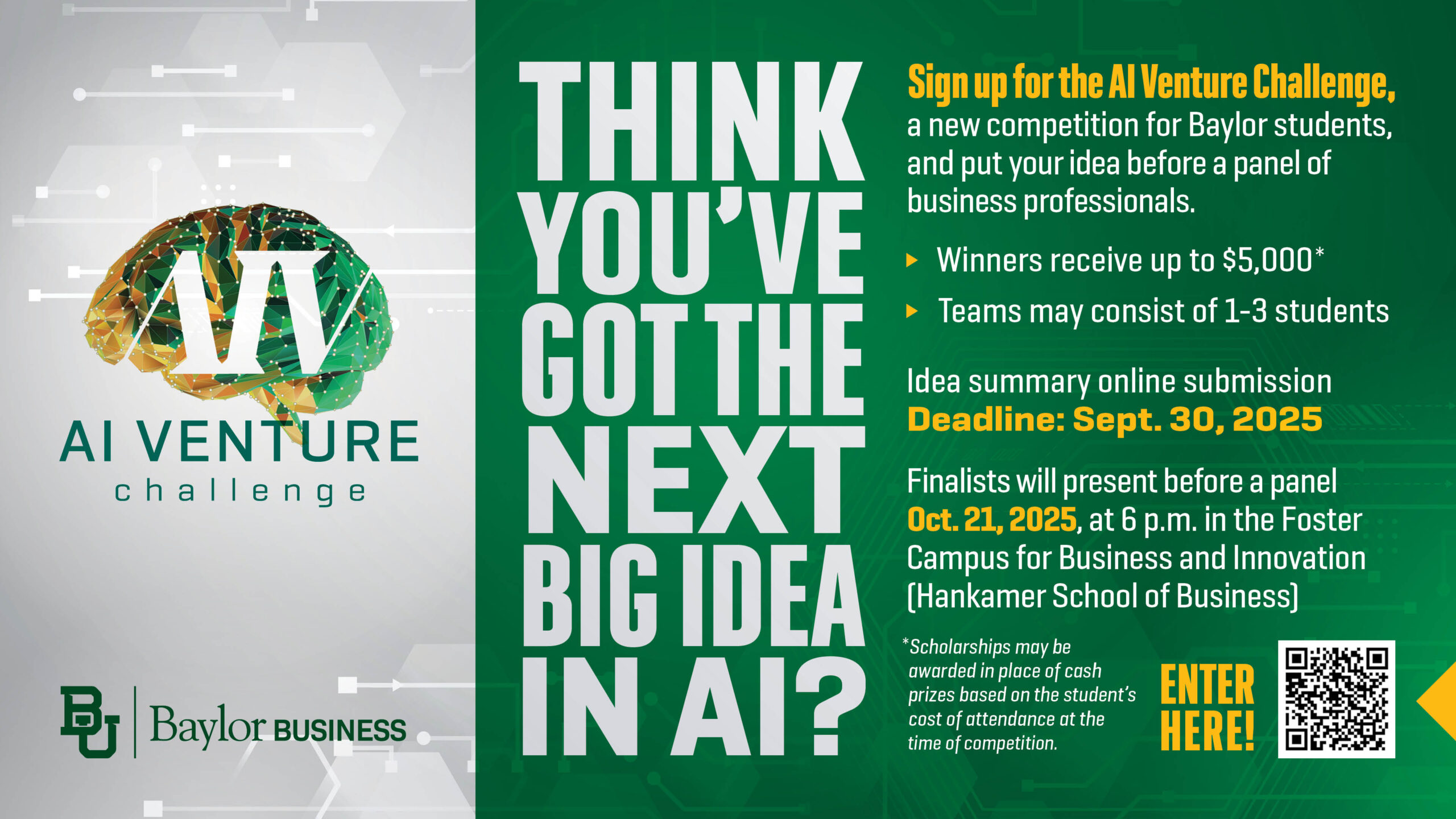
“Think you’ve got the next big idea in AI?” asks the flyer for Baylor’s inaugural AI Venture Challenge, a Shark Tank-style startup competition in which Baylor students can win up to $3,000 in funding for their AI business plans.
The challenge came from the desk of Business School Dean Dr. David Szymanski, who, in his first year at Baylor, has pushed for the adoption of AI across all business disciplines. Working alongside the entrepreneurship department, Szymanski wanted to lead something that combines a top-10 program with the popular technology.
“We have a top entrepreneurship and innovation program,” Szymanski said. “And so what you really want to do is ask the question, ‘What would a leader in this field do?’… It’s about being out in front, seeing things differently and seeing opportunities in the marketplace that other people don’t.”
For Szymanski, the answer is AI. From an institutional perspective, staying ahead of the workplace skills of the future is essential, Szymanski said. And on the student side, it’s a way to build AI proficiency and a chance to get a business off the ground.
Students with an idea must submit their business plans through a survey by Sept. 30. According to Dr. Lee Grumbles, assistant clinical professor in the entrepreneurship and corporate innovation department, the only requirements are that each team consists of one to three students, that all students are undergraduates and that the business is AI-based.
Following the initial questionnaire, the top 10 teams will advance to the final round on Oct. 21, which will involve a presentation before a panel of two entrepreneurship professors and one industry professional. About 25 teams have already expressed interest, but Grumbles said he’d like to see 75 or 100 teams apply and turn the challenge into a recurring event.
Students outside the business school are welcome, even encouraged, as Grumbles will meet with computer science students in their classes throughout the week. There’s also no limit on how developed one’s business plan can be. The submission can be a day-old idea or a more developed, already existing business.
“The term startup is fairly broad,” Grumbles said. “Companies that have been in business for two years are still considered new ventures. They can be brand new startup ideas that are still in the vetting stage, or ones that already have LLCs formed.”
Though a unique-to-Baylor challenge, the push to adopt AI in entrepreneurship is well underway. There are already over 10,000 AI startups existing worldwide, and the funding keeps coming. 1,300 of these have already crossed the $100 million valuation threshold, and new self-made billionaires are popping up like never before.
The funding for Baylor’s challenge might not make any billionaires, but winners will split a prize of $5,000, which Grumbles said is for funding each team’s venture. First prize will be awarded $3,000, while second and third will win $1,500 and $500, respectively. However, the flyer states that winnings can be paid in the form of a scholarship.
As AI continues to fast-track to the future, Szymanski hopes competitions and other AI initiatives become not just a new experience for Baylor students, but the norm.
“I think what we’ll see in another three to six months is that we’re probably not going to have these separate conversations about AI,” Szymanski said. “It’s going to be a part of what we are and part of what we do.”
