By Joana Karoshi | Staff Writer
A professor cracking open a can of beer in the middle of class might not be what Baylor students expect from a sociology lecture.
But for Kevin Dougherty, the moment is part of a larger lesson.
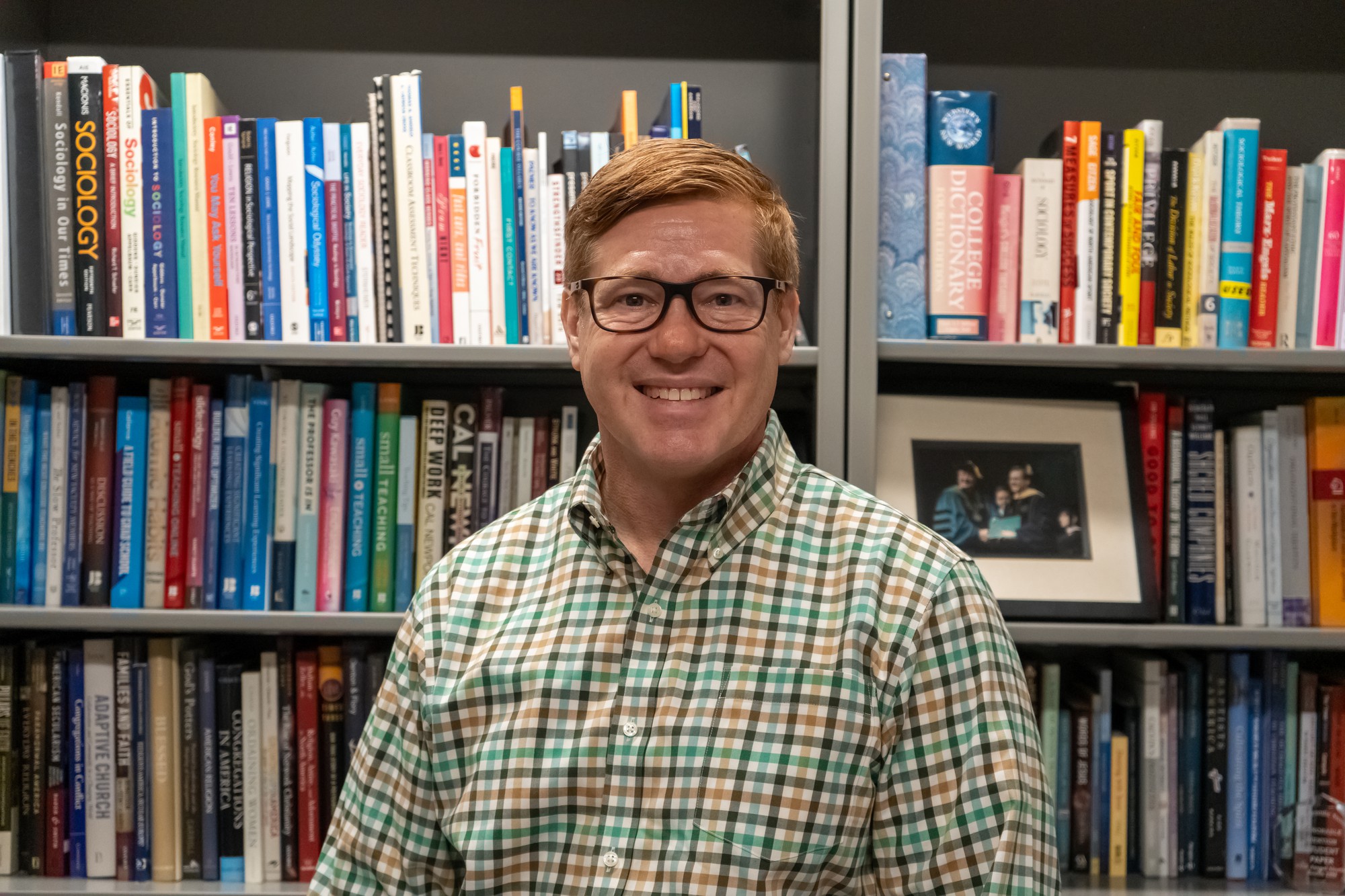
Dougherty, a sociology professor who asks students to call him “Kevin” rather than Dr. Dougherty, has built his teaching around experiences that challenge conventional classroom boundaries. Whether taking students to unfamiliar places around Waco or using unexpected activities to illustrate sociological concepts, he approaches teaching as a chance to learn beyond textbooks and lectures.
For The Woodlands senior Hayden Bradshaw, that approach made Dougherty’s class unlike any other.
“He is kind of a hoot for sure,” Bradshaw said. “He is just all over the place, but so intentional. … I could tell that he was a very, very caring and gentle person overall, too.”
Bradshaw first encountered Dougherty during his freshman year, when the professor visited another class to discuss the “different fences” people construct between themselves.
Bradshaw enrolled in SOC 1305 with Dougherty. On the first day of class, Dougherty played the opening scene of “Forrest Gump,” highlighting the shoes the main character was wearing. He paused the clip to introduce a central idea for the semester:
“This semester, we are going to learn to walk in the shoes of others,” Dougherty said.
That principle became a recurring theme throughout the course.
Students participated in experiences outside the classroom, including visits to places they might not ordinarily encounter. Bradshaw recalled visiting a Jewish synagogue, an unfamiliar experience for him.
Dougherty refers to exams and assignments as “learning celebrations,” emphasizing the collective experience of demonstrating what students had learned.
“He helped us get out of our comfort zone as well,” Bradshaw said. “He is so willing to break boundaries of the classroom and break boundaries of social norms.”
For Bradshaw, the unusual activities were both entertaining and a tool to transform experiences into sociological concepts.
Dougherty’s approach to teaching reflects his own relationship with learning. He decided to do a Ph.D. in sociology because he wanted to learn how “religion works in contemporary society.”
“I love to learn,” Dougherty said. “It’s why I became a professor. It’s why I went to graduate school. For me, teaching is just an opportunity to learn with new friends.”
He views students as collaborators in that process rather than passive recipients of information.
“Every semester … I view the students that are with me as co-learners, and we’re going to go on a journey together,” Dougherty said. “If I’m the same at the end as when I started, I failed. I failed myself and I failed the students.”
That philosophy also influences how Dougherty approaches the classroom.
“It starts with a deep love and respect for students that somehow I want to take this subject that I love and share it with these students that I love so that they can come to love the subject for themselves,” he said. “And that combination of love for your subject, love for your students and bringing those two loves together is the recipe for successful teaching and learning. “
Dougherty has taught at Baylor since 2005 and has received the university’s Outstanding Professor Award twice. He was also named a Master Teacher, one of Baylor’s highest teaching distinctions.
His research similarly reflects a willingness to explore the unexpected intersections between religion and everyday life.
Growing up in a religious family, with a father who was a minister, Dougherty was familiar with religious organizations from an early age. His childhood church experience was also racially diverse, something he initially assumed was typical of American congregations.
“My dad had friends in ministry that were Black and Latino, so growing up, I thought that that was everybody’s experience,” Dougherty said.
It was not until graduate school that he realized how uncommon that experience was. That realization prompted his research into religious affiliation, racial diversity and the factors that contribute to integration within congregations.
He found that racial diversity and racial integration are not necessarily the same thing. A congregation may include people from different racial backgrounds without those individuals developing meaningful relationships across racial lines.
“I thought that simply getting people of different races into the same worshiping space would automatically lead to positive outcomes,” Dougherty said. “What I’ve learned over time is that racial diversity is not the same as racial integration.”
That distinction has since shifted his research toward racial justice and the role congregations can play in addressing divisions within society.
He identified two fundamental roles of religious congregations: providing meaning and providing belonging. While religious beliefs offer explanations to life’s fundamental questions, congregations also create opportunities for people to develop relationships with others.
“If it’s only about meaning, a podcast can provide you meaning; an individual Bible study reading the Bible by yourself can provide you meaning,” Dougherty said. “But the other fundamental task of a congregation is to provide belonging.”
One of his more unexpected research interests emerged from a classroom project. Dougherty asked students to photograph tattoos they encountered and share the stories behind them. Each class began with a photograph and a discussion of what the tattoo meant to its owner.
Students used the photographs to examine broader sociological concepts, including culture, gender, race, social class, politics and religion.
As the project developed, Dougherty noticed many Baylor students with explicitly religious tattoos, including crosses, Bible verses and other religious symbols.
The observation led him to investigate how religious expression through tattoos has changed over time. He subsequently researched religious tattoos, producing several academic articles and a book chapter.
Dougherty found that religious tattoos do not necessarily indicate that someone is particularly religious. Rather, they can represent one aspect of a person’s identity among many others.
In a national study, Dougherty found that approximately 10% of Americans have a tattoo they consider religious or spiritual. Surprisingly, people with religious tattoos were not necessarily more religious than those with other tattoos.
“We have all sorts of markers of our affiliations, and our sense of identity,” Dougherty said. “Faith is just a part of that, but it’s one part of many things, and having a religious tattoo doesn’t necessarily mean that your faith is the defining identity of who you are, but it’s one aspect of who you are.”
For Bradshaw, however, Dougherty’s influence extends beyond the academic subjects he teaches.
After taking his class, Bradshaw reached out to Dougherty for coffee and to learn more about him outside the classroom. The two exchanged phone numbers and have since met for coffee and lunch several times.
Their relationship has continued beyond the semester, with Dougherty checking in on Bradshaw during the summer while he was completing an internship.
“He’s been definitely like a friend, like a really, really good friend,” Bradshaw said.
Dougherty’s approach to teaching, he said, has made him a memorable presence in his time at Baylor.
“If any student can take SOC 1305 with Kevin Dougherty, I would highly recommend it,” Bradshaw said. “It is more than just a classroom; it’s a family. And everyone is always welcome back to the family.”