By Stephanie Starks | Staff Writer
You’ve tried counting sheep, turning on ambient nature sounds or leaving a nightlight on, but none of these age-old methods seem to help you get more sleep.
If that sounds familiar, you’re not alone. The Centers for Disease Control and Prevention estimates that roughly 30% to 46% of American adults get fewer than seven hours of sleep, below the recommended amount.
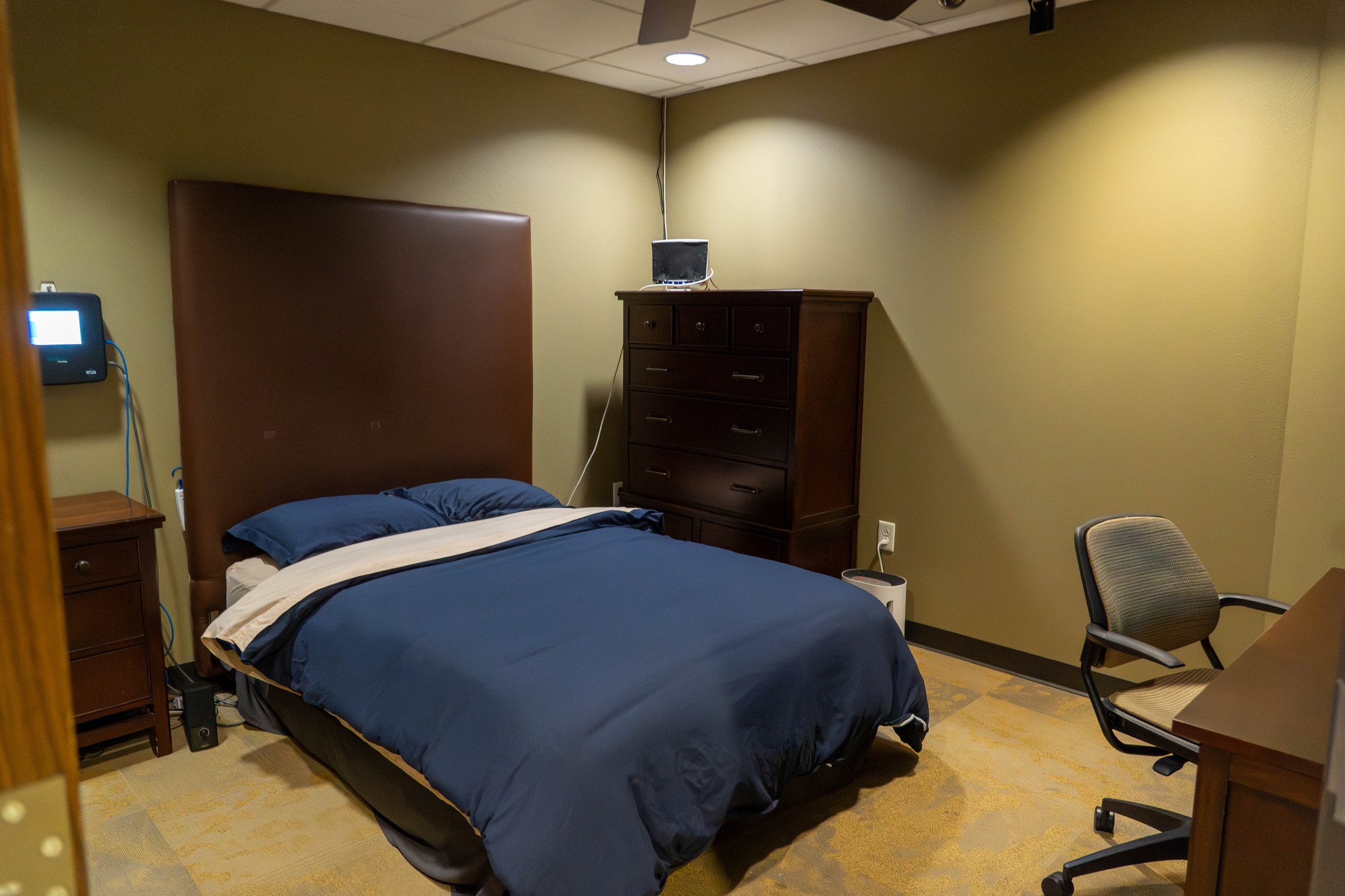
To better understand sleep and its effects, Baylor established the Sleep Neuroscience & Cognition Laboratory in downtown Waco in 2015. Led by principal investigator Dr. Michael K. Scullin, the lab examines how sleep influences cognition and behavior and how research findings can address real-world challenges.
Corinne Fitzsimmons, a senior graduate student in the lab, has worked there since 2022. During that time, she has helped conduct experiments examining sleep restriction and sleep extension.
“The amount of hours that a student actually gets, even with a mild sleep restriction, in the sleep world, 20 minutes is meaningful,” Fitzsimmons said.
Sleep plays an important role in memory consolidation, the process through which memories are reinforced. Even modest reductions in sleep, Fitzsimmons said, can affect a person’s ability to pay attention and retain information.
“Mild sleep restriction can have impairments on those factors, particularly attention,” she said. “In order to learn, people need attention. They need attention in order to take in information, to think about it and recall it later. Sleep can have some big effects on learning overall.”
The lab also examines how people can improve their sleep through behavioral changes. For individuals experiencing more serious sleep concerns, such as sleep apnea, Fitzsimmons said Baylor Health Services or other specialists in the Waco area may be better equipped to help.
One study conducted in the lab examined the relationship between sleep and gratitude.
“If a person has less sleep, their flourishing and gratitude goes down,” Fitzsimmons said. “If a person has more sleep than their normal, it goes up. There is a direct link in terms of how a person feels and how they are expressing themselves with the world, and that is on a state level. It does not affect personality per se, but it’s affecting how they are as an individual in those ways.”
Currently, the lab is researching dream incubation, which examines how thoughts and experiences before sleep can influence dreams.
Dreams can be difficult to study because researchers often rely on participants’ recollections of what they experienced while sleeping. However, Fitzsimmons said researchers have found connections between pre-sleep thoughts and what happens during sleep.
“What you think about before you go to bed will affect what is going on in your mind while you sleep,” Fitzsimmons said. “We have seen this with some other studies on targeted memory reactivation. Targeted memory reactivation is more triggering it while you are asleep, you can create associations with the sound, and then play that sound when you are asleep, and that will make the memory stronger with whatever it was associated with.”
Dr. Jason Carter, dean of the Robbins College of Health and Human Services, has worked with Scullin to examine the social pressures surrounding sleep among college students.
“I think of it as a one-two punch,” Carter said. “The problem that we are seeing is there is less sleep happening than there used to be, and the quality of that sleep, due to technological advancements, has deteriorated, and so you don’t get into that deep restorative sleep as much.”
Carter encourages students who struggle with sleep to limit screen time for at least two hours before bed.
“It’s very difficult in this society to do that, but the blue light that is emitted from TVs and screens suppresses the release of a very important hormone in the body called melatonin,” Carter said. “You have probably heard of melatonin. People think they can buy it as a supplement, and it replaces the natural melatonin, and it doesn’t.“
Caffeine is another factor that can make it harder to fall asleep, particularly when consumed later in the day. Carter said caffeine has a half-life of about six hours, meaning half of the amount consumed remains in the body after that time.
“If you have a cup of coffee or a Monster Energy drink in the morning, six hours later you still have half the caffeine in the body,” he said. “Six hours after that you have half of the half. So you will still have a quarter of the caffeine that you drank at 6 a.m. in you at 6 p.m.”
Carter also emphasized the importance of rest beyond its physical benefits, connecting sleep to rest in Christian faith.
“There is a calling within Scripture for rest, and from Sabbathing to just reading Scripture around what God commands us to do is rest at times,” Carter said. “Rest and sleep are still a huge mystery to us. It is one of the reasons I stay involved with research. There’s so much we don’t know about sleep, and think of it, we spend one-third of our lives sleeping if we do it right.”