By Josh Siatkowski | Lead Writer
After years of functioning across 10 buildings on campus and in downtown Waco, Baylor’s newest college has entered the early stages of constructing a central location for its programs.
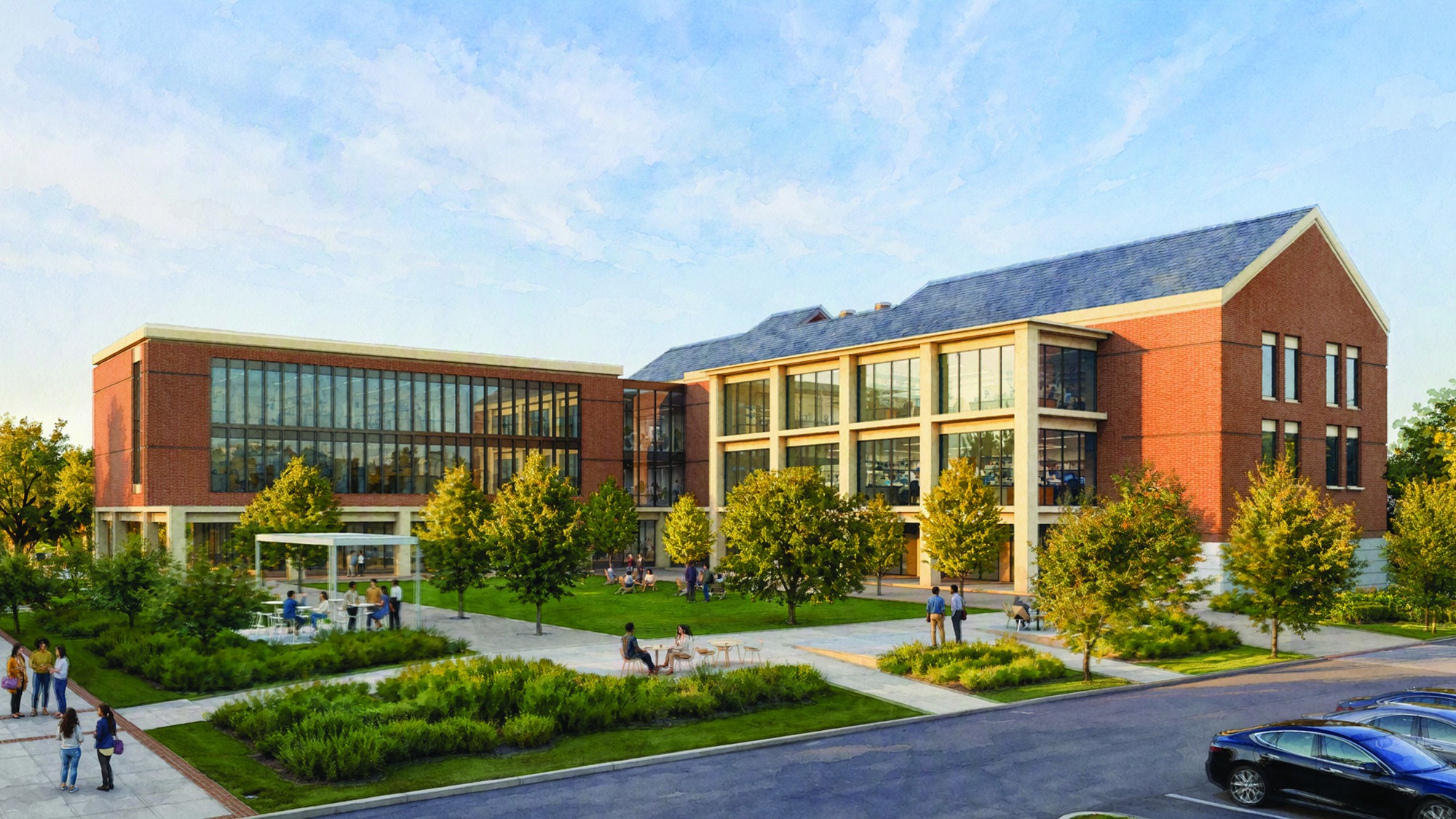
Announced last week, the Robbins College of Health and Human Sciences is launching a fundraising program to build a new academic center on campus. The project will be fully donor-funded, led by an anchor gift from Mary Jo Robbins and the Robbins Foundation of Texas that was made public at an event during Homecoming.
The construction timeline depends on fundraising progress, and the location has not been set. But Baylor is working with an architectural firm to survey campus and expects to confirm a site in the coming months. At 66,000 square feet, the William K. and Mary Jo Robbins Academic Center will be comparable in size to Morrison Hall, significantly smaller than the 508,000-square-foot Baylor Science Building and the 275,000-square-foot Foster Campus for Business and Innovation.
The new development comes amid what Robbins College Dean Dr. Jason Carter called “12 years of steady growth” since the college was formed in 2014.
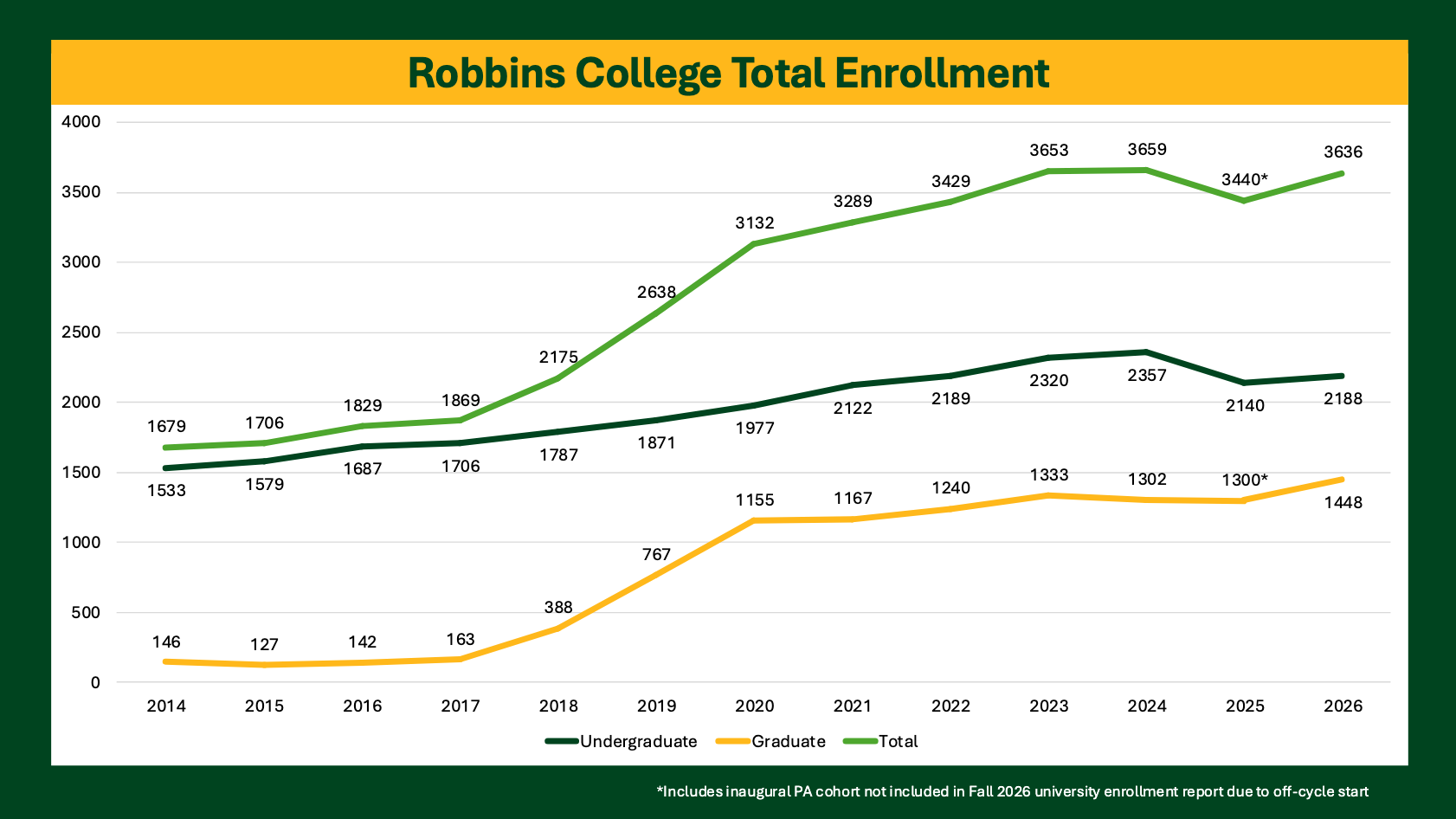
With about 1,500 undergraduates enrolled in its inaugural year, that number reached 2,188 this fall, according to the Office of Institutional Research. Driven by growth in the 1,000-student Health Science Studies major and a doubling of Child and Family Studies enrollment, Robbins is the third-largest undergraduate unit on campus, behind only the College of Arts and Sciences and School of Business.
Robbins also houses about one-fifth of Baylor’s graduate students, giving it a total population of over 3,600 students.
That growth has brought challenges, Carter said.
“When you have that kind of growth, you have to take space as it becomes available, and so we are actually spread across 10 different buildings between main campus and downtown.”
On campus, Robbins College occupies five academic buildings for its numerous programs. Mary Gibbs Jones houses design and nutrition. Goebel holds interior and apparel design. Marrs-McLean Gym hosts the public health department and human performance; and Hankamer and Cashion serve as the administrative hub and host communication sciences and health science classrooms.
For Amarillo graduate student Mason Gregory, who got his bachelor’s in public health in May and is pursuing a master’s degree in bioethics, the experience was even more fragmented. And because public health courses often lean on the collaborative Allied Health model, it was even more challenging.
“A lot of my classes were centered in Cashion, Hankamer, Marrs-McLean Gym, but also Sid Rich [and] Marrs-McLean Science Building,” Gregory said. “I’ve had Robbins College courses in Draper. I’ve had a pathophysiology course in the communications building, in Castellaw.”
Off campus, Robbins College also occupies the Clifton Robinson Tower, the Piper Center for Family Studies and Child Development and three other buildings in downtown Waco. Carter said part of the construction’s goal is to limit the negative effects of a fragmented community.
“There will be no downtown programs anymore, which is really great because when a [physical therapy] or [physician’s assistant] student comes into town, I want them to experience the Baylor experience. I want them to be on our campus, have a chance to walk down Fifth and sit in front of Old Main.”
Because Robbins College is so large, the new building will serve as a central hub that provides key upgrades for the college rather than eliminating the need for its other spaces on campus. One of those key upgrades is new applied research space, which is currently housed in a 90-year-old building that it shares with Baylor’s spirit team and previously with Baylor’s acrobatics and tumbling team.
“We’ve become a very research-active college, and we’ve had to create state-of-the-art laboratories in Mars McLean Gym,” Carter said. “If you’ve ever been through Mars McLean Gym, you know it’s not set up for state-of-the-art research labs.”
In addition to laboratories, the project is expected to include collaborative space, classrooms, a chapel, and a new home for Robbins College administrators.
While the total budget and value of the anchor donation are not currently public, Carter’s priorities now shift to fundraising for the new building. Carter said he’s looking to make significant progress on the fundraising front in the next year. He even has a gift from the Office of Advancement to keep him going: a golden shovel that he’ll one day use to break ground on the yet-to-be-determined site.
“I like to move fast, but it’s going to depend upon whether we get some of those commitments,” Carter said. “We have to get to a full commitment to the building before we break ground. But fortunately, Mary Jo Robbins and the Robbins Foundation got us a big chunk of the way there.”
Because Robbins College programs often overlap or rely on group work, Gregory said he is most looking forward to seeing faculty and students in a space where they are encouraged to work together.
“I think the biggest impact is just overall going to be collaboration.”