By Stephanie Starks | Staff Writer
Baylor’s community gardens are a part of a broader effort to address food insecurity and promote environmental stewardship. Through the Sustainable Community and Regenerative Agriculture Project (SCRAP), Baylor partners with the City of Waco and McLennan County residents to build a more sustainable food system.
SCRAP’s efforts have helped divert 317,972 pounds of food waste from landfills over the past year, according to its 2022-25 report. The report also found that food insecurity affected 14.4% of Central Texas and 19.7% of Waco residents in 2025.
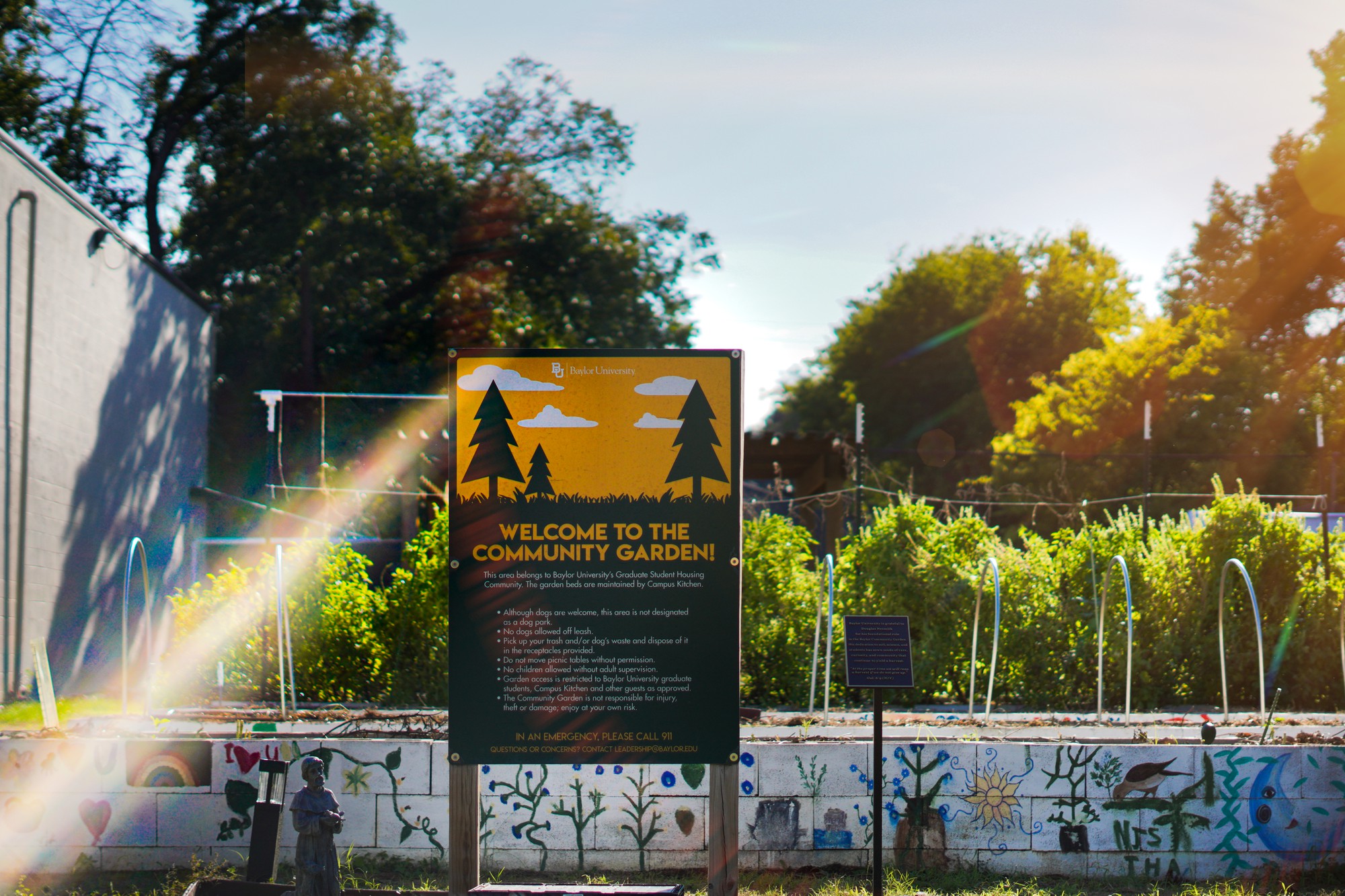
The grant-funded research collective brings together community organizations, educators and students to address food insecurity through gardening, food recovery and environmental education. On campus, students can see the work firsthand in two community gardens: one at Teal Residential College and another near the Armstrong Browning Library. Classes ranging from engineering to education use the gardens.
Dr. Joshua King, a professor of English and founding member of SCRAP, said students should recognize the needs of the community around them.
“One in five of our residents has difficulty in accessing adequate food,” he said. “If students can recognize that there are ways for them to help right in our community, from literature to social work, students are the ones who are going to have the greatest amount of change as the next generation.”
Since its founding, SCRAP has involved roughly 20,000 people in educational events and volunteer efforts. King said the project has influenced some students’ career goals and inspired them to become more involved in addressing food insecurity.
Lewisville master’s student Miquela Lopez, a member of the Theology, Ecology and Food Justice Program, said she visits the community gardens and works on a farm. She also said gardening can help students develop a deeper connection to the land and the food they eat.
“When [students] work with something that depends on them, it changes their perspective,” Lopez said. “Being a part of the gardens makes it easier since students are coming together with their peers. It’s even more tangible for students to see the literal fruit of their labor.”
Dr. Jennifer Howell, director of the Theology, Ecology and Food Justice Program and a founding member of SCRAP, said the project allows organizations to work together on problems that no single group can solve alone.
“It bolsters my confidence in knowing that I am not the only one involved in addressing [food insecurity],” Howell said. “SCRAP is a beautiful vision of what the community can do when we work together.”
Howell said students are always welcome to get involved with the SCRAP collective, community gardens and the wider community by connecting with local organizations such as Da’Shack Farmer’s Market.
“I hope that students are inspired to be active parts of their community after they graduate from Baylor,” Howell said. “SCRAP is a real partnership where everyone is seen, heard and known.”
SCRAP’s work also extends into local schools, where educators are finding ways to connect students with the outdoors. Dr. William Sterrett, a professor of educational leadership and a member of the Baylor Sustainability Committee, works with school districts to incorporate environmental learning into students’ education.
“I believe that some of the best learning happens outside the classroom,” Sterrett said. “We need to get students outside and give them vitamin N. I don’t think there are any vitamins called that because the ‘N’ stands for nature.”
Sterrett has worked with educators to create outdoor learning opportunities, including an outdoor classroom at Hewitt Elementary where students help care for live chickens.
“Here in Central Texas, we can be a part of the solution [that will help pollination rates],” Sterett said. “[My team] is working with Belton ISD to make pollinator gardens where pollinators have an opportunity to rest and recharge before their journey [back to Canada].”
For Sungratsu, India, master’s student Lanu Lanukumzuk, studying theology, ecology and food justice has helped him build skills he hopes to share with his Naga community along the India-Myanmar border.
“I have the desire to be able to grow my own food,” Lanukumzuk said. “I am deeply rooted with the idea of growing food to feed and care for others. I want to learn how to be able to help teach other people how to grow their own food.”
Dr. Stephanie Boddie, an associate professor in the Diana R. Garland School of Social Work and a founding member of SCRAP, said the collective’s cross-sector partnerships have helped organizations develop new programs, including health education and cooking classes.
“SCRAP is unique because it brought this multi-sector group together that had not previously worked with one another,” Boddie said. “This partnership has allowed them to reimagine their work and expand upon it.”
Boddie said food insecurity also carries broader health consequences when people lack access to nutritious food. She said SCRAP’s work reflects the connection between caring for the environment and caring for people.
“The SCRAP collective is trying to figure out how to help care for the Earth as we care for our neighbors,” Boddie said.