By Stephanie Starks | Staff Writer
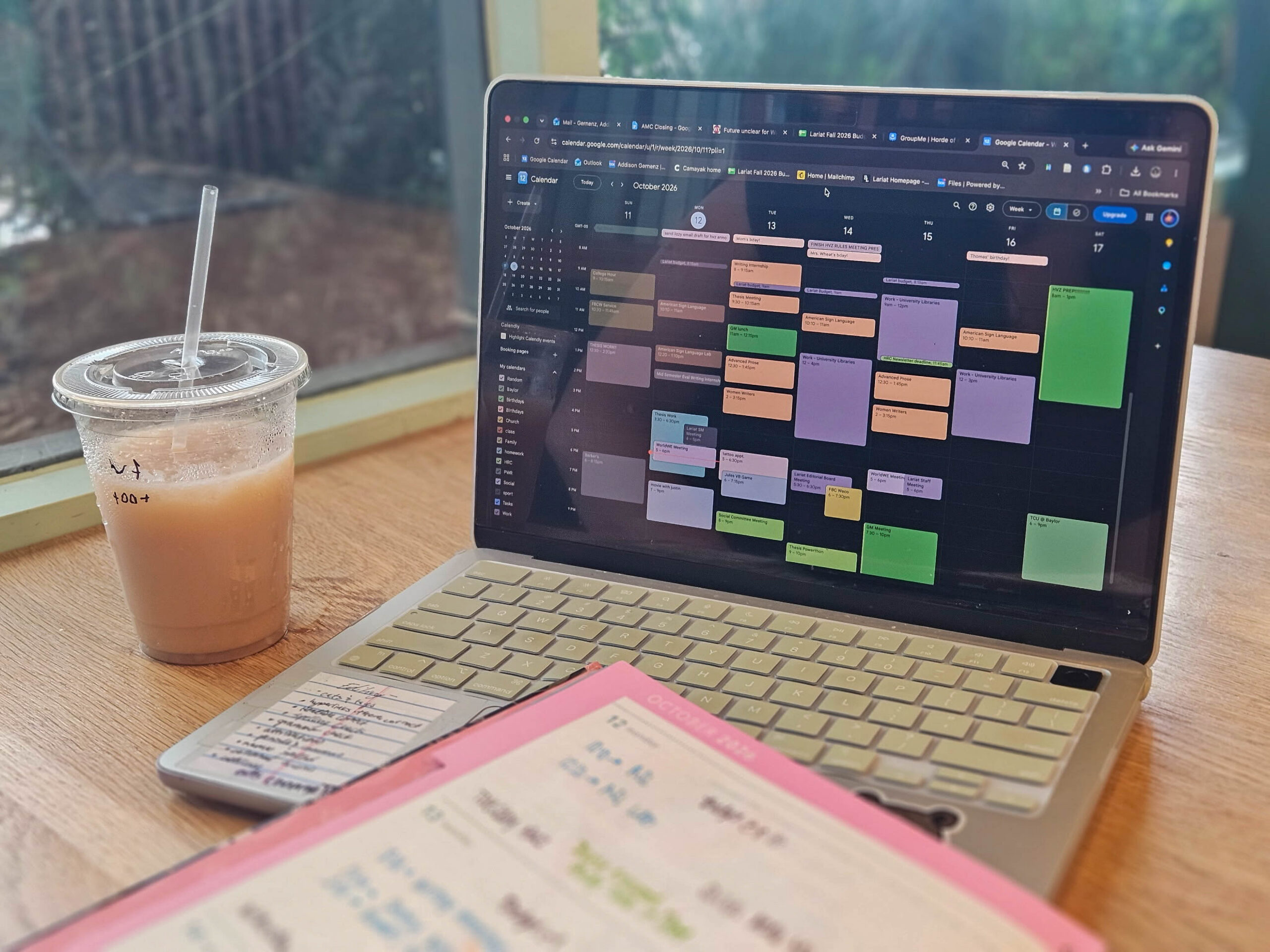
From color-coded classes to carefully scheduled study sessions, students are using Google Calendar to organize nearly every hour of their day. And while digital planning makes some students feel more productive, it can also leave little room for spontaneity.
For students balancing classes, assignments, social lives and extracurriculars, Google Calendar offers many ways to manage their schedules in one place. Marietta, Georgia, junior Shelby Grace Sparrow said that using Google Calendar has made her feel more aware and productive.
“I really use the white space,” Sparrow said. “It has made me more mindful of how much time I am spending on certain things and where I need to commit more or less time to other things.”
Digital planning has become increasingly widespread. In 2023, Google for Education had more than 170 million users, according to About Chromebooks. Additionally, statistics published by Briefly in 2023 suggest that 70% of U.S. adults prefer digital calendars over paper ones.
Despite the convenience of digital planning, Sparrow said she still values using a physical planner alongside Google Calendar. She uses the two tools for different purposes, separating scheduled commitments from assignments and deadlines.
“I use my physical planner for to-do lists and homework, but I use Google Calendar for strictly timed events such as classes,” Sparrow said. “For my planner, I feel like I can set more specific deadlines about papers and assignments, but I also do not have the pressure of having a specific block of time tied to my day.”
Sparrow said she began using Google Calendar halfway through her freshman year at Baylor, saying she didn’t know how she did “roughly 19 1/2 years without also having a Google Calendar.”
In an August 2026 Psychology Today article, college mental health expert Dr. Rob Danzman said digital calendars can help students manage the transition from the structured environment of high school to the independence associated with college.
Danzman also said organizing responsibilities and commitments in a calendar can reduce the mental burden associated with remembering tasks and deciding how to spend time.
“It’s one of the super practical tactics I share with students that has an incredible compounding effect without them realizing it’s therapy cloaked as strategic planning,” Danzman said.
However, Dr. Scott Varda, a communication professor, said students risk developing an illusion of productivity by relying too heavily on digital calendars.
“Students need to ask themselves, am I being productive with my [use of Google Calendar] or am I checking a series of boxes on my list?” Varda said.
Varda said digital tools can also encourage what researchers call “cognitive offloading,” or relying on technology to store information rather than remembering it independently.
“With any switching from analog to digital technology, people get a simultaneous concern of both the increasing speed and the amount of things that you input,” Varda said. “This creates a cognitive offloading in a person’s brain. In one sense, people can put it in their calendar and forget about it. In another sense, people have shut their brain off and are not thinking about it.”
Another concern Varda said students should consider is overscheduling. When a student plans every available hour, it becomes difficult to embrace unexpected opportunities.
“I understand the desire of students to plot out the 46 things that they have to do every week on a digital, easy-to-access calendar,” Varda said. “On the other hand, I think there is value in living life like the ancient Greeks. Go wander by a creek and think about valuable things. When everything is calendarized, it is hard for any brain type to go from every planned block in the calendar.”
Varda said calendar blocking, a practice in which people divide their day into designated periods for specific tasks, can help manage responsibilities. But he warned that becoming too dependent on the practice may leave students feeling unable to deviate from their schedules.
“There can be a real threat of too much dependence, like with any technology,” Varda said. “Students need to use this tool in a responsible way. Calendar blocking can be detrimental to students’ mental health.”
He said college students should make time for activities that cannot always be planned in advance, whether that means exploring campus, meeting new people or spending time with friends because “students can not put spontaneity on their Google Calendar.”
While digital calendars can help students manage responsibilities, Varda said college should also be a time for unexpected experiences and personal discovery.
“Make sure that there is time for the crazy adventures that friends convince you to do,” Varda said. “There is never going to be another time in a student’s life where they are exposed to a lot of different ideas and experiences. Making them the most productive version of themselves at all times loses the creative and decision-making part of them that makes the college experience worth having.”