By Kamryn Anthis | Staff Writer
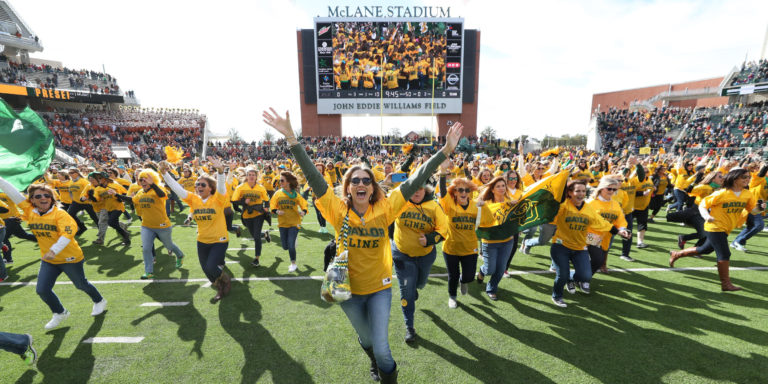
One of President Linda Livingstone’s first efforts to address the university’s past exclusions came in 2017, when she invited generations of women back to campus to participate in a tradition they had once been denied: running the Baylor Line.
For the first 24 years of the Baylor Line’s existence, only male students were permitted to participate. Although the tradition became coeducational in 1994, women who attended Baylor before that change had never experienced it themselves.
On Oct. 28, 2017, more than 800 women returned to Baylor to run the line, marking an early effort in Livingstone’s presidency to acknowledge and address the university’s history.
Director of Campus Recreation Dr. Kim Scott, who participated in the reunion, said Livingstone saw an opportunity to address a longstanding exclusion early in her presidency.
“When they hired Dr. Livingstone in 2017, she heard about that and decided she couldn’t make a lot of changes immediately, but that was one thing she could fix,” Scott said. “So in the fall of 2017, they invited all the women who were freshmen at Baylor between 1970 and 1994 … to get a Baylor Line jersey and to run the line.”
Scott said the experience brought together women who had spent decades without the opportunity to take part in one of Baylor’s most recognizable traditions.
“These are all women who are 40-, 50-, 60-years old,” Scott said. “And the thought of running the line was a little bit intimidating to some, exciting for others. But it was a really historic time… that gave us a reason to come together. That is a memory that we’ll all have for a long time.”
Today, freshmen are invited to run the Baylor Line before every home football game.
Flower Mound freshman Tallulah Paci said participating in the tradition helped her develop a sense of belonging at Baylor.
“It’s one of the many things you get to participate in … where you get to be introduced into the Baylor family in a way by participating in the traditions,” Paci said. “And it’s a moment where everyone can come together and be made to feel like they belong at Baylor.”
Paci said running the line also gave her an opportunity to connect with classmates and make new friends.
“For me personally, I really enjoyed it because I feel like it was a good bonding moment with my friends,” Paci said. “I also got to meet a lot of people as we were doing it. … It was super exciting, and it felt like everyone was coming together.”
Scott said the Baylor Line’s history reflected a broader period of changing expectations surrounding women’s rights and opportunities.
“Title IX and the equality for women had just come on the scene,” Scott said. “It was all brand new that we should be the same, that we should have the same rights and the same opportunities. So it just hadn’t made it to that particular tradition.”
Although women have been permitted to run the line since 1994, Paci said she believes ensuring all students can participate is essential to the sense of community the tradition is intended to create.
“Women are also part of the family, and I feel like they should be allowed to participate in their traditions as well,” Paci said. “… I think it makes perfect sense to have everyone do it because then everybody gets to be a part of the family.
The 2017 reunion was one of several efforts during Livingstone’s presidency to acknowledge and address aspects of Baylor’s history. Other initiatives have included recognizing the university’s African American graduates and establishing the Memorial to Enslaved Persons.
Scott said the reunion demonstrated how the university could acknowledge past exclusions while creating new opportunities for those affected.
“We can’t go back and undo things that were done 50, 100, 200 years ago, but we can do our best to say, ‘We recognize we did it wrong and we’re going to try to make it as right as we can,'” Scott said. “That’s what this was. It was, ‘Hey, these people never had the chance, and we want to give them the chance.'”