By Giselle Lee | Staff Writer
As students look to expand their academic horizons beyond the Baylor bubble and engage in global learning, many think about the competitive Fulbright Awards. However, the Office of Engaged Learning (OEL) offers support for other competitive programs that provide opportunities to study abroad.
The annual Critical Language Scholarships (CLS) and Boren Awards, which offer fellowships worth up to $25,000, recently opened for applications. The CLS and Boren Awards give students opportunities to learn about different cultures and languages around the world.
Eliza Denley, coordinator for fellowships and awards for the OEL, said the CLS and the Boren Awards are structured programs that let students travel to other countries and engage in immersive language learning, but they differ in program specifics.
“The CLS is over the summer, and it is limited to languages that are critical for national security or for economic prosperity of the U.S.,” Denley said. “The Boren Awards are a little bit longer and a little bit more independent; they’re at least six months to a year. There’s a wider selection of languages you can learn, but it’s a bit more intensive and independent of a process, and there’s a year-long federal service requirement after.”
Denley said both programs are good options for students interested in pursuing careers in federal service, but their broader purpose is to help students develop personally and professionally as “citizen diplomats.”
“[Both] build your own comfortability, competency and your confidence and your ability to engage with people from all different backgrounds, on a more personal level, but also on a more global level,” Denley said. “You are engaging with people from around the world and learning how to build mutual understanding across cultural, language, geographical barriers.”
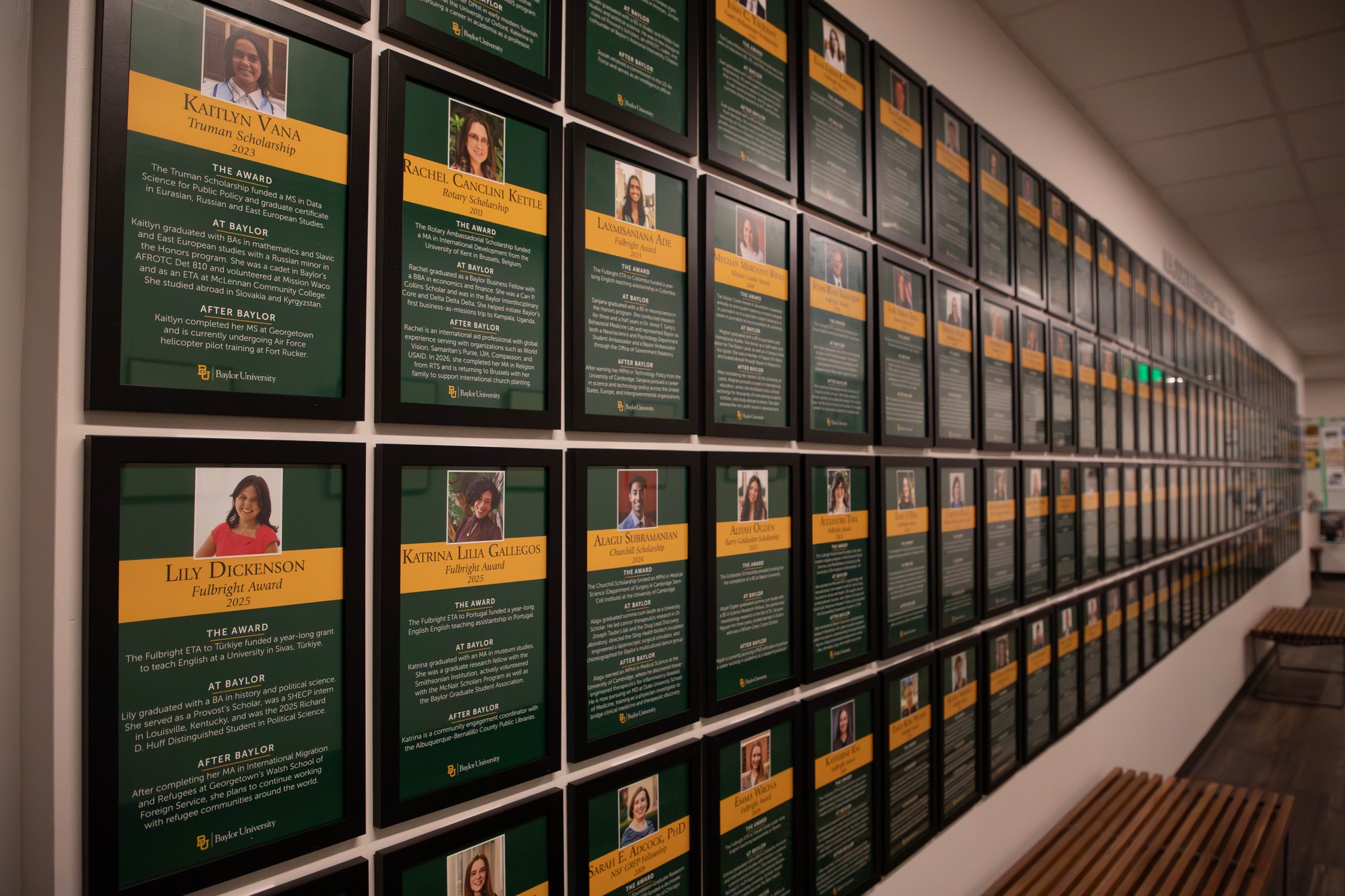
Josh Browder, a 2026 Baylor graduate and CLS awardee, traveled to Japan during the summer in 2024. He said his upbringing in Spain during his father’s Fulbright was a major driving factor in his interest in languages and culture. Now, the OEL hangs their portraits side by side on its “Wall of Fame.”
“On that wall they put us next to each other because we were the first father-son duo from Baylor to win major awards, so that was really special for us,” Browder said. “I grew up in Spain; our first memories are from Spain. When we came back to the U.S., I went to a Spanish immersion school. I remember towards the end of high school, I began to appreciate more just having that cultural experience and the secondary language and being able to communicate with more people.”
After taking up Japanese during COVID-19 and at Baylor, Browder said he was committed to doing everything to the fullest and pursuing excellence because it was a way to glorify God.
“Japan was one of the few where you needed at least two years of college credits to apply,” Browder said. “I believe that being faithful and trying to glorify God is just doing my absolute best to do whatever excellence looks like in that area. [Since] I’ve been studying [Japanese] for several years, I thought to go ahead and submit an application and see if I can just continue to pursue it and if God continues to open doors for me in that area.”
Browder said the biggest benefit of doing the CLS was how it shaped his worldview and challenged his assumptions about life based on his cultural upbringing.
“A term that I’ve kind of started using after that experience was just what it means to be a global citizen,” Browder said. “Recognizing that even though I might be from a different country, I’m still a child of God in the same way that people from different countries are children of God. It’s made me care a lot more about the field of international relations in the sense of how we’re being good neighbors to other people.”
Taylor Chung, a 2025 Baylor graduate and Boren Award Scholar, grew up in Hong Kong. He first heard about the Boren Awards and CLS through conversations with a professor because he wanted to pursue a career in public service.
After receiving the CLS twice and eventually earning a Boren Award, Chung accepted the award and studied introductory Swahili at the University of Florida through the African Flagship Languages Initiative before spending the rest of the program in Tanzania.
“My biggest takeaway from the experience was really learning what it’s like to experience a new culture entirely and to immerse myself in it while treating myself or learning to be humble, no matter what,” Chung said. “For example, I would regularly take the public bus. I would be the only Asian person or foreigner on the bus, and I would have conversations with people, and it was very eye-opening to learn from them.”
Chung said the experience helped him gain working-level proficiency in Swahili and fueled his passion for African policy, especially inclusive development. He said students should reach out to the OEL if they are interested in applying, as it is “worth always trying.”
“Being honest and authentic is important,” Chung said. “Being confident that your story is important and just have an excitement or a passion to learn, because there’s so much to learn from the other side of the world.”
Browder said global experiences such as the CLS and the Boren Awards are more formative and better prepare students to tackle career challenges than an internship.
“I think that my global experiences have done way more to shape the way that I interact with others, the way that I communicate with others, and have developed empathy and open-mindedness in my life far more than I would have gained from doing three summer internships,” Browder said. “I would encourage students to see these global experiences as just as valuable and not a waste of time.”
For those concerned about how the CLS or Boren Awards may affect their college timeline, Denley encouraged interested students to reach out to the OEL to learn more.
“For the Boren, you need to be actively matriculated at a university at the time of your application,” Denley said. “But you don’t necessarily have to have previous experience in the language when you apply, especially for some of the more niche or indigenous languages that the Boren offers. These are open to students of all majors, so there’s no restriction on you have to only be an international studies major or something like that to apply.”