By Hannah Webb | News Editor
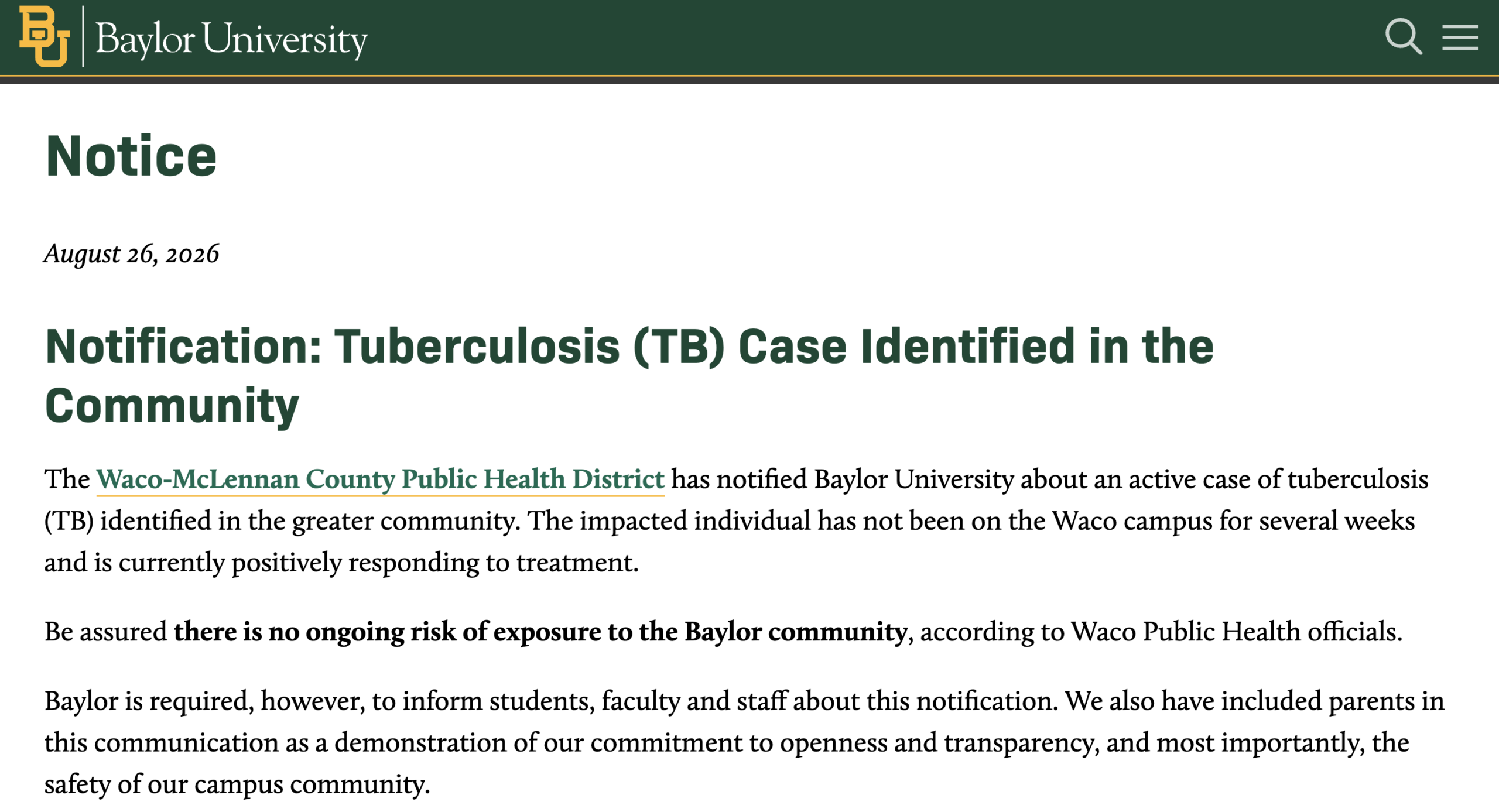
The Waco-McLennan County Public Health District notified Baylor Wednesday of an active tuberculosis case in the greater Waco community. University officials said there is no ongoing risk of exposure to the Baylor community.
In an email sent to students, faculty, staff and parents Wednesday afternoon, Baylor said the individual has not been on Baylor’s campus for several weeks and is responding positively to treatment.
Despite the case in the Waco area, Baylor said the situation does not pose an ongoing risk to campus.
“Be assured there is no ongoing risk of exposure to the Baylor community,” the university said in its email.
Baylor Health Services is working with the Waco-McLennan County Public Health District to identify members of the Baylor community who may have had significant exposure. Those individuals will be contacted through their Baylor email within the next 14 days and offered free testing.
In a statement, Baylor spokesperson Lori Fogleman confirmed that the university was notified as part of standard public health procedures.
“Tuberculosis is a reportable condition, and it’s standard procedure that once the Waco-McLennan County Public Health District was notified about a case, they in turn notified the university,” the statement reads.
The two organizations have held several in-person meetings to coordinate identifying close contacts, notifying members of the campus community who may have had significant exposure and planning testing for those individuals. Fogleman said the partnership is “important.”
Baylor said individuals not contacted by public health officials do not need to be tested based solely on the community case.
According to the Centers for Disease Control and Prevention, TB is a bacterial infection caused by Mycobacterium tuberculosis. The bacteria most commonly affect the lungs and can spread through the air when an infected person coughs, sneezes or speaks. People with active TB disease are most likely to spread the bacteria to people with whom they spend significant amounts of time.
The CDC reported 10,260 cases of TB disease in the United States in 2025, including 1,295 cases in Texas. Texas had the second-highest number of reported cases in the country, behind California, which reported 2,150 cases.
Baylor has existing procedures for identifying students who may be at increased risk of TB. All incoming students are required to complete a TB risk screening questionnaire as part of the university’s medical clearance process. Depending on their responses, students may be required to provide proof of a recent TB test.
The screening asks whether students were born in or have lived in a country considered high-risk for TB, have an immune-suppressing medical condition or have had known exposure to someone with active TB.
For members of the Baylor community identified as close contacts in the current case, testing will be available Sept. 14 and Sept. 23 from 8 a.m. to 2 p.m. at the Baylor Health Center on the second floor of the McLane Student Life Center. Close contacts can schedule testing through Baylor’s Health Portal. Testing is also available by appointment on weekdays through the Waco-McLennan County Public Health District.
Baylor established a call center Wednesday to answer questions from students, faculty, staff and parents. The center will operate until 9 p.m. Wednesday and from 9 a.m. to 5 p.m. Monday through Friday beginning Thursday.
Fogleman said the call center is intended to give the Baylor community a central place to seek information and reassurance.
“As we learned during the pandemic, activating the Baylor University Information Line is such a helpful resource,” the statement said. “The call center provides a single point of contact if students, parents, faculty, staff and others have questions, just need more information, clarity or reassurance.”
For some students, the university’s notification provided reassurance while still raising concerns about possible exposure.
Southlake freshman Abby Nguyen said she was concerned about the case but felt reassured by the university’s communication.
“It is scary, obviously, but if it’s just one case, I am hoping it will all be OK,” Nguyen said.
Nguyen said she believed Baylor’s decision to notify the university community was important.
“I think transparency from Baylor is very important, and they did the right thing by telling us so quickly,” Nguyen said.
Asunción, Paraguay, sophomore Debora Friesen said Baylor had an obligation to notify students about the case.
“I think Baylor, to a certain degree, has an obligation to let people know,” Friesen said.
Friesen said she was also concerned that news of the case could cause students to panic without understanding the level of risk.
Fogleman said the university understands the notification may be concerning but emphasized that there is no ongoing risk to campus.
“We know this news is concerning, especially at the start of the semester, but the most important message is that there is no ongoing risk of exposure to the Baylor community,” Fogleman said.
Baylor said it will continue working with Waco-McLennan County Public Health and will provide additional updates if circumstances change or further action becomes necessary.