By Mackenzie Grizzard | Assistant News Editor

When the Rosenbalm Fountain glows blue every April, I’m usually transported to the time in my life when my favorite color was blue.
I loved the blue of the ocean, the glow of the sky and the fluffiness of state fair cotton candy, as most young girls do.
When I see that blue light now, I think of that girl.
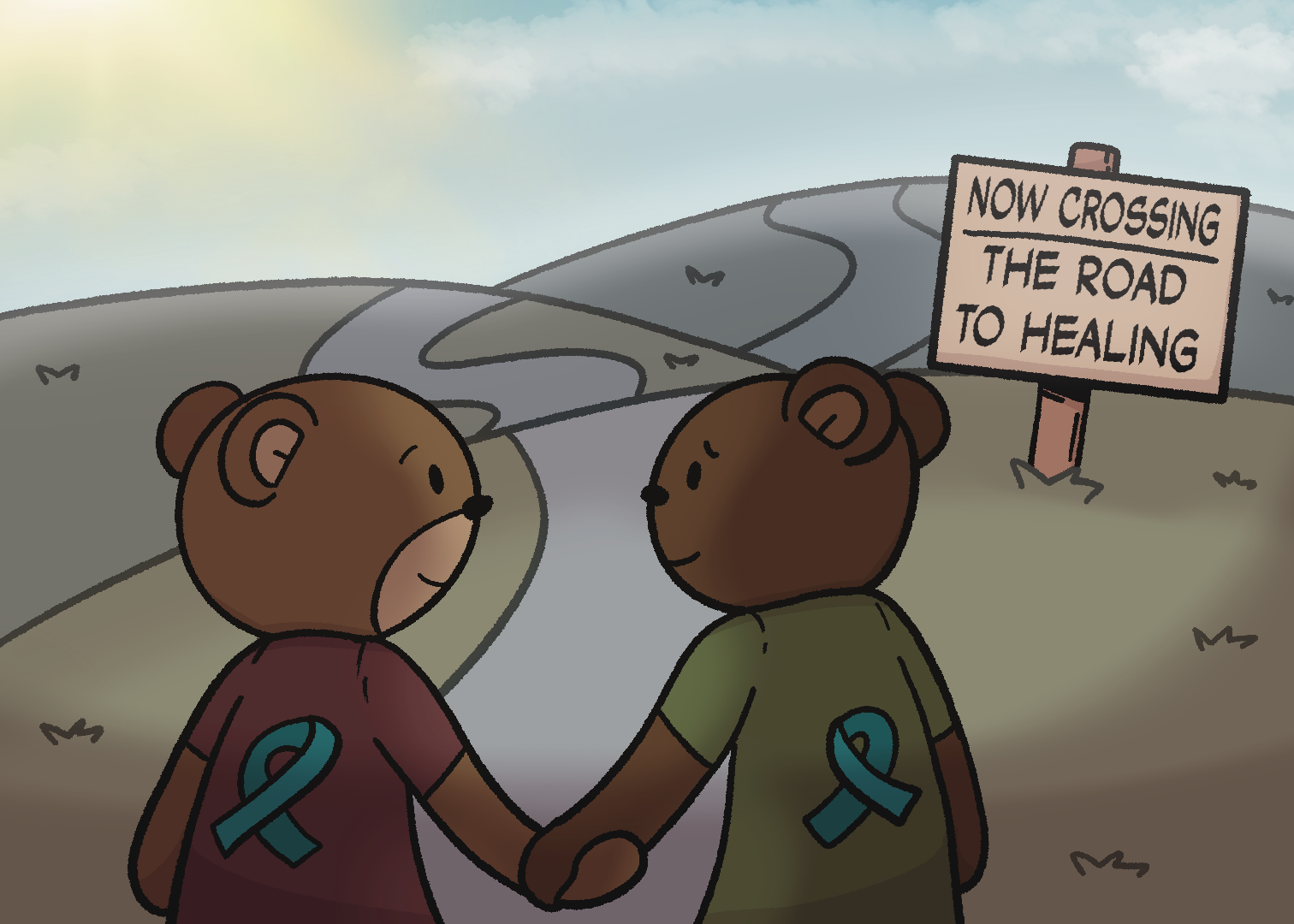
The fountain glows blue in honor of Sexual Assault Awareness Month, but more importantly, it glows for those who have had everything taken from them.
It glows for those terrified to report, for those who wanted to protect those who wronged them and for those like me, who never really “got over it.”
“Don’t let it have power over you.”
I repeated this to myself as much as I heard it said to me. Yet power is a tricky thing. It can’t be given to you, bestowed upon you by an enchanted sword in fairy tales. But it can be taken by hands, minds and bodies consumed by lust and greed.
I told myself that what happened to me only had power if I allowed it to, but in reality, it held power because it stole mine.
It’s hard to come to terms with loss. I was once a young girl who viewed the world with wide-eyed wonder and was unafraid because she had no reason to be. There was once a time when the only thing that had touched me without my permission was the ocean waves.
I’ll never get over the loss of that girl. If it’s true that there’s nothing more powerful than hope, then she had all the power in the world.
As women, we’re often told that beauty is power. We’re told that “power” is having eyes linger on your backside as you walk past, like vultures circling a dying animal. We’re told that we should reframe lust as power to take back control from a world that celebrates sexuality yet punishes empowerment.
The piece of meat that sits behind the glass at the butcher’s is not powerful simply because it is stared at hungrily. In that same way, power becomes a deformation of righteous benevolence. A gentle hand becomes a muzzling one — clamped over a trembling mouth.
When discussions arise around sexual assault, most already have what is usually referred to as a “perfect victim” in their eyes. There’s a certain nuance that often arises when religion enters the conversation, and it’s what kept me shackled with shame.
For years, the shame I felt sitting in the Lord’s house, trapped inside a body defiled, was all-consuming. As my innocence was stolen, my relationship with God paid the price.
In my experience, shame and anger often go hand in hand. Most days, I was so angry at God for allowing that to happen to me. I couldn’t understand how something so vile could be a part of his plan. But mostly, I was angry that the body he created was tarnished.
I had to accept that I was cursed. Not just with memories that would shake me awake in tears, but to spend the rest of my life living inside a body that no longer belonged to God or me.
There are some harsh truths for you to come to terms with to heal. They are non-negotiable, and they are from the heart of someone who knows what it’s like to shy away from the touch of others.
There will be no linear path. Scrubbing your skin raw in the shower will not erase what happened. The worldly distractions you chase will not drown out the feeling of loss. You cannot combat suffering with omission — you have to feel it to heal it.
One day, you’ll look up and realize the world has passed you by, and that, even though you’re not physically in that memory, you never really left it. You cannot expect to wash yourself clean when you’re afraid of standing under the hot water.
Embracing and accepting what happened doesn’t always set you free; more often than not, we are willing prisoners to our own suffering.
That’s how we often misconstrue power. A constant tug-of-war battle between you and that memory isn’t you taking power back from the person who stole it in the first place — it’s taking it away from the person you are today.
What happened to you doesn’t define you, but it does shape you. You have a choice to be stuck in that room forever or to become a person they never touched, never stole from and never had power over.
One day, you’ll feel the sun warm on your face and realize you aren’t still trapped in that room. You will relax in the arms of your close friends and hug your father, and you’ll finally realize that taking power back isn’t done through the same violence that took it in the first place — it’s allowing yourself to live again.
My favorite color isn’t blue anymore. It’s green, like the wide-open fields in the West and the leaves of trees that sweep the world. I’m not 12 years old anymore, and I’m not a perfect victim.
For those who resonate with blue lights this month, I wish you nothing but healing and peace. Hopefully, my story has encouraged you to find hope in loss and power in prayer.
If nothing else, maybe knowing you aren’t alone is enough.
Wherever you are in your healing process, whether it’s shame or anger or somewhere in between, I encourage you to feel it. If you can feel pain, you can also feel all the wonderful joys of being alive — and what an incredible blessing that is.
The hands of strangers do not have power over you, but the hands of the Lord do. His hands are the soft and gentle deliverance of divinity — and that is what true power is. Be gentle with yourself. Most times, our God’s gentle touch is so light we are numb to it entirely.
I am not dirty. Neither are you. John 15 reminds us that we are already clean because of the words God has spoken to us, and what a miracle it is to bask in that power. Perhaps you and I have felt unclean because we were deaf to his word and numb to his touch.
It was when I stopped trying to scrub my skin away that I felt the cleanest. We often lose ourselves in the glorification of unfeeling, and it’s in that trap of emotional anesthetic that we lose God, too.
Whatever the case may be, and whatever your story might say, there is freedom in feeling and power in peace. You are loved, and you are already clean. What’s stopping you from feeling it?
Letter from the editor: If you are a victim of sexual assault, Baylor has resources available. Anonymous reports can be made through the Title IX website.