


By Kalena Reynolds | Arts & Life Editor
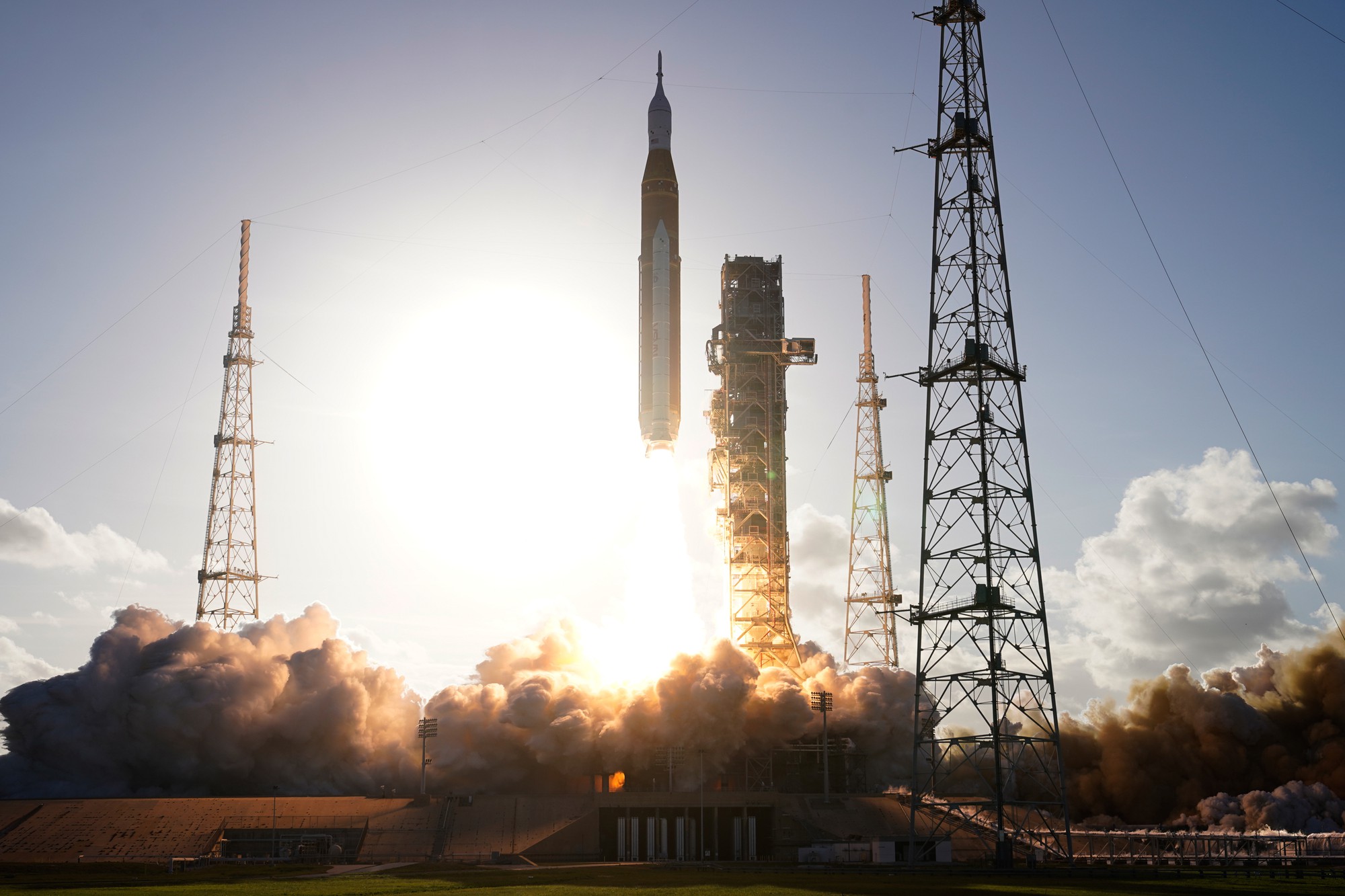
Four NASA astronauts have set out on a trip around the moon and back. The Artemis II mission occurs just over 50 years after the last moon expedition with the goal of creating a space station where astronauts could stay for an extended period of time.
The trip is set to be the farthest point that humans have ever traveled away from Earth, according to Dr. Benjamin Rose, assistant professor in the physics and astronomy department.
Rose also said this is the second Artemis launch.
“One of the other things that’s really interesting and difficult and increased risk is this is called Artemis II because it’s the second launch of this system,” Rose said. “There’s a lot of new pieces here. The space launch system, the rocket, has very few flights. The Orion crew capsule has been in space once before with people in it.”
Dr. Lorin Matthews, the physics and astronomy department chair, said one of the main challenges in this process is obtaining access to water. Because of this, NASA has set out to explore the lunar south pole to research the possibility of harvesting the material.
“They think that there is frozen water in the lunar regolith, so that is the soil of the moon,” Matthews said.
Rose said the lunar south pole is a very different region from the areas that have been explored on the moon before.
“The region looks like it has ice in the shadows there, water ice, and so that is sort of new material and new planet formation material,” Rose said.
As part of the process, NASA is also exploring alternatives to building materials.
“For every pound of material that you take up into space, you have to use ‘X’ number of pounds of fuel,” Matthews said. “So it is very expensive to get things up into space. If you’re going to build a habitat, you don’t really want to have to take bricks and mortar or glass … So they would like to be able to develop something where they could use the lunar regolith and actually use that to make solid building material.”
To build a sustainable space station, Matthews said accurately predicting radiation levels is crucial to astronaut safety.
“We do have space weather, and they can predict solar flares coming to Earth,” Matthews said.
To utilize these predictions, Matthews elaborated that, to craft a habitat on the moon, NASA must build a special room for radiation protection.
“They’ll have to go get in a little shielded, safe room that has extra thick shielding to shield them from the radiation,” Matthews said.
Matthews added that the habitat must withstand a wide range of temperatures as the moon shifts from hot to cold, depending on whether it’s facing the sun.
Above all else, Matthews said that NASA must answer the questions of how to supply air to the habitat. A problem related to dust particles, which Matthews has been researching since her undergraduate degree at Baylor.
“The thing that’s related to my research is that the moon’s surface is very dusty, and I study dusty plasmas, which is how dust charges up when it’s exposed to plasma,” Matthews said.
Matthews clarified that plasma is an ionized gas and that dust particles, aka lunar dust, can also become charged if exposed to rain.
Matthews said the dust particles on the moon are very sharp and sticky.
These dust particles are closer to minuscule glass shards, according to NASA.
“As learned from the history of the mining industry, breathing in rock dust daily over years can affect lung health and function,” according to an article by NASA. “While the full health effects of inhaling lunar dust are not yet known, NASA’s Apollo astronauts reported sneezing and nasal congestion after breathing in the regolith that clung to their spacesuits and made it inside their spacecraft.”
With this in mind, Matthews emphasized the true risks of this space venture.
“You have no atmosphere,” Matthews said. “You can’t breathe. The dust is going to kill you. The radiation is going to kill you.”
While the risks are high, according to Matthews, the moon is the most applicable option for a space habitat given the travel time. Matthews said it takes about three days to reach the moon, compared to the next best option — Mars — which would be a two-year trip.
“If we got to Mars, it would be a lot of the same problems,” Matthews said. “There’s not a magnetic field on Mars anymore. It does have an atmosphere, but, of course, not one you can breathe. You do have temperature extremes. It’s also very dusty.”
