


By Alexandra Brewer | Arts & Life Writer
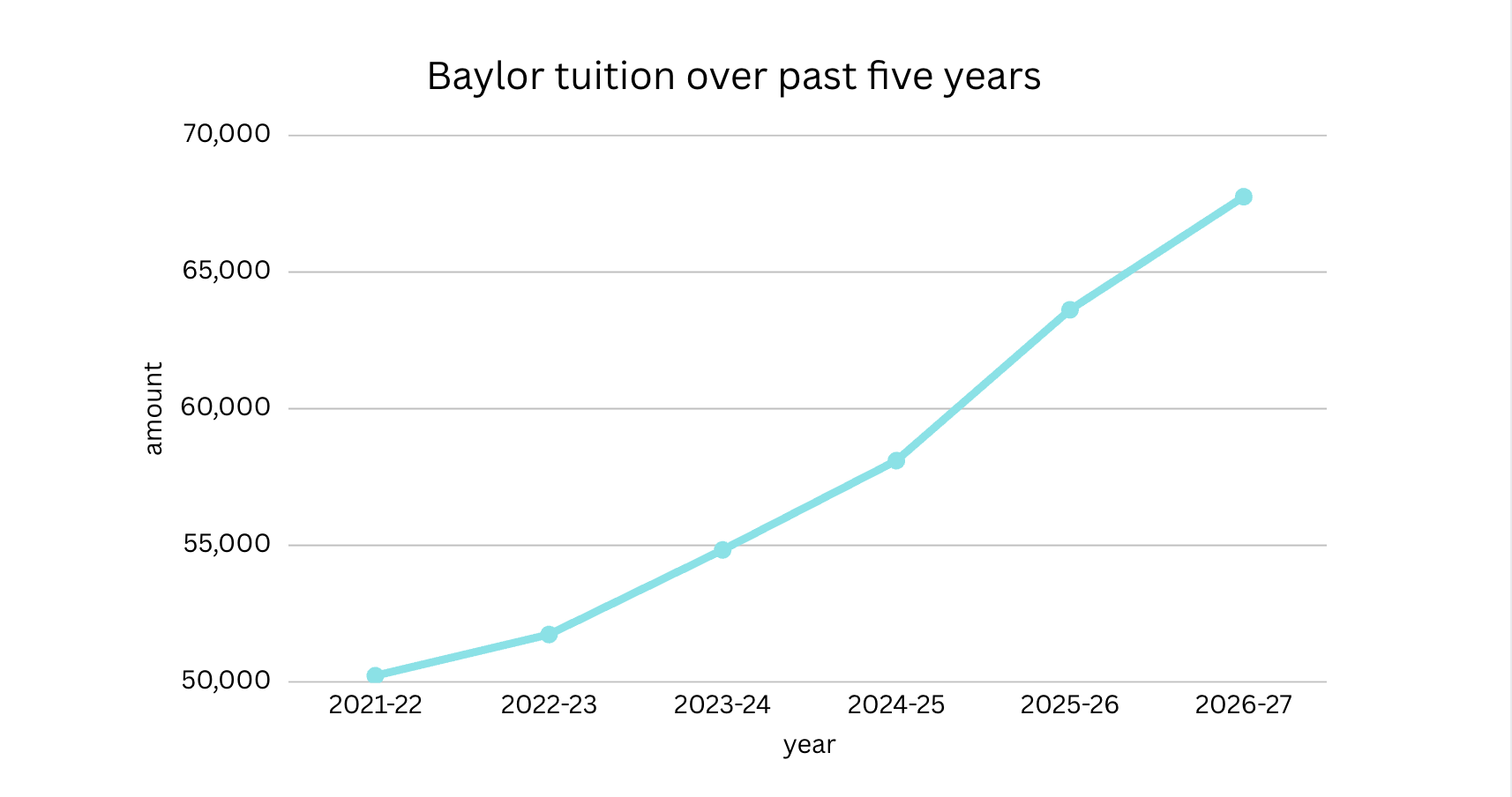
Baylor’s tuition has risen 44.53% over the past decade, and the university’s most recent increase has drawn reactions from students and families about affordability and transparency.
The Baylor Board of Regents approved tuition and fees for the 2026‑27 academic year on Feb. 20, including another increase that will raise the sticker price from $63,620 to $67,756 for undergraduate tuition and fees. The board emphasized scholarship support and financial aid measures designed to help students manage the increase, including expanding need‑based aid and continuing programs like the Baylor Benefit Scholarship.
For Fort Worth junior Summer Leiter, who pays for college without parental support, said the increase has big implications.
“Because I’m paying for college on my own, that is a big deal,” Leiter said.
She works on campus as a community leader at Brooks College, relying on her wages along with financial aid to cover tuition. With the tuition increase, Leiter faces a problem.
“I might have to get a second job,” Leiter said.
Though Leiter said more going on behind the scenes might require the increase, rising tuition affects students in ways administrators don’t see.
“I’m sure nobody’s super happy about it, but I think that it does impact people more than the people on top realize,” she said.
The increase in tuition doesn’t just affect those who pay their own, though. Leiter also described a recent example of a student on a five-day meal plan who couldn’t afford weekend meals and had asked Leiter to swipe her into the dining hall.
“I was talking with one of my friends over the weekend who had a five-day meal plan who was like, ‘I don’t have money to get food on the weekends,’” Leiter said.
The rising cost of tuition masks a deeper truth — living and learning at a private university strains students in ways the tuition price doesn’t show.
“It’s really easy to think if you can afford Baylor, then you can afford to live well while you’re at Baylor,” Leiter said. “But I know a lot of people sacrifice everything in order to go to school here.”
Omaha, Neb., sophomore Kayli Hartzell said she was concerned about the lack of communication before the tuition increase.
“I come from a split household, so finances are already kind of hard,” Hartzell said. “It was just a little concerning with how much of an increase and how little talk there was about it before.”
Hartzell added that continual increases in tuition are unsustainable, and she wouldn’t be surprised if Baylor loses students because of it.
Paso Robles, Calif., freshman Quinn John highlighted the broader consequences for future students. If tuition continues to increase, John said eventually students and parents will stop being willing to pay it.
“This could definitely be a make it or break it type of thing,” John said. “Whether it increases, meeting the threshold of people that are like, ‘That’s too much. We can’t go here.’”
Some families said they anticipated the increase. Benjamin Lacy, whose daughter attends Baylor, said he was not surprised by the news since many colleges are increasing tuition. Though Lacy put money aside for his daughter’s college years ago, the tuition increase required another review of his finances.
“We did the math back years ago and put away some money for college,” Lacy said. “We had it divided up over four years, so we had to go back and recheck that we were going to be able to continue to afford the full tuition bill.”
Lacy noted that communication from the university could be improved. At the same time, he praised the university’s educational quality.
“I would reiterate that we’re very happy with the education that’s being provided. I think Baylor does a great job of that,” Lacy said.
Financial data from Baylor provides context for the increase. Operating expenses in fiscal year 2025 rose by $77 million, a 7.8% increase from the 2024 fiscal year. The largest portion — $21.9 million, a 5.5% increase — went to salaries and wages for faculty and staff, driven by investments in research personnel and cost-of-living adjustments. Personnel benefits also increased 6.9% due to higher salaries.
Operating expenditures rose by $31.2 million, or 9%, primarily due to a change in the dining contract to a cost-plus structure, though much of this is offset by higher auxiliary revenues. Depreciation increased $10.1 million, or 15.2%, due to major capital projects placed in service. Salaries and wages now make up 39% of total operating expenses.
Despite the financial rationale, students said rising tuition has real-world consequences.
“How many 18-year-olds coming out of high school do you know that actually understand loans and fees and all of those things?” Leiter said. “People are sending their lives away, and they don’t even realize it.”

