By Mackenzie Grizzard | Assistant News Editor
Half a century ago, Baylor Homecoming celebrations included barricade kissing, snake dancing and “Hawny Frog” skits, trading elaborate floats for simple wagons and buggies. Today, much like 1909, the bonfire still burns bright, a pep rally flings green and gold afar, the parade bridges downtown Waco and campus and, of course, the football game is a staple. Decades of Baylor Homecoming shine brightly in their similarities, with some crown jewels fading into the archives.
Dr. Elizabeth Rivera, university archivist for Baylor’s Texas Collection, has seen many changes in Baylor’s rich homecoming traditions throughout the years, with just a few constants.
“So it’s the bonfire, the pep rally, the parade and the football game that are all present in 1909,” Rivera said. “And all four of those are consistent today.”
Baylor is now formally recognized for holding the nation’s first collegiate homecoming celebration in 1909, as well as the first-ever bonfire and first-ever snake dance, which, according to Rivera, served as a sort of “conga line” around the blaze.
“In 1915, they did the weird snake dance too,” Rivera said.
Between football games, Baylor boys went through a “tortuous” snake dance in the middle of the field to the accompaniment of the Alessandro and Baylor bands, according to the Baylor University Archives.
The Athletic Rally before the 1920s also included the snake dance to the playing of gongs, rattles and shouting from all men in attendance, namely lawyers and preachers. In the dance, participants would form a line to mimic a snake in a competitive, synchronized march across the field.
The snake dance seems to have phased out by the 1920s, and several other traditions began to steal the homecoming limelight, including plays, recitals and the famous barricade kissing.
In 1931 and 1933, the homecoming football matchup was against TCU, and the rivalry was the creation of the “Story of Hawny Frog.” The skit consisted of a horned frog that rides into Bruiser’s den, where a battle between the two mascots ensues. According to Rivera, the skit involved an “uncle” character for additional humor.
“It’s also fitting when you think about that they didn’t have social media the way you all have,” Rivera said. “So that’s a way not only to connect with people, but it’s also entertainment.”
“The Story of Hawny Frog” was also recreated in 1935, where a stage play depicting the creation of Baylor with Judge Baylor and W.M. Tryon also took place.
Flashing forward to the 1940s, a kissing tradition took root on Baylor’s campus. To protect Baylor from vandalism by rival schools, freshmen were tasked to guard the bonfire and the rest of the campus for the five nights leading up to the game.
By the 60s and 70s, kissing had become an integral part of this tradition, with a Lariat article from 1974 describing the barricade custom.
“The procedure for guarding the campus is to stop each car as it passes through campus,” The article reads. “If a Baylor student or ex-student will not kiss his date, his date must kiss each keeper of the barricade.”
According to the archives, the kissing barricades seem to phase out by the 80s, but the bonfire tradition remains as strong and bright as ever.
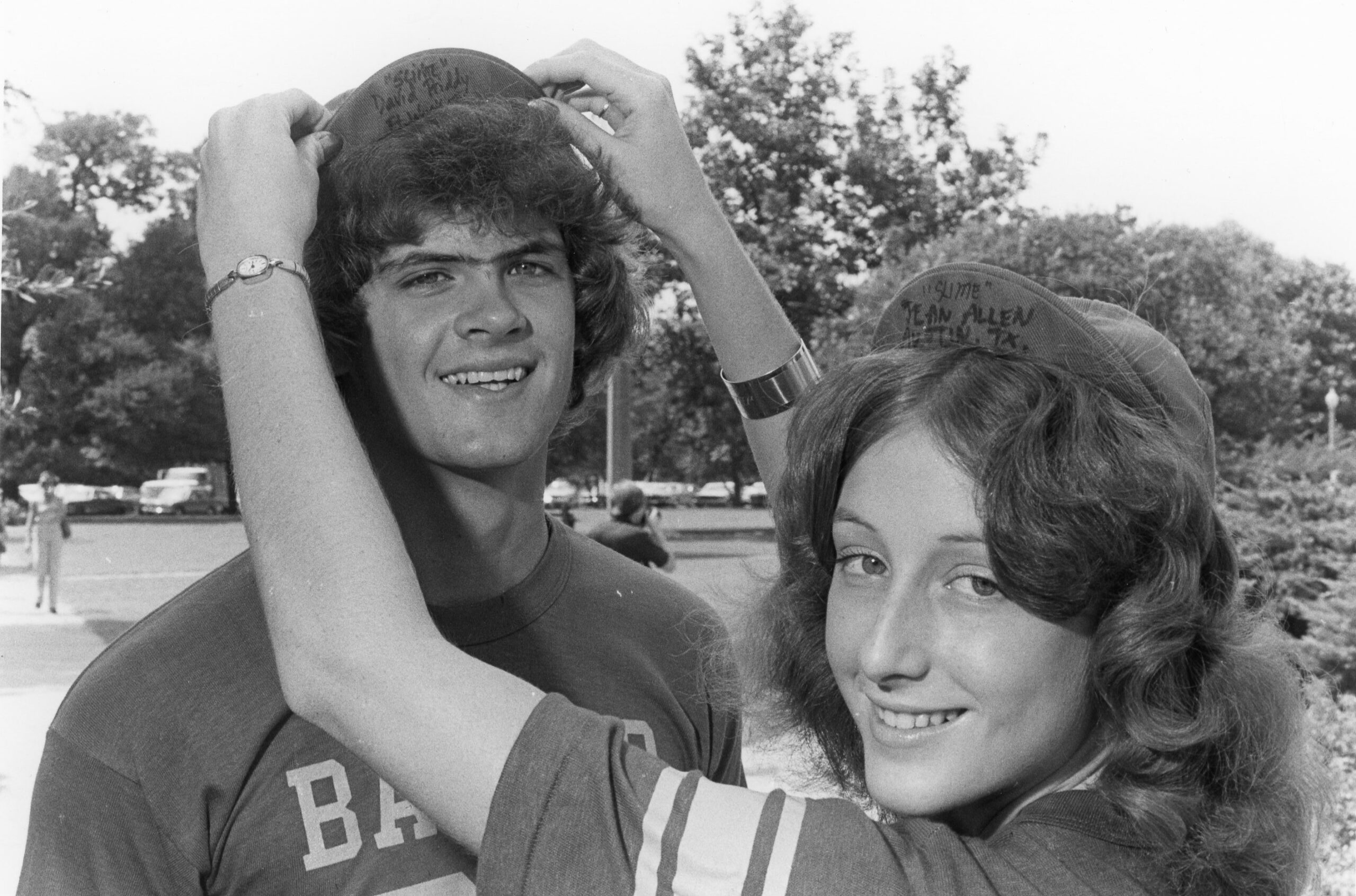
A tradition that might be more familiar to current students is the Baylor “slime caps,” small-billed baseball caps freshmen must wear until homecoming. This eventually transitioned to being worn only on the first day of school and is now handed out to freshmen as they sign the line at McLane Stadium.
Hallsville freshman Hudson Daub, one of Rivera’s student researchers, said learning about Baylor’s traditions throughout the years has helped him feel closer to the university as a whole.
“Sometimes it’s easy for me to think of Baylor as just a school I go to, but this research has reframed that mindset,” Daub said. “Baylor has an expansive and rich culture that comes packaged with experience. Being a student at Baylor means being a part of a community that is both past, present and future.”
As traditions change and time passes, Rivera reminded students that being a part of homecoming is being part of history and the next generation.
“I think for me, what stands out with all of this is that humans don’t change,” Rivera said. “It’s the need for connection and the way people feel seen and heard through their creative works. Whether it’s the floats or the football players performing or if it’s the bonfire, it’s just a time to gather with people.”