

Close Menu
The Baylor Lariat
    Facebook X (Twitter) Instagram YouTube LinkedIn
    Trending
    • Board of Regents approves nearly $1 billion operating budget, new AI-centered master’s degree
    • Foster Pavilion to host rising country star Braxton Keith
    • Dog days: Q&A with Wacoan that built hot dog social media brand
    • Country legend Willie Nelson returns after 72 years for night of harmonies, hits
    • Students react to ‘very stressful’ Canvas outage ahead of finals
    • Canvas access to be restored, Friday finals moved to online Thursday
    • Baylor delays finals as nationwide Canvas outage impedes studying
    • SLIDESHOW: IM Claw Cup Championship
    • About us
      • Spring 2026 Staff Page
      • Copyright Information
    • Contact
      • Contact Information
      • Letters to the Editor
      • Subscribe to The Morning Buzz
      • Department of Student Media
    • Employment
    • PDF Archives
    • RSS Feeds
    Facebook X (Twitter) Instagram YouTube LinkedIn
    The Baylor LariatThe Baylor Lariat
    Subscribe to the Morning Buzz
    Tuesday, June 9
    • News
      • State and National News
        • State
        • National
      • Politics
        • 2025 Inauguration Page
        • Election Page
      • Homecoming 2025
      • Baylor News
      • Waco Updates
      • Campus and Waco Crime
    • Arts & Life
      • Wedding Edition 2025
      • What to Do in Waco
      • Campus Culture
      • Indy and Belle
      • Leisure and Travel
        • Leisure
        • Travel
          • Baylor in Ireland
      • Student Spotlight
      • Local Scene
        • Small Businesses
        • Social Media
      • Arts and Entertainment
        • Art
        • Fashion
        • Food
        • Literature
        • Music
        • Film and Television
    • Opinion
      • Editorials
      • Points of View
      • Lariat Letters
    • Sports
      • Football
      • Basketball
        • March Madness 2026
        • Men’s Basketball
        • Women’s Basketball
      • Soccer
      • Baseball
      • Softball
      • Volleyball
      • Equestrian
      • Cross Country and Track & Field
      • Acrobatics & Tumbling
      • Tennis
      • Golf
      • Pro Sports
      • Sports Takes
      • Club Sports
    • Lariat TV News
    • Multimedia
      • Video Features
      • Podcasts
        • Don’t Feed the Bears
        • Bear Newscessities
      • Slideshows
    • Sing 2026
    • Lariat 125
    • Advertising
    The Baylor Lariat
    Home»News»International

    Ancient scrolls discovered, deciphered by scientists

    webmasterBy webmasterJanuary 22, 2015 International No Comments3 Mins Read
    Share
    Facebook Twitter LinkedIn Pinterest Email
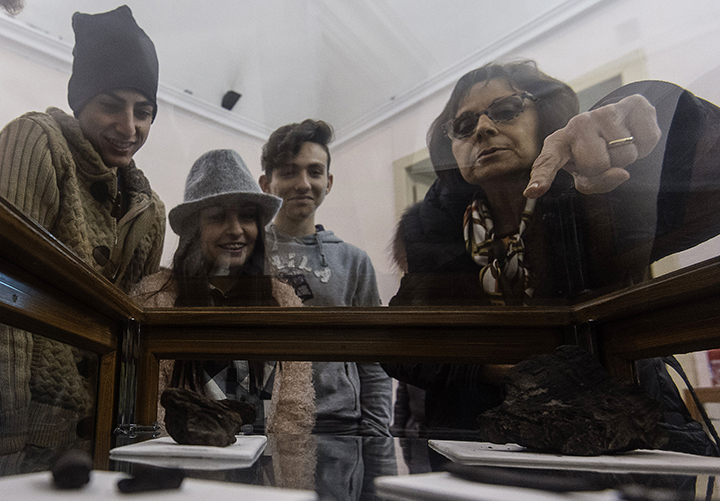
    Visitors look at ancient scrolls completely covered in blazing-hot volcanic material at the Naples' National Library, Italy, Jan. 20, 2015. Scientists have succeeded in reading parts of an ancient scroll that was buried in a volcanic eruption almost 2,000 years ago, holding out the promise that the world's oldest surviving library may one day reveal all of its secrets. The scroll is among hundreds retrieved from the remains of a lavish villa at Herculaneum, which along with Pompeii was one of several Roman towns that were destroyed when Mt. Vesuvius erupted in A.D. 79. (AP Photo/Salvatore Laporta)
    Visitors look at ancient scrolls completely covered in blazing-hot volcanic material at the Naples’ National Library, Italy, Jan. 20, 2015. Scientists have succeeded in reading parts of an ancient scroll that was buried in a volcanic eruption almost 2,000 years ago, holding out the promise that the world’s oldest surviving library may one day reveal all of its secrets. The scroll is among hundreds retrieved from the remains of a lavish villa at Herculaneum, which along with Pompeii was one of several Roman towns that were destroyed when Mt. Vesuvius erupted in A.D. 79. (AP Photo/Salvatore Laporta)

    By Frank Jordans
    Associated Press

    BERLIN — Scientists have succeeded in reading parts of an ancient scroll that was buried in a volcanic eruption almost 2,000 years ago, holding out the promise that the world’s oldest surviving library may one day reveal all of its secrets.

    The scroll is among hundreds retrieved from the remains of a lavish villa at Herculaneum, which along with Pompeii was one of several Roman towns that were destroyed when Mt. Vesuvius erupted in A.D. 79.

    Some of the texts from what is called the Villa of the Papyri have been deciphered since they were discovered in the 1750s. But many more remain a mystery to science because they were so badly damaged that unrolling the papyrus they were written on would have destroyed them completely.

    “The papyri were completely covered in blazing-hot volcanic material,” said Vito Mocella, a theoretical scientist at the Institute of Microelectronics and Microsystems (CNR) in Naples who led the latest project.

    Previous attempts to peer inside the scrolls failed to yield any readable texts because the ink used in ancient times was made from a mixture of charcoal and gum. This makes it indistinguishable from the burned papyrus.

    Mocella and his colleagues decided to try a method called X-ray phase contrast tomography that had previously been used to examine fossils without damaging them.

    Phase contrast tomography takes advantage of subtle differences in the way radiation — such as X-rays — passes through different substances, in this case papyrus and ink.

    Using lab time at the European Synchrotron Radiation Facility in Grenoble, France, the researchers found they were able to decipher several letters, proving that the method could be used to read what’s hidden inside the scrolls.

    “Our goal was to show that the technique is sensitive to the writing,” said Mocella. In a further step, the scientists compared the handwriting to that of other texts, allowing them to conclude that it was likely the work of Philodemus, a poet and Epicurean philosopher who died about a century before the volcanic eruption.

    The next challenge will be to automate the laborious process of scanning the charred lumps of papyrus and deciphering the texts inside them, so that some 700 further scrolls stored in Naples can be read, Mocella said.

    Scholars studying the Herculaneum texts say the new technique, which was detailed in an article published Tuesday in the journal Nature Communications, may well mark a breakthrough for their efforts to unlock the ancient philosophical ideas hidden from view for almost two millennia.


    ancient texts Mt. Vesuvius Papyri
    webmaster

    Keep Reading

    Board of Regents approves nearly $1 billion operating budget, new AI-centered master’s degree

    Foster Pavilion to host rising country star Braxton Keith

    Students react to ‘very stressful’ Canvas outage ahead of finals

    Canvas access to be restored, Friday finals moved to online Thursday

    Baylor delays finals as nationwide Canvas outage impedes studying

    Student research findings emphasize importance of deep friendships

    Add A Comment

    Comments are closed.

    Recent Posts
    • Board of Regents approves nearly $1 billion operating budget, new AI-centered master’s degree May 21, 2026
    • Foster Pavilion to host rising country star Braxton Keith May 20, 2026
    About

    The award-winning student newspaper of Baylor University since 1900.

    Articles, photos, and other works by staff of The Baylor Lariat are Copyright © Baylor® University. All rights reserved.

    Subscribe to the Morning Buzz

    Get the latest Lariat News by just Clicking Subscribe!

    Follow the Live Coverage
    Tweets by @bulariat

    Facebook X (Twitter) Instagram YouTube LinkedIn
    • Featured
    • News
    • Sports
    • Opinion
    • Arts and Life
    © 2026 ThemeSphere. Designed by ThemeSphere.

    Type above and press Enter to search. Press Esc to cancel.