

Close Menu
The Baylor Lariat
    Facebook X (Twitter) Instagram YouTube LinkedIn
    Trending
    • Surviving the Arctic: Baylor’s ARKTOS Research Center completes Phase 1
    • Holocaust exhibit at Jones Library confronts American history
    • Baylor alumnus debuts Texas-centric nature documentaries
    • Candlebox, Fastball to perform at free Brazos Night concert
    • 7 Brew draws crowd for Waco opening
    • Sison Tacos introduces run club for Waco community
    • Baylor wide receiver room gears up for eye-catching fall season
    • Bringing faith to business: Baylor senior finds purpose through mission work
    • About us
      • Spring 2026 Staff Page
      • Copyright Information
    • Contact
      • Contact Information
      • Letters to the Editor
      • Subscribe to The Morning Buzz
      • Department of Student Media
    • Employment
    • PDF Archives
    • RSS Feeds
    Facebook X (Twitter) Instagram YouTube LinkedIn
    The Baylor LariatThe Baylor Lariat
    Subscribe to the Morning Buzz
    Tuesday, April 14
    • News
      • State and National News
        • State
        • National
      • Politics
        • 2025 Inauguration Page
        • Election Page
      • Homecoming 2025
      • Baylor News
      • Waco Updates
      • Campus and Waco Crime
    • Arts & Life
      • Wedding Edition 2025
      • What to Do in Waco
      • Campus Culture
      • Indy and Belle
      • Leisure and Travel
        • Leisure
        • Travel
          • Baylor in Ireland
      • Student Spotlight
      • Local Scene
        • Small Businesses
        • Social Media
      • Arts and Entertainment
        • Art
        • Fashion
        • Food
        • Literature
        • Music
        • Film and Television
    • Opinion
      • Editorials
      • Points of View
      • Lariat Letters
    • Sports
      • Football
      • Basketball
        • March Madness 2026
        • Men’s Basketball
        • Women’s Basketball
      • Soccer
      • Baseball
      • Softball
      • Volleyball
      • Equestrian
      • Cross Country and Track & Field
      • Acrobatics & Tumbling
      • Tennis
      • Golf
      • Pro Sports
      • Sports Takes
      • Club Sports
    • Lariat TV News
    • Multimedia
      • Video Features
      • Podcasts
        • Don’t Feed the Bears
        • Bear Newscessities
      • Slideshows
    • Sing 2026
    • Lariat 125
    • Advertising
    The Baylor Lariat
    Home»Featured

    Air Force general: Actions aim to deter NKorea

    webmasterBy webmasterApril 11, 2013 Featured No Comments4 Mins Read
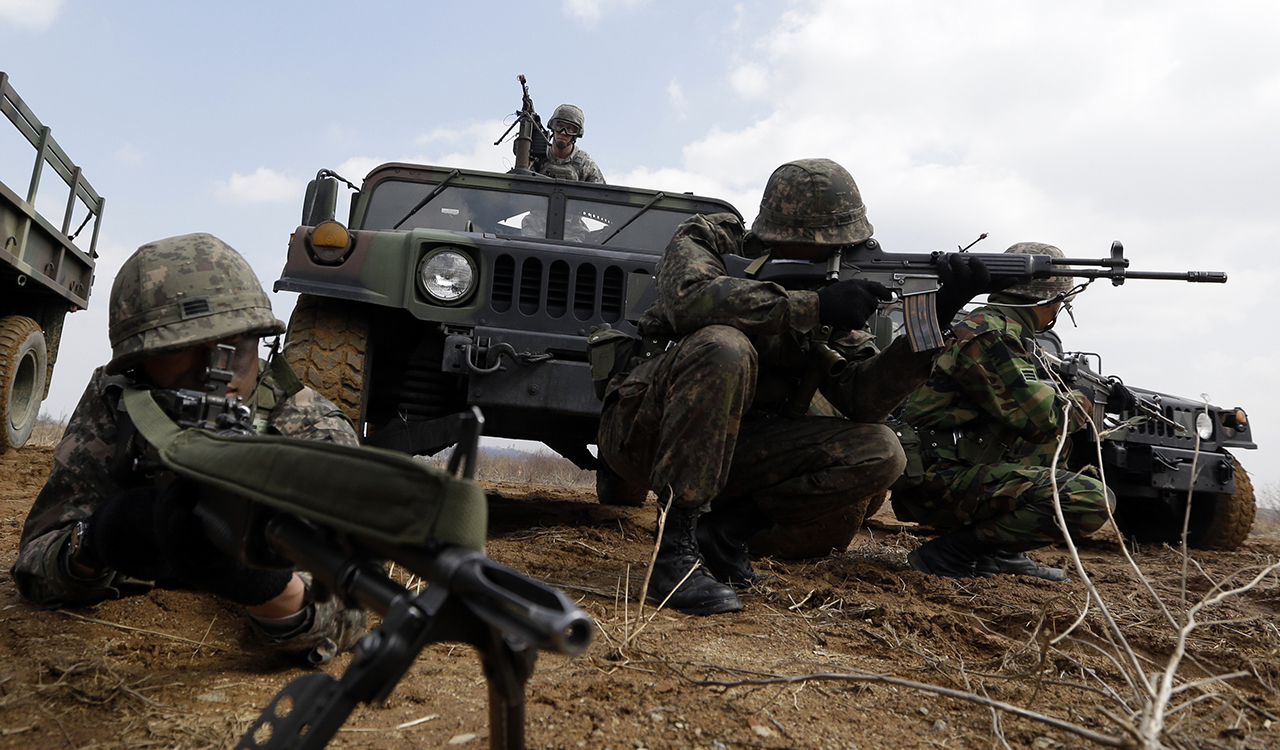
    South Korean Army soldiers aim their machine guns, along with U.S. Air Force's Airman First Class, Lee Simpson from Sportanburg, South Carolina, top on a humvee, during a joint military drill between South Korea and the United States to protect U.S. air base near the Osan U.S. Air Base in Pyeongtaek, south of Seoul, South Korea, Thursday, March 14, 2013. In recent days, North Korea has vowed "merciless" retaliation and said it will no longer abide by the armistice that ended the Korean War. Pyongyang is angry about ongoing U.S.-South Korean military drills and about new U.N. sanctions, issued over the North's December long-range rocket launch, which the U.N. called a cover for a banned missile test, and its third underground nuclear explosion, conducted Feb. 12. (AP Photo/Lee Jin-man)
    Share
    Facebook Twitter LinkedIn Pinterest Email

    South Korean Army soldiers aim their machine guns, along with U.S. Air Force's Airman First Class, Lee Simpson from Sportanburg, South Carolina, top on a humvee, during a joint military drill between South Korea and the United States to protect U.S. air base near the Osan U.S. Air Base in Pyeongtaek, south of Seoul, South Korea, Thursday, March 14, 2013.  In recent days, North Korea has vowed "merciless" retaliation and said it will no longer abide by the armistice that ended the Korean War. Pyongyang is angry about ongoing U.S.-South Korean military drills and about new U.N. sanctions, issued over the North's December long-range rocket launch, which the U.N. called a cover for a banned missile test, and its third underground nuclear explosion, conducted Feb. 12. (AP Photo/Lee Jin-man)
    South Korean Army soldiers aim their machine guns, along with U.S. Air Force’s Airman First Class, Lee Simpson from Sportanburg, South Carolina, top on a humvee, during a joint military drill between South Korea and the United States to protect U.S. air base near the Osan U.S. Air Base in Pyeongtaek, south of Seoul, South Korea, Thursday, March 14, 2013. In recent days, North Korea has vowed “merciless” retaliation and said it will no longer abide by the armistice that ended the Korean War. Pyongyang is angry about ongoing U.S.-South Korean military drills and about new U.N. sanctions, issued over the North’s December long-range rocket launch, which the U.N. called a cover for a banned missile test, and its third underground nuclear explosion, conducted Feb. 12. (AP Photo/Lee Jin-man)
    By Audrey McAvoy
    Associated Press

    JOINT BASE PEARL HARBOR-HICKAM, Hawaii — The United States sent its most powerful airplanes to the Korean peninsula in recent weeks in part because it wants North Korea to know what the American military is capable of doing, the top U.S. Air Force commander in the Pacific said.

    B-2 stealth bombers, F-22 stealth fighters and B-52 bombers have recently all flown to South Korea for exercises or short deployments in what amounted to a dramatic display of U.S. air power. The stealth planes are capable of sneaking past radar undetected. B-2 and B-52 bombers are capable of delivering nuclear weapons.

    “Every morning that a potential adversary gets up and goes, ‘You know what, I’m not going to mess with America today’ — that’s a good morning,” Gen. Herbert Carlisle said Tuesday in an interview at his headquarters in Hawaii. “We need all those mornings to keep coming.”

    The U.S. is hoping a missile defense system it’s sending to Guam, a U.S. territory and strategically important military outpost 1,500 miles south of Tokyo, will have the same deterrent effect, he said.

    If “they know we got something that can knock down their missiles — it may stop them from shooting them,” Carlisle said.

    The U.S. has also explained it’s reassuring its allies by showing it’s prepared to defend them.

    The missile defense system — called Terminal High Altitude Area Defense — is designed to intercept missiles during their final stage of flight. It joins other technology the military has to intercept missiles during their initial and midflight phases.

    Carlisle said the U.S. also is considering sending high-altitude surveillance planes from Guam to Japan during the tropical island’s summer storm season. Often, typhoons and thunderstorms around Guam ground the Global Hawk drones from April through November. The planes would be less likely to face weather problems if they were flying out of a place like Misawa Air Base in northern Japan, Carlisle said.

    The U.S. uses the drones to monitor North Korea and could do so from Japan as well, Carlisle said.

    “They could do all the missions that they do now if they were flying out of Japanese bases,” he said.

    Tokyo is also considering buying some of the drones for its own use, Carlisle said.

    “We’re still working it with the Japanese government. I don’t know whether we’ll do it this year or not. It does cost money to do that, again that’s another factor. We’re still examining it and looking at how to make it happen. When we do it is another question,” he said.

    Cost is an issue as the Air Force copes with automatic federal budget cuts imposed when Congress failed to reach a deal to avert them.

    The Pacific is least affected among other parts of the Air Force because of the Obama administration’s emphasis on Asia and the Pacific and because of current tensions on the Korean peninsula. Even so, an F-16 squadron in Alaska — 18th Aggressor Squadron at Eielson Air Force Base— is being grounded along with others elsewhere in the country.

    Carlisle said the Air Force’s core activities — maintenance and operations — are disproportionately affected because the military lacks the flexibility to cut other spending.
    Congress didn’t allow the branch, for example, to cancel acquisitions programs even when they’re behind schedule or not meeting requirements, he said. It also can’t cut airmen salaries or health care coverage.

    On top of this, the Air Force is implementing a year’s worth of budget cuts in six months. That’s because the services were told Congress would come to an agreement to avoid the budget cuts and so the Air Force didn’t plan for them when the current fiscal year started in October.


    webmaster

    Keep Reading

    Surviving the Arctic: Baylor’s ARKTOS Research Center completes Phase 1

    Holocaust exhibit at Jones Library confronts American history

    Baylor alumnus debuts Texas-centric nature documentaries

    Bringing faith to business: Baylor senior finds purpose through mission work

    How we suffer from misplaced humility

    KSA Hanin Gala promotes unity across cultures

    Add A Comment

    Comments are closed.

    Recent Posts
    • Surviving the Arctic: Baylor’s ARKTOS Research Center completes Phase 1 April 14, 2026
    • Holocaust exhibit at Jones Library confronts American history April 13, 2026
    About

    The award-winning student newspaper of Baylor University since 1900.

    Articles, photos, and other works by staff of The Baylor Lariat are Copyright © Baylor® University. All rights reserved.

    Subscribe to the Morning Buzz

    Get the latest Lariat News by just Clicking Subscribe!

    Follow the Live Coverage
    Tweets by @bulariat

    Facebook X (Twitter) Instagram YouTube LinkedIn
    • Featured
    • News
    • Sports
    • Opinion
    • Arts and Life
    © 2026 ThemeSphere. Designed by ThemeSphere.

    Type above and press Enter to search. Press Esc to cancel.