 You open this door with the key of hunger; beyond it is another dimension. You find yourself sitting at a table surrounded by strangers.
You receive your meager plate of grilled chicken and mixed vegetables and turn to leave when the question comes.
“Will this be together or separate?”
You freeze. You know you shouldn’t have to pay as much as the lobster, but how much?
All of the calculus and algebra you’ve ever learned starts to slip through your head.
You slowly pull out a $20 bill, but one last piece of paper lays in front of you. Among the lines and numbers one word leaps out.
One horrible word — gratuity. You are about to enter: The Tipping Zone.
As anyone who can work in the service industry can tell you, college students don’t tip well.
There’s a variety of reasons for this — lack of finances included — but more and more often reasonable and intelligent people are struck dumb when it comes to simple math like calculating tips.
For the record, sales tax is 8.25 percent of the total. Double that and add a dollar (generally) and you have a pretty good tip.
Unfortunately, the math that we get the most of in college and the latter part of high school is not math that we use every day.
Advanced algebra, calculus and trigonometry all have their places in academia, but they’re rarely used in day-to-day life.
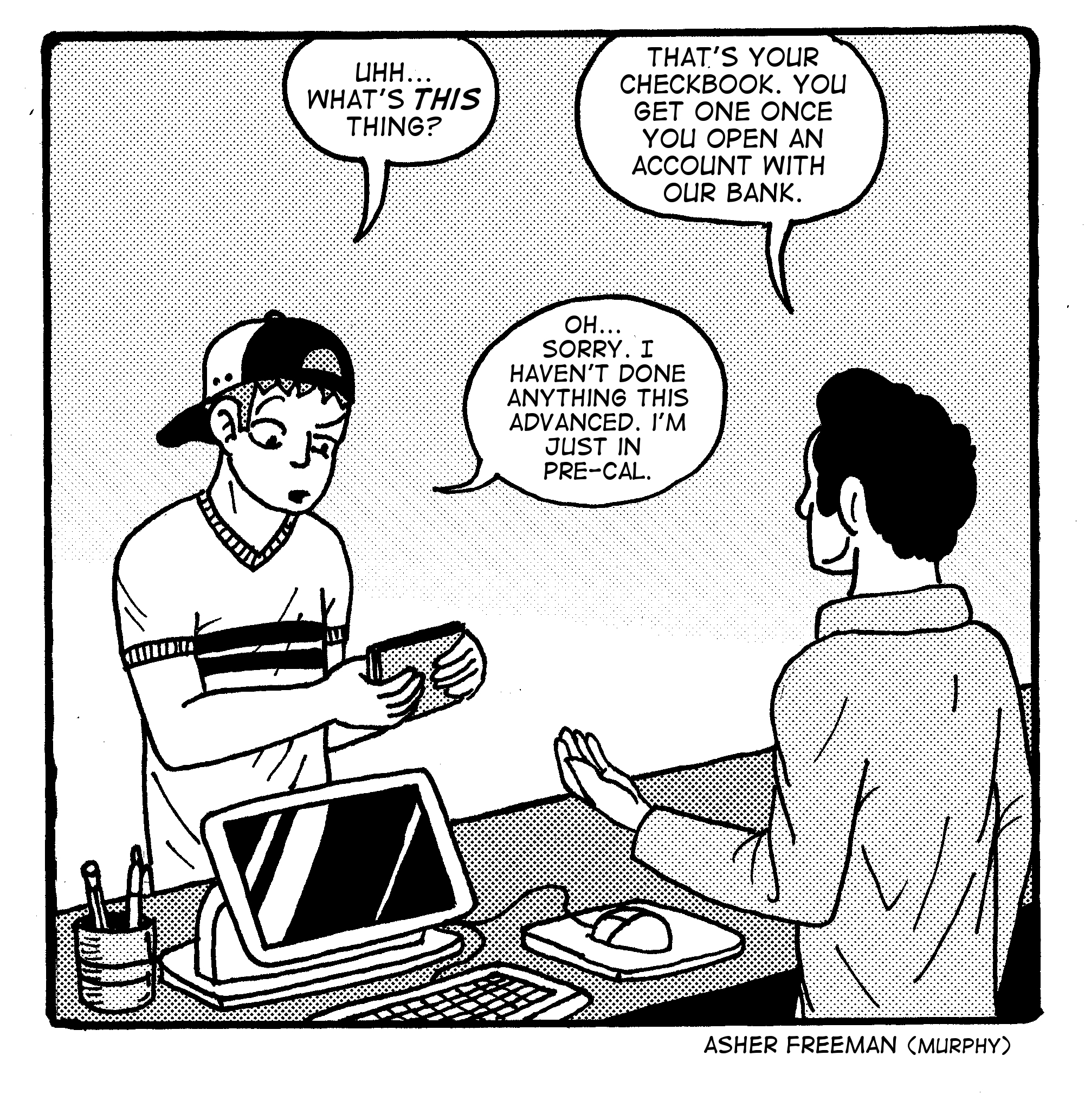
There is a math that we use, or should use, every day that helps us function in society — geometry, arithmetic, percentages, fractions, compound interest, balancing a checkbook, interpreting statistics, noticing patterns. In short, practical math.
Before we go any further, it’s important to note that we don’t think math should be done away with.
We just believe that to a large segment of the population practical math will be exponentially more beneficial than advanced calculus.
Plenty of people need advanced math, but many more — history majors, English majors, pre-law — don’t need it. What they do need is math that makes them a functional member of society. Again, practical math.
In addition to basic skills like balancing a checkbook and managing a budget, practical math education should focus on using math in critical thinking situations.
One great example is overall value. True, that pair of shoes is $10, but they will last you six months to a year at best.
It’s much smarter to buy the $60 pair of shoes and keep them for four to six years with maintenance.
Or, for example, that bag of pasta is cheaper overall, but this more expensive one is cheaper per ounce.
It’s a simple concept when you think about it, but it’s often overlooked.
Another benefit to a practical knowledge of math is that Internet rumors will be a lot less pervasive.
For example, a popular Internet trend is to compare the deaths of presidents Abraham Lincoln and John F. Kennedy — They were elected 100 years apart, they were both killed on a Friday, etc. etc.
When you apply practical math to the situation, you realize that most of this is so stupefyingly common that there’s really no coincidence at all.
The Friday deaths coincidence, for example, breaks down to a 1 in 7 chance.
President William McKinley and Kitty Genovese were both murdered on a Friday, but nobody talks about that.
Also when you realize presidential elections happen every four years, it’s obvious that there’s no extreme coincidence that two presidents were elected 100 years apart.
George Washington, Ulysses S. Grant and George H.W. Bush were all elected 100 years apart and they all served in the military.
Ergo it must be a conspiracy.
Another benefit of practical math is the ability to discern the accuracy of statistics.
Whenever you hear “nine out of 10 dentists agree,” a citizen armed with practical math can immediately discern that 10 is a tiny sample size.
That means that as a society we can start thinking a lot harder about polls and statistics.
For example, a commonly quoted statistic is “you’re more likely to get struck by lightning than attacked by a shark.” The intent is to contextualize the likelihood of a shark attack with another unlikely event — a lightning strike.
Strictly speaking this is true — the average American is far more likely to get struck by lightning than mauled by a shark.
When we apply a little practical math, however, we realize the true ridiculousness of this statement. There can be hundreds of lightning strikes in a single storm and scores of storms each year across the country.
Sharks are still restricted to bodies of water.
Hundreds of millions of Americans are near lightning strikes every year. Significantly fewer are around sharks.
For some people, being trampled by a zebra is far more likely, but a surfer with an open wound shouldn’t be worried most about lightning.
For too long, we have just accepted numbers that anyone spat at us. The ATM tells us we have this much money and we accept it.
A politician tells us a statistic that supports our views and we accept it.
There is no incentive to change this because for many, even basic math is a vast mystery.
This is unacceptable. This is something that as a society we cannot allow.
We need to be re-educated on mathematics, but not derivatives and cosines.
We need as a society to rediscover math’s everyday role in our lives, and since the public schools obviously aren’t doing that, it falls to the universities.
We need to consider a “practical math” class.
For most it will, hopefully, be a refresher course and should never take the place of the higher mathematic studies.
But we have act quickly before an entire generation of college graduates can’t do something as simple as calculate a tip.