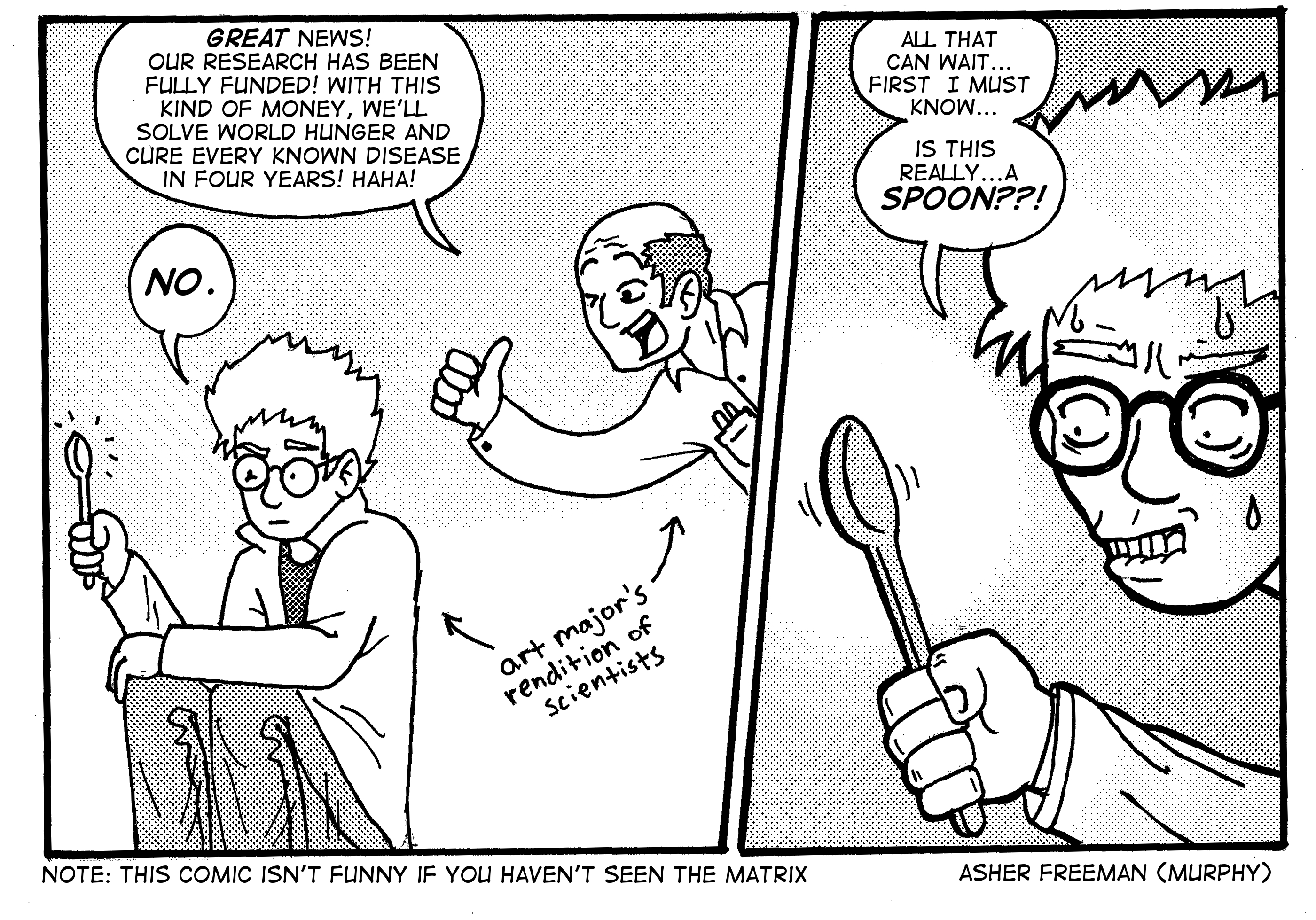
 “Have you ever had a dream, Neo, that you were so sure was real? What if you were unable to wake from that dream? How would you know the difference between the dream world and the real world?” These questions were posed to Neo after Morpheus informed him that reality was not as it seemed.
“The Matrix” was one of those movies that was both action-packed and thought-provoking. In the movie, Neo awakens and realizes that the world that he had previously been living in was just a computer simulation. The real world was much more grim and needed his help.
This caused a lot of people to look at the world around them and question its authenticity in philosophical debate — is it real or not?
The philosopher that is given credit for the computer-simulation argument is Nick Bostrom.
He asserts that a human civilization will reach a technological level that will allow us to simulate reality in a computer program if possible.
Assuming that it is possible to simulate reality, a comparable civilization reaching such a benchmark would likely also simulate reality. Therefore, it is possible for civilizations to exist in a simulation.
In other words, there is only one true reality, but there is the possibility that there are many simulated realities.
If civilizations can exist in a simulation, then is the reality we experience even reality at all? If simulated societies can create simulated societies within simulated societies, then it is more likely that our universe is a simulation rather than the real thing just because of the sheer volume of simulations compared to the single host reality.
The question becomes are we Horton, or are we the Whos? Are we ‘it,’ all that’s out there? Or is someone else simulating the reality we perceive?
This is what led researchers at the University of Bonn in Germany to take the philosophical thought experiment and turn into an empirical experiment.
Admittedly, the Lariat editorial board is in over its head with the scientific explanation, but apparently the simulations that the University of Bonn has created, although seemingly infinitely small, are nearly indistinguishable from reality.
The problem is the power of the computers running the simulation. Once computers become much more powerful, the simulation will be able to expand and eventually hold a simulated universe.
According to the researchers at the University of Bonn and the MIT Technology Review, in the simulation, the laws of nature arose on their own without being put into the program.
The end result: If the experiment goes according to plan, then the scientists will be able to know if this world that we live in is a simulation or not.
If the world is a computer simulation, then a lot of ethical questions quickly arise. In the case of the researchers, is it right to tell a world full of people that they aren’t even real?
Would Armageddon-style panic spread throughout the world upon hearing the news? Are viruses capable of entering our simulation? What kind of havoc would they wreak?
If someone told you, with certainty, that the world we perceive is just a simulation, would you continue to take out loans and go to school?
Even if there are some people out there that would continue their lives in the same way, there will inevitably be a group of people that would have some darker motives. Would everything collapse into anarchy and hedonism?
The world isn’t ready for this kind of knowledge just yet. Luckily, it will take a long time for the experiment to be completed and even longer for it to be peer-reviewed, but once it is all said and done, the scientists need to have a long discussion about whether or not releasing their findings is the right thing for the world. In the Matrix, it had a profound effect on Neo, but that’s science fiction. It won’t work like that in “reality.”