By Jen Forse | Staff Writer
Baylor’s new Math Mastery program is designed to give students individualized help with pre-calculus and Calculus I, but inconsistent attendance could determine whether the program continues beyond its first semester.
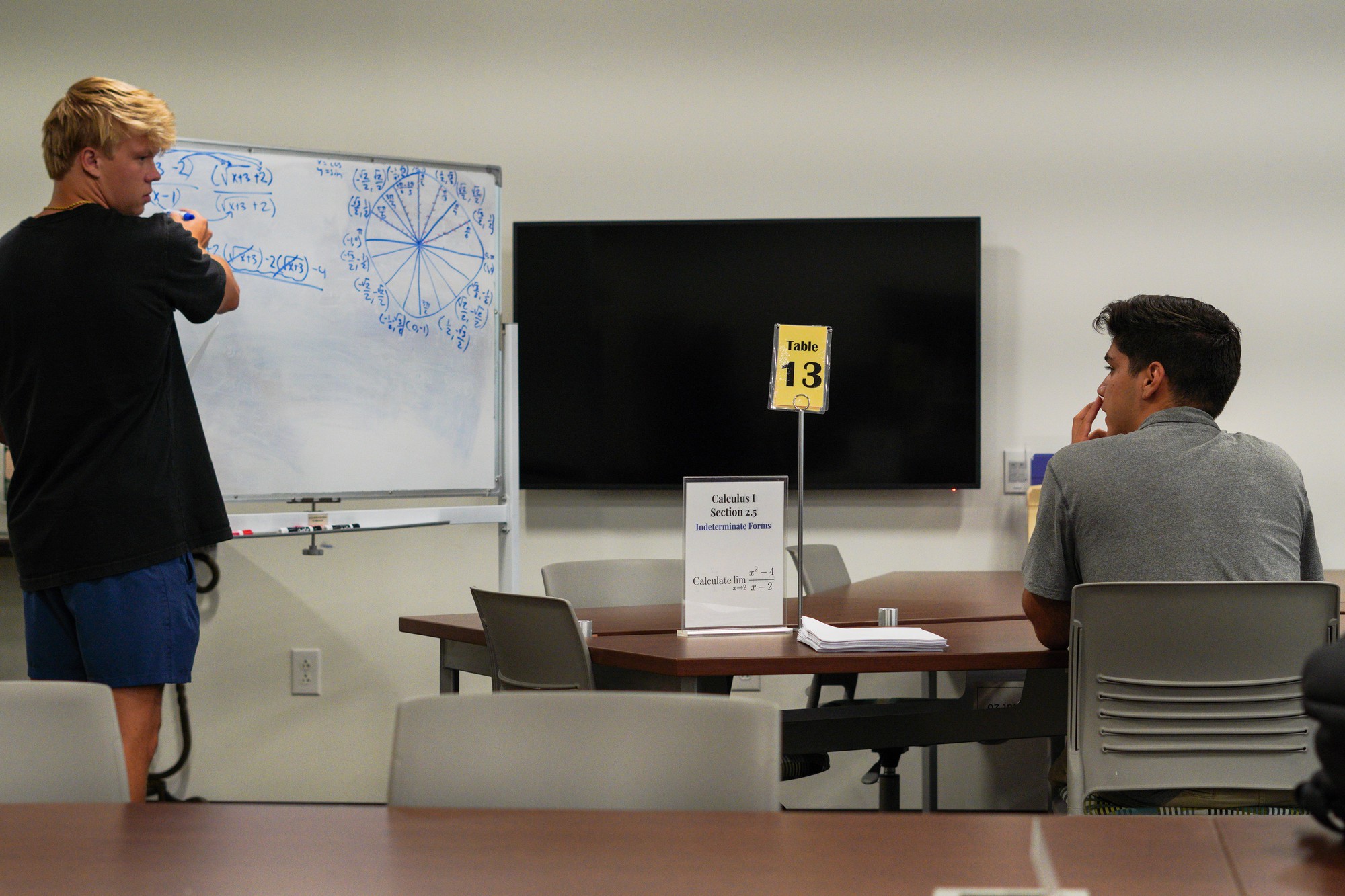
Math Mastery is available from 7-8 p.m. Monday through Thursday, located in the Sid Richardson Learning Commons. Each table focuses on a specific mathematical concept and has a tutor available to help students work through problems and strengthen their understanding. Students can move between tables throughout the session depending on the topics they want to practice.
A reference projected along the back wall shows which concept each table covers.
Needham, Massachusetts, senior Jack Henderson likened the program to a mathematical gym, where students can work out their “math muscles” and hone their skills.
“Students can come in and sit at, for example, the product rule table and they can work on 20 problems with a tutor there to help them out,” Henderson, who is a mathematics major, said. “They can work on the product rule for, let’s say, 20 minutes. Once they feel confident, they’re free to over to the power rule table and work on the power rule.”
The tables will change throughout the year based on what students are learning in their classes, Henderson said.
“We have access to some of the syllabi the calc and pre-calc professors are using,” he said. “We’re going through the schedules, noting what teachers are covering for the week, and trying to cater Math Mastery to the students.”
Henderson said the program also has flexibility to keep heavily attended topics available for longer periods.
“We believe this will be a better way to serve the math need we see at Baylor, as opposed to [supplemental instruction] and group tutoring, which students are used to,” Henderson said. “It’s a much more individualized approach and allows students to go at their own pace.”
Case studies from the Senate-Administration Workgroup on Admissions suggest that incoming college students are increasingly struggling with college-level math courses. Dave Kung further relates SAWA’s data with global trends in numerical reasoning and literacy in his article published by the Math Association of America.
While Math Mastery currently caters to pre-calculus and Calculus I students, the program may expand in the future if it is successful, Henderson said.
“Day one we had 25 students come to Math Mastery,” Henderson said. “Day two, we had two.”
Spokane, Washington, sophomore Oliver Ling said limited advertising could be contributing to inconsistent attendance.
“I’ve only been here Tuesday last week, but that day Math Mastery was advertised only through a pop-up notification on Navigate,” Ling said. “I saw maybe three students that night, but I’ve heard other nights had more people.”
Henderson said if Math Mastery continues to get 20-25 students a night, the program is likely to continue. If attendance falls to two or three students a night consistently, however, the program could end prematurely.
Still, Ling said he is hopeful the program will gain traction as the semester continues.
“I think we’ll get a real idea of how much we’re helping later on in the semester as we see more students coming in,” Ling said.