By Kaylee Hayes | Reporter
Digital displays — from phones and TVs to theater projectors — fall short of showing the full spectrum of colors visible to the human eye. Two Baylor professors are responsible for innovating technology known as 6P Color, a multi-primary color system to solve this issue, playing a major role in reshaping how screens reproduce color, emotion and visual storytelling in the future.
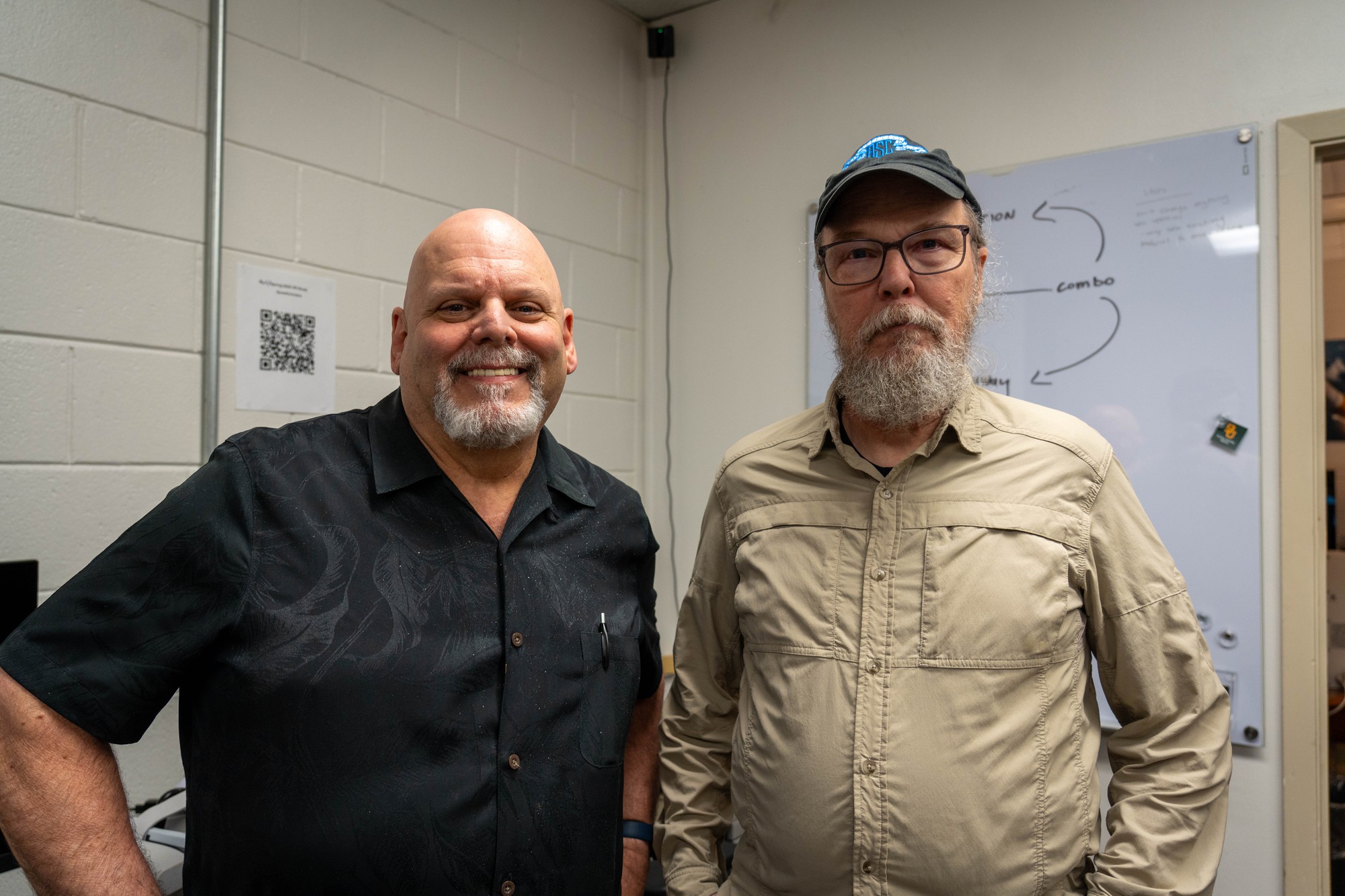
The project began in 2018, when former Sony engineer Gary Mandle contacted Baylor film professors Dr. Corey P. Carbonara and Dr. Michael Korpi regarding the long-standing limitations in the RGB — the three-color system of red, green and blue used in nearly every modern screen.
RGB covers only a small portion of the human visual perception spectrum, leaving large areas of color undetectable on digital devices. Mandle believed a new approach could broaden that range, prompting a partnership with Baylor.
Carbonara, professor of film and digital media and co-principal investigator, said Mandle framed the issue as a matter of rethinking how color is represented at the most foundational level.
“He had an idea for a better color system that would solve some of the major errors that were occurring in color that was being used with regard to lasers in the motion picture theater environment,” Carbonara said.
At its core, the issue was simple — RGB is too limited to reproduce the majority of colors humans can naturally perceive. Instead of three primaries, the Baylor team began exploring a six-primary system that could support a far wider color gamut.
This work became known as 6P Color, an innovative, wide-gamut display technology designed to dramatically expand what screens can show. Carbonara said the improvement is substantial for the industry.
“Now with 6P, we go just shy of 87% of everything in there,” Carbonara said.
This expansion relates to the CIE 1931 Chromaticity Diagram, the foundational map of human color vision. While most RGB displays occupy a small triangular region of that map, 6P pushes outward toward the curved spectral boundary that represents all the natural colors human eyes can perceive.
To test whether 6P’s widened color reproduction affected viewers, the team conducted several studies with Baylor students. These experiments used identical raw motion picture images rendered in both standard RGB and 6P’s enhanced multi-primary configuration.
The results were significant.
Students consistently preferred the 6P version, often without being able to articulate why. Carbonara said the response aligns with biology rather than a conscious preference.
“This melanopsin is really what is triggering the awe and stimulation that we feel when we see the Caribbean or the tranquil waters of the Mediterranean,” Carbonara said.
Korpi said the effect persisted in blind comparisons, highlighting the intricacies of visual preference.
“People will prefer the one that has the cyan, even though there’s no visible difference in the color of the picture … they look the same, but I always go to this one,” Korpi said.
When the team presented their early research to Hollywood cinematographers, visual effects engineers and studio technologists, they invited detailed criticism.
“We asked them, ‘Tell us what’s wrong with this. Tell us why this won’t work,’” Korpi said. “They had no notes.”
Korpi said the response was “unusually strong,” with several experts even asking to keep the handout.
Part of the appeal, Korpi said, is 6P is not tied to specific shades of red, green or blue. Instead, it defines color using numeric coordinates, making the system much more flexible and expansive.
“We’re not going to pick which red, green, blue … we’re just going to call the color by its coordinates,” Korpi said.
Research assistant Elle Jansick said this coordinate-based method mirrors how human vision captures light in the real world, enabling the system to produce more accurate, natural color.
“You organically capture 6P color,” Jansick said. “They’ve made it as close as possible to replicate that.”
Jansick noted the team’s work emphasizes biologically accurate color reproduction, aligning primaries with known visual pathways — including rods, cones and other photoreceptive systems that influence emotional and perceptual responses. This design allows 6P displays to feel more lifelike than conventional RGB screens.
For filmmakers, the 6P gamut allows colorists and cinematographers to wield color as an expressive tool. Carbonara said this supports more nuanced storytelling, mood-setting and emotional texture while offering creators a range of possibilities.
“It’s another way of being able to tell stories utilizing color and utilizing the physiological response to color,” Carbonara said.
Beyond film, Korpi said the future of digital displays will revolve around color science and perceptual accuracy, not resolution. The era of the “resolution race”— like 4K and 8K — is fading, he said.
“It isn’t about the ‘K-wars’ anymore; now color is the true new frontier,” Korpi said.
More than 100 patents have emerged from their work, and while many potential commercial partnerships remain under confidentiality agreements, Korpi said industry interest spans across the display sector.
“I can’t think of one major company you would think of that isn’t aware of this,” Korpi said.
As 6P Color prepares to be a major presence at the Consumer Electronics Show in January, Carbonara said he sees the project as a technological milestone and an attempt to bring the feeling of natural color to everyday screens.
“There’s so much beauty that God has made in nature, and to be able to bring that experience to a motion imaging environment that is displayed on a display technologically — this is the next major focus for where imaging and displays are going,” Carbonara said.