By Josh Siatkowski | Lead Writer
For the better part of a decade, Don Carpenter has bought breakfast and lunch for his students almost every weekday. And while he’s opened his schedule — and his wallet — for many of the thousands who have sat through his financial accounting class, Carpenter makes one thing clear: The meeting is not just a free meal.
“I tell them, ‘You know I buy, but it’s going to cost you something,’” he said. “’You have to answer questions … We’re going to have a purpose to this. It’s not like we’re just going to chat about the football game; I want to learn about you.’”
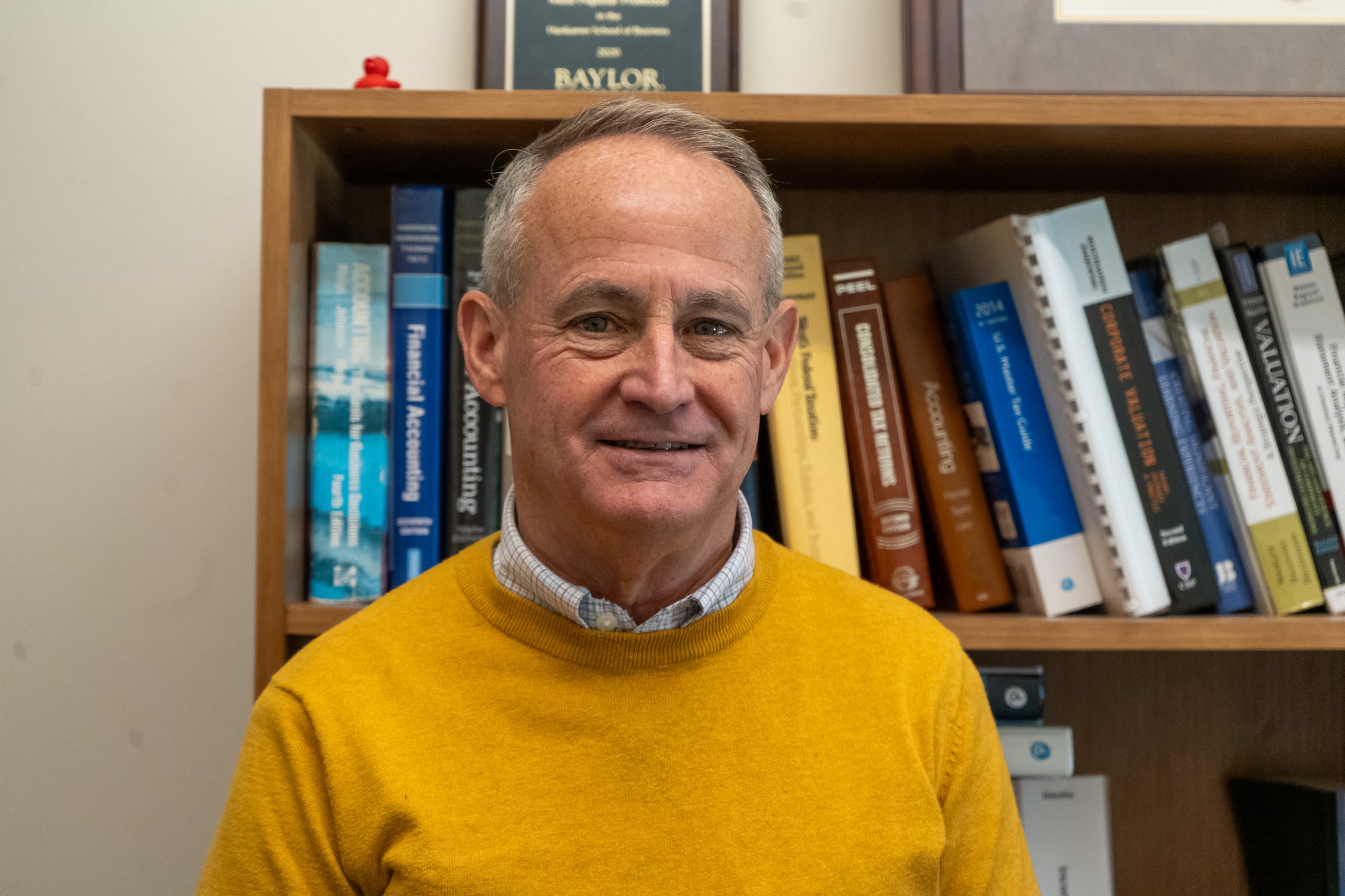
Carpenter, a clinical associate professor in the accounting department, has been at Baylor since 2016. Now in his 11th year, he’s become a symbol of the business school’s core curriculum. Every one of the roughly 1,000 business students who come in each year spends two mornings a week in Foster’s McClinton Auditorium for Accounting 2303, taught only by Carpenter.
And every morning starts the same way. In his East Texas accent that has hung around since his childhood in the town of White Oak, Carpenter addresses the lecture hall with four simple words: “OK, it’s accounting time.”
But many students, even those who take his class, know Carpenter in a different setting. He’s not just the talking head who preaches accounting concepts in the front of a lecture hall. He’s the professor who cannot walk the halls of the Paul L. Foster Campus for Business and Innovation without being greeted by dozens of students; whose lunch visits get booked up months in advance; and who manages a Rolodex with thousands of names well enough to remember something about every student he’s met.
For Carpenter, a 35-year industry veteran, he got his fair share of the profession while working in Houston as an executive for auto parts manufacturer Tenneco and disposal giant Waste Management. Much of his decision to return to teach at his alma mater stemmed from his desire to stay engaged after retiring from a demanding career.
The need for engagement became harder to meet, though, after Baylor’s business school shifted to more lecture-hall classes over the last decade.
“There was a lot of angst in the business school about moving to these large sections,” Carpenter said. “It becomes impersonal in that sense. … One of the things I thought was, ‘Well, we need to take steps to avoid this lack of being impersonal.’”
The solution was a program Carpenter coined “You Book, I Buy.” Since 2018, Carpenter has maintained a sign-up sheet with 10 slots per week available for students to schedule breakfast or lunch with him. And ever since it began, those slots fill up at a speed that rivals Sing ticket sales. This semester, he has been booked through final exams since October.
Carpenter doesn’t know exactly how many students he’s met with over the years, but the simple math says 10 meals a week times 32 weeks per school year times eight years makes about 2,500.
Some things about all of those “You Book, I Buy” visits are always the same. The Starbucks in Moody Library has remained a reliable breakfast spot. And until The Mix Cafe’s closure early this year, Carpenter was on a years-long streak of chicken Caesar salads for lunch (now mostly swapped for a Chick-fil-A salad from the SUB). The questions he asks — about life stories, aspirations and faith — also start the same way.
But every meeting he’s had takes a different direction. Whether it’s talking about a student’s summer job as a rodeo clown or meeting with Baylor basketball legend and NBA draftee Jared Butler, there’s always something to remember. Whatever that something is, it’s almost always deeper than accounting, and both he and his students learn from each other.
“It definitely felt like a two-way conversation where we were eager to hear his advice and about his story, but he also was definitely asking us questions, trying to learn about us, to build a connection with us,” said Southlake senior Daniel Six, who met with Carpenter alongside a group of friends as a freshman.
For Carpenter, some of the thousands of meetings have made a lasting impact years later.
“There was one where I had a student, and she seemed so disconnected in class, but I was surprised. She reached out and said, ‘I want to have breakfast with you,’” Carpenter said.
While they met, the student shared that her mother had committed suicide before the semester started. That meeting made Carpenter realize that “the story is now completely different.”
“It’s kind of emotional, but it puts everything in context,” he said. “I would have never known that. I would just have thought, ‘Here’s a student that’s going through the motions.’”
On the weekdays, it’s rare to see Carpenter eating alone. But even as a self-described introvert who loves “a Saturday where I go run in the morning, and I do not leave the house again,” he likes it that way. He sees the spiritual power of a shared meal as a tool to share the Gospel and live out his faith.
“Someone said one time, ‘We learn about Christ through his Word. We see him through his meal,’” Carpenter said. “Something about a meal makes us just the same.”
But it’s also a way to combat an epidemic of loneliness and disconnection, brought on, Carpenter thinks, by cultural shifts like noise-canceling headphones and drive-thru restaurants.
“One of my goals is to stamp out drive-in windows because it’s the most dehumanizing thing in the world,” he said. “If you think about it, we put our convenience above connecting with people.”
Even at dinnertime, Carpenter finds himself breaking bread with students. Twice a semester, he and his wife host roughly 50 honors accounting students for a unique honors requirement: discussing a book over a home-cooked meal.
Six, who was also in Carpenter’s honors section, said that he appreciated not only his generosity, but also his theological perspective on work after reading Tim Keller’s “Every Good Endeavor.”
“He didn’t approach as much of a balance as living out your faith through your work and that the work itself, not just because of its result, or not because of telling your coworker the gospel, but just in doing the actual work you can glorify God and live out your faith,” Six said.
Across Carpenter’s thousands of gatherings, conversations have extended to all sorts of topics. But central to every connection is the importance of the student and feeling “permission to talk about themselves.”
“When you say to someone, ‘I am buying your meal,’ it says you matter,” Carpenter said.