By Giselle Lee | Staff Writer
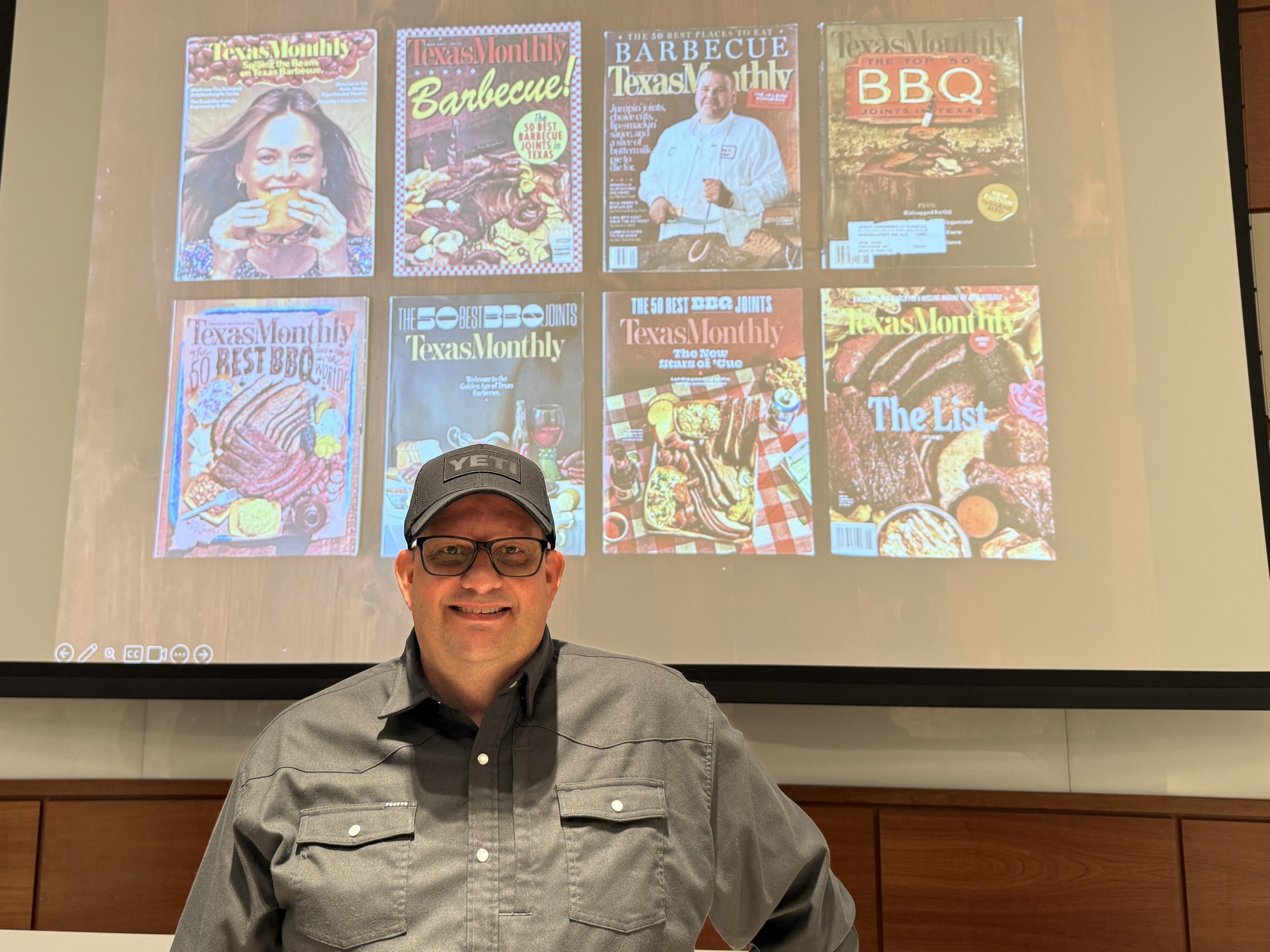
When Daniel Vaughn, the barbecue editor at Texas Monthly, first moved to Texas from Ohio 25 years ago, a smoked brisket and spare rib meal in Dallas changed his life. Since then, he has ventured to over 2,700 barbecue joints around Texas, the U.S. and internationally, in hopes of making Texas barbecue “the most popular barbecue style in the world.”
In a lecture hosted by the Journalism, Public Relations and New Media Department Monday evening in the Marrs McLean Science Building, Vaughn shared two things that were certain in his life: a love for barbecue and a passion for highlighting the people behind the smokers.
“I connect people with great barbecue — It’s as simple as that,” Vaughn said. “I want to tell you where to find the great barbecue, and I want you to be able to enjoy it.”
Vaughn’s said his travels were how he first got his “foot in the door” at Texas Monthly, after convincing the “Top 50 BBQ Joints” tasting team in 2013 to bring him in. Vaughn’s journeys have culminated in two books detailing barbecues across Texas and North Carolina and a feature in an Anthony Bourdain episode of the Travel Channel series “No Reservations.”
“Over the years, my style of writing has changed pretty significantly,” Vaughn said. “I started out writing primarily about the food and details about the food. Nowadays, I think it’s more interesting and I think my readers think it’s more interesting to write a lot more about the people involved and the story and their backstories.”
Throughout his 13-year career in tasting and rating barbecue joints, Vaughn said he witnessed a big transformation in Texas barbecue as competition grew. Alongside the team that created the 2025 edition of “Top 50 BBQ Joints,” Vaughn has the task of revisiting restaurants from an Excel spreadsheet compilation.
“I feel like I’ve already done a lot of what I set out to do, which is to make Texas barbecue the most well-respected, the most popular barbecue style in the world,” Vaughn said. “Having someone dedicated to write it, about a specific style of barbecue full time, does give it a lot of press, a lot of ink that other styles don’t really have.”
The Woodlands junior Bryce Walles said Vaughn’s evolved narrative style also reflected a real-life disconnect between generations.
“[His writing style] goes back to understanding people rather than the products that they make, and valuing what goes on behind making the food that we eat, especially with newer industries and the way that the world had been going with fast food and things like that,” Walles said.
Despite that, Walles said Vaughn gives hope to people who value the cultural experiences documented in travel media.
“Everywhere that he goes, no matter what part of town, where he is, different countries, he goes there and he talks with the people that make the food and he sits down and he eats it,” Walles said.
Kim Patterson, a lecturer in the journalism, public relations and new media department, said Vaughn’s speech was a reminder of how important the written word was in advocating for the “heart of the barbecue story,” especially within communities that may go overlooked.
“By him covering Texas barbecue, he has turned it into a cultural phenomenon,” Patterson said. “The whole country beats a path to Central Texas to have our barbecue. It’s always been there, but no one was telling the story. The more positive attention that he can give to the barbecue industry and these small businesses is critical.”
Walles said a lot of the places he has seen or eaten at in Texas are larger barbecue joints, but Vaughn has given him a broader perspective beyond “big-name brands.”
“He’s mentioning things here in Waco that I haven’t even heard about that have been here for over a century,” Walles said. “That’s just a big part of [how] barbecue’s everywhere and it’s been around for a long time, but we’re so ingrained to go to the big-name brands on the corner that we don’t get to experience that.”
Vaughn encouraged students to find something they’re passionate about and write about it, but said hard work was an essential element to success, regardless of profession.
“Passion alone is not something that is going to get you a job like mine either,” Vaughn said. “I hear it often from barbecue joint owners and from aspiring writers that if you have a passion, it’s going to happen. I’m a special case.”