By Giselle Lee | Staff Writer
Immigration policy has become one of the most debated topics in American politics, with shifts in federal policy creating uncertainty for immigrant communities across the country.
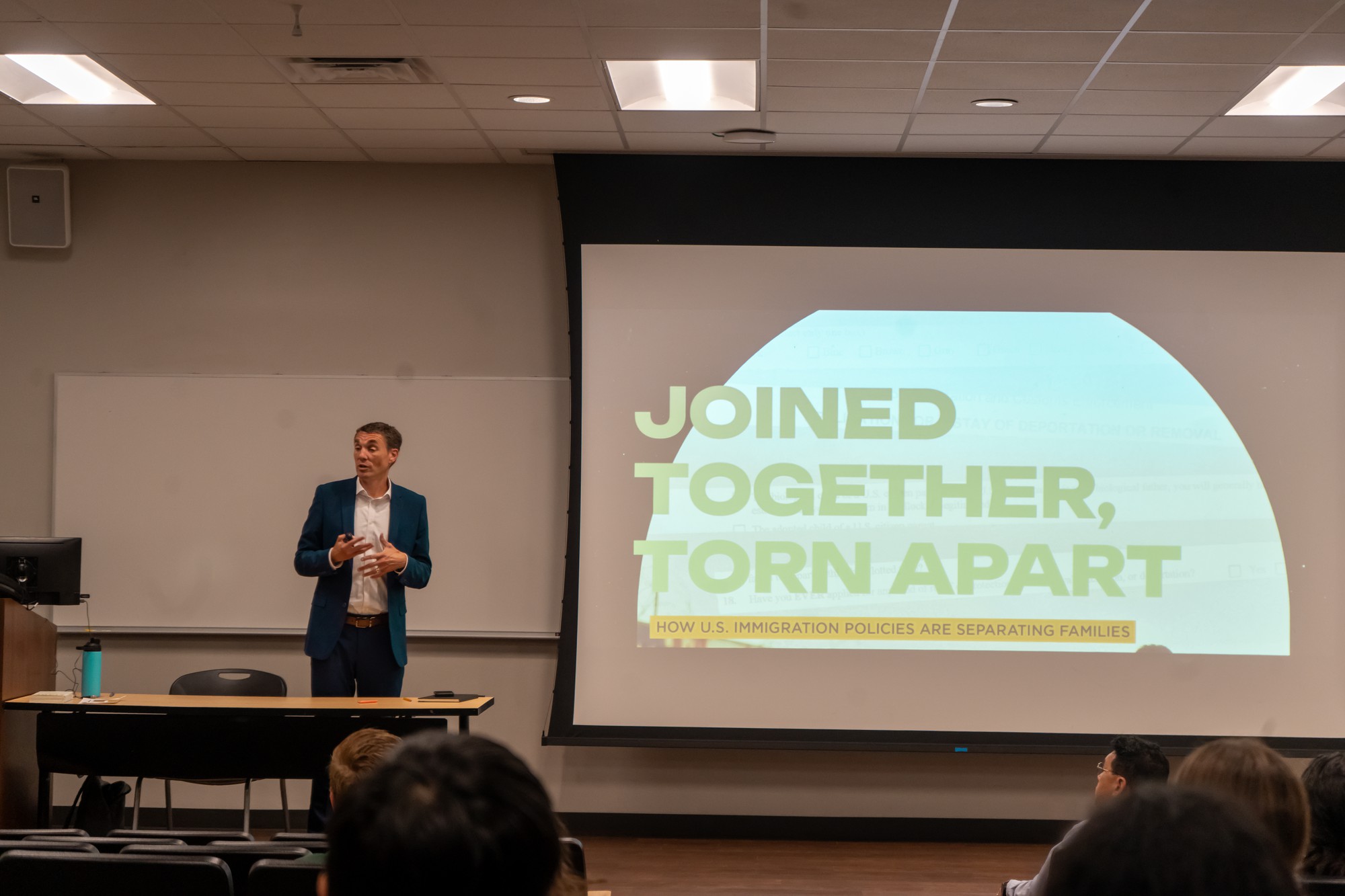
In an effort to understand how immigration policy affects both immigrant and American communities, Baylor’s Department of Sociology invited Dr. Phillip Connor, a lecturer in Princeton University’s School of Public and International Affairs and Department of Sociology, to present his research Monday in the Draper Academic Building.
Connor discussed how policy changes affecting undocumented immigrants can have broader effects on American families, businesses and the economy.
He said past conversations surrounding policies affecting undocumented immigrants have often focused on their effects on immigrant populations. Connor laid out “step by step” how the same policy maneuvers impact American families, economies or businesses on both a short-term and long-term basis.
“Sometimes people are not quick to kind of connect the dots of what kind of impacts there could be when there’s kind of different policy changes for one population that you may not be part of,” Connor said. “They may not always be; everyone may not be connecting these policy environments to themselves, but it is occurring.”
Beyond his interest in data analysis and his experience studying immigration, Connor said his identity as a Canadian American immigrant and a Christian has shaped his passion for working with immigrant communities. Outside of his academic work, he has taught ESL classes and preached in neighborhood immigrant resource centers.
“We then have lived in many different places, but each place that we have lived, we’ve always been very close to different immigrant populations,” Connor said. “I’m very grateful and very blessed to be able to carry over some of the things that I do and am really excited about an academic or a policy sphere.”
Connor said he hopes to “crystallize” how students interact on a day-to-day level with immigrants themselves and to shape compassion towards groups around them that may be vulnerable to certain policy threats.”
“As followers of the word, we are called to be there for those who are in vulnerable places,” Connor said. “I am hopeful that students will continue to think of how they can be there and to walk alongside those in vulnerable situations.”
Jennifer Laderi, a doctoral candidate from Nigeria, and Nousheen Lalani, a doctoral candidate from India, said Connor’s presentation resonated with them as international students.
For Laderi, Connor’s talk helped her work as a sociologist by encouraging her to be more open to viewing topics from “the good and bad aspects of things” and to understand trends rather than “propose solutions.”
“If you heard things, you have to look at it from both perspectives,” Laderi said. “From the talk, we’ve already seen that immigration being undocumented is not negative. There is always a positive side of everything. You can see that [the immigrants] are undocumented, but they are a big part of our society; they are a big part of our economy. They are not just here being undocumented — they are contributing.”
Lalani said Connor’s presentation helped her see how certain policies may be “painted” as beneficial for Americans but are actually counterproductive.
“The discussion is very pertinent on policy ramifications, especially for immigrants and international students,” Lalani said. “There’s no clean extrication of undocumented immigrants because they are so embedded in the culture and within the family institution. Removing them has ramifications for Americans and for American households.”
Connor said he also hoped students would be “perplexed” by his work, as university institutions are meant to “question” and “problematize the situation.”
“There’s probably many that maybe haven’t really thought about the impacts of different policies on their everyday lives as Americans,” Connor said. “I hope that just raises some ideas and some facts that would be important for them to know.”
Washington doctoral candidate Michael Ervin said the family aspect of Connor’s presentation made him think more deeply about the conflicting rhetoric over immigrants in America.
“We can’t make that separation when there’s a huge majority of American families who are connected to immigration, which I thought was powerful,” Ervin said. “When we think about who is American, what does it mean to be American, I think there’s a lot of negative rhetoric.”
Ervin said Connor provided “statistical backing” to his views on immigration policy, especially surrounding the lack of recognition for immigrant communities’ input in the American workforce.
“It was interesting seeing this kind of projected statistics of what would happen if certain policies are enacted,” Ervin said. “I also like that he focused on this idea of how there’s so much contribution from immigrants in the labor force. That kind of thing I don’t think is talked about a lot in the rhetoric of politics.”
Connor encouraged students to build their passion for policy areas “fraught with a lot of political rhetoric,” as they are a big part in bringing “fresh and new ideas” amid challenges in passing legislation.
“Someone like me who has been in this policy environment for many, many years, we get stuck in our ways,” Connor said. “We have our approaches. We’ve known what’s been tried, but it’s always good to have a fresh perspective.”
“What I appreciate from students is that [they] maybe don’t have a policy history of knowing this topic intimately, but it’s marvelous how students are able to connect dots that I or other people in this environment have not done before,” he continued.