


By Joana Karoshi | Staff Writer
A Baylor undergraduate student achieved an international undergraduate research honor for his work on pediatric gut health, but rather than sit in his success, the honor encouraged him to ask more questions.
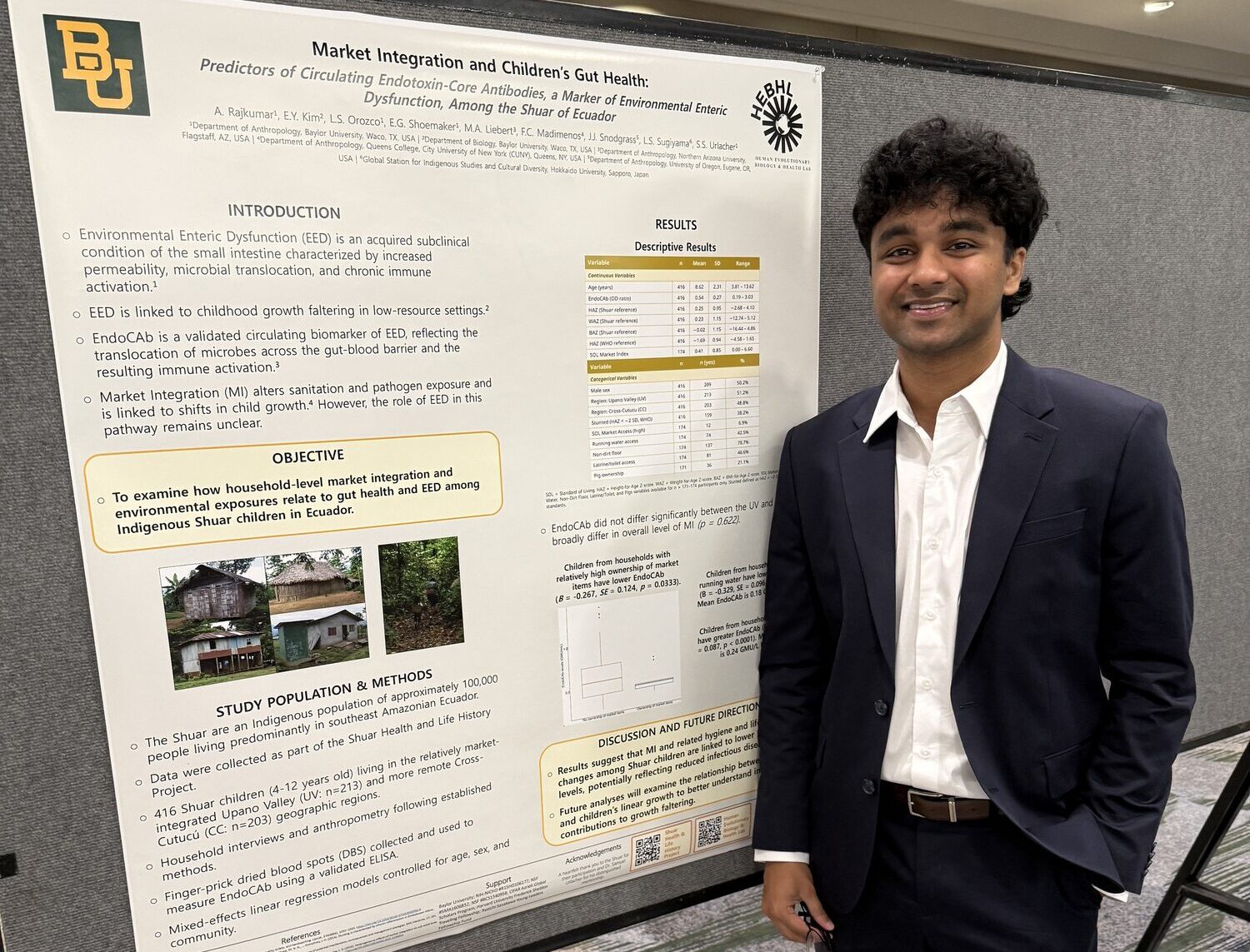
Frisco junior Abhi Rajkumar, a University Scholar majoring in a pre-med track with a focus on human biology research, was awarded the Hilde Spielvogel Award at the Human Biology Association Conference. The annual award is given to one undergraduate researcher based on the quality of research, analysis and presentation, as evaluated by the association’s publications committee.
His project examined the relationship between market integration, environmental conditions and intestinal health in children in Ecuador. Specifically, the study analyzed a gut biomarker, EndoCAb, in blood samples from more than 400 children across two regions: the Upano Valley and Cross-Cutucú.
Rajkumar’s findings suggested that increased access to market goods and improved water availability were associated with lower EndoCAb concentrations, indicating reduced intestinal permeability and lower pathogen exposure. The research connects environmental infrastructure and socioeconomic conditions to measurable differences in gastrointestinal health outcomes.
“These results highlight the significant roles that environmental conditions, socioeconomic status and accessibility play in shaping gastrointestinal health,” Rajkumar said. “Addressing these regional disparities will require targeted policy interventions aimed at improving infrastructure and resource access.”
The award comes during Baylor’s STEM Research Month, a time Rajkumar said was important for undergraduate visibility in research spaces. He said the recognition is not just personal validation, but an opportunity to show younger students that research pathways are accessible early in their academic careers.
“Everyone starts somewhere,” Rajkumar said. “If you’re interested in research, reach out to a lab that excites you and express your interest. Take the time to learn, put in the effort and trust the process.”
Rajkumar presented his findings at the Human Biology Association conference in Denver, where he engaged with researchers and students from institutions including the University of Pennsylvania, Washington University in St. Louis, Johns Hopkins University and Harvard University. He described the experience as both academically rigorous and socially formative, noting that conversations with peers helped him contextualize his research.
“It felt less like a conference and more like a family,” Rajkumar said. “What stood out most was the sense of community and the opportunity to engage with people doing similar work at different stages.”
Faculty in Baylor’s anthropology program said the award reflects both the strength of the student’s work and the mentorship structure behind it.
Dr. Katie Binetti, undergraduate program director in anthropology, said the award is significant because undergraduate students rarely have the opportunity to present primary research in highly competitive professional settings.
“It’s not just that the research is strong,” Binetti said. “It’s that students are being trained well enough to participate in a professional scientific conversation at all.”
She added that receiving top recognition in that setting signals both strong mentorship and academic preparation.
Binetti also pointed to a broader issue in undergraduate research visibility, noting that many students do not initially consider anthropology as a pathway into lab-based scientific work. She said Baylor’s structure allows students outside traditional anthropology majors to engage in biological and field-based research more directly than in many larger departments.
“That opportunity is what changes things for students,” Binetti said. “Once they see the kind of work happening here, they realize they can do it, too.”
Dr. Lyndsay DiPietro, lab coordinator in the anthropology department, emphasized the hands-on nature of undergraduate training in Baylor’s anthropology labs. She described a learning environment in which students work directly with biological data, skeletal materials and physiological samples under close faculty mentorship.
“In anthropology, students don’t just read about the science,” DiPietro said. “They physically work with it, analyze it and learn how to interpret real data.”
She added that the department’s smaller size allows faculty to build closer relationships with students, which she believes strengthens both research outcomes and student development.
“We get to know our students individually,” DiPietro said. “That changes how they learn and how far they can go.”
Rajkumar’s project, conducted under mentorship in Baylor’s Human Evolutionary Biology and Health Lab, reflects that approach. He currently serves as a research assistant in the lab, and he will continue his research trajectory this summer through a clinical research internship at Johns Hopkins Medicine and the Bloomberg School of Public Health, where he will work on cerebrovascular outcomes and health insurance policy.
For Rajkumar, the award reinforces a broader perspective on research.
“Research isn’t just about generating data,” Rajkumar said. “It’s about asking questions that lead to meaningful conversations and, ultimately, better solutions.”

