By Addison Gernenz | Intern
Saturday evening brought a crowd to Waco Hall for Gateway to India, an event heavily organized by the Indian Subcontinent Student Association and the Gateway to India student board. Returning for its 29th year, the event featured women in colorful lehengas and dancers in themed costumes participated in the cultural dance competition featuring a multitude of South Asian performances.
The event raised $1,500 for Developments in Literacy, a charity that provides educational access to women and children in Pakistan.
Frisco junior Ada Khoja served as a Gateway to India director this year, along with Plano senior Ananya Mandava and Sugar Land junior Mahika Palani.
“We start preparing for the next show immediately after the show ends,” Khoja said. “It’s a very long process. It’s very busy, especially this semester; it’s ramped up in terms of work.”
The months leading up to Gateway to India are increasingly busy for Khoja and the team of directors as they prepare.
“There are so many factors to consider,” Khoja said. “There’s external teams, there’s catering, there’s food, there’s decorations, there’s the mixer event the day before the event, there’s hotels, there’s transportation, there’s so many aspects to consider that it really does require a lot of foresight and planning to be able to put on a show, especially for so many people.”
This year, seven teams competed in the dance competition. Within the year, Gateway to India received affiliate competition status with the Desi Dance Network, a large network of collegiate competitions where Bollywood teams compete to earn a chance to compete later at their Legends competition.
Khoja said this is a huge achievement for ISSA and Gateway to India, as they have been working toward the status for multiple years.
The performances all had a theme, storyline and impressive choreography. The songs consisted of traditional, Bollywood, hip-hop and American pop.
All dances were accompanied by a guiding video that introduced the theme, built hype and shared dialogue and key storyline elements.
The University of Texas at Dallas’ Raftaar started out the with a Vikings act that included two large cardboard ships. Their act heavily implemented the video aspect, pairing a short film between their dance segments.
As a whole, the act delivered a moving storyline paired with captivating choreography and ultimately brought home the first place trophy, as well as winning awards for best segment and best opening video.
Raftaar was not the only team to present an original storyline — Texas A&M University’s Maaya act followed an evil carnival, distinguished by a video and costumes that matched the red-and-white-striped background of the carnival tent.
University of Alabama at Birmingham’s Rangeela act led the audience through a Mafia card game, which led to a gruesome twist. Rangeela’s act was full of twists and suspense, including a jarring costume change in which the players traded their T-shirts for bloodied, torn versions of the same shirts.
The creatively designed performance, with clever costumes, ritualistic choreography and a backdrop of large painted playing cards, placed third overall.
Other performances were based on preexisting stories. Both the University of Texas at Austin’s Punjabbawockeez and Georgetown University’s Guzaarish brought adjusted storylines of beloved movies.
Members of Punjabbawockeez, dressed in matching red Christmas sweaters, performed a humorous twist to “Home Alone,” where Kevin’s parents are distracted in returning home and the robbers triumph over Kevin as the grand finale.
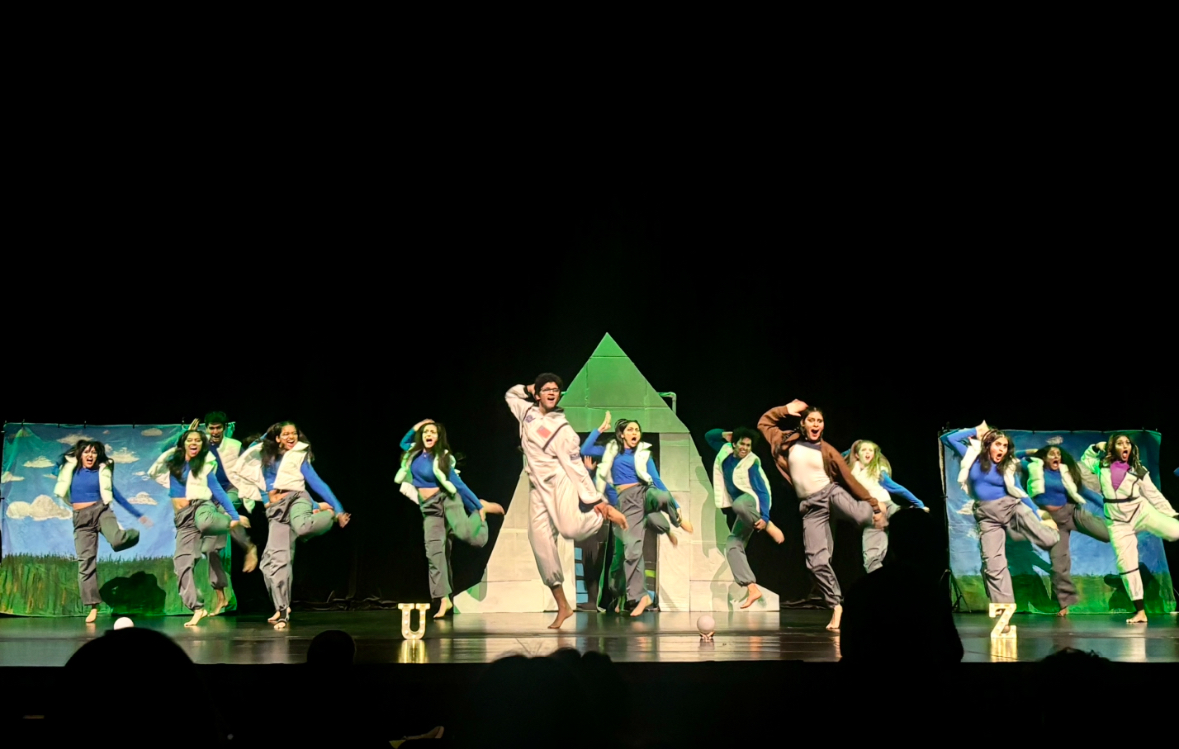
Guzaarish delivered an emotional adaptation of Christopher Nolan’s “Interstellar,” leaving the audience in shock by adding an unexpected death scene at the end that wasn’t in the original film.
Folk stories influenced other dances, specifically Rice University’s Riyaaz “Into the Woods” themed dance and University of Maryland’s Manzar performance based on the Hindu story “Rakhi” about protection, love and sacred bonds between siblings.
Manzar members, who won both best male lead, best female lead and second place overall, took the stage in beautiful, colorful skirts in front of a Hindu village background. Their performance was the most culturally rooted, with their South Asian connections ultimately driving their storyline. The historical and culturally influential aspects of the act led Manzar to second place.
“Dance is vital in a lot of cultures, extending outside of just the Indian subcontinent,” Khoja said. “It’s nice to see how different regions incorporate into their culture. Obviously, it’s a very big part of desi culture, which is the entire region.”
Mandeville, La., junior Maria Petrolia has roomed with Khoja for three years now, which was her introduction to Indian culture. Petrolia danced in the fashion show this year, directly beside Khoja.
“It’s not something I’ve had the opportunity to do before,” Petrolia said. “My dance experience has been limited to swing and theater, so it was a neat experience to learn a new style.”
Khoja has enjoyed seeing cultures close to home, as well as having the opportunity to engage with cultures she had not previously had a chance to experience or witness.
“It’s super important for Baylor and the community to have awareness of these events,” Khoja said. “It’s super cool to partake in a different culture, especially because ISSA … expands beyond just India. It also includes Pakistan, Nepal, Bangladesh and all those other surrounding countries.”