By Juliana Vasquez | Staff Writer
Five years after a historic winter storm crippled Texas’ power grid, even a few inches of snow can spark anxiety across the state. But as icy roads returned to Waco this week, Baylor students and engineering experts say the system, and Texans themselves, may be better prepared than before.
This panic for Texas residents isn’t unfounded, though, as many remember the 2021 ice storm in which the Texas power grid failed, causing many residents to lose power and resulting in 246 storm-related deaths.
Tyler senior Annabelle Prosperi recalled her experience during the 2021 ice storm, noting that the real danger of it was the lack of preparation Texans had.
“We were not prepared at all for it,” Prosperi said. “Nobody expected it to be as bad as it was, so it caught everyone off guard.”
Associate Professor of engineering Dr. Emmanuel Agamloh explained the Texas power grid is unique from other major U.S. power grids, as it is essentially its own independent body. Because the Texas grid is isolated, the system works as an interconnecting map, from generators to transmitters to companies to individuals.
“We have electricity generators that are generating the electricity,” Agamloh said. “We also have power transmission companies that have the operating transmission lines, and so the power is transferred from the generating companies and then it’s wheeled across a network of transmission lines and then we have retail companies … that sell electricity to you.”
Agamloh said the 2021 ice storm created the perfect conditions for a grid failure to occur.
“There were so many unprecedented conditions that were taking place at the time, both relating to the high demand on the system and the lack of generation capacity to meet that demand, and then also maintenance issues that popped up,” Agamloh said.
For out-of-state students coming into the weekend like Hudson, Wis., senior Christian Duffey, the panic before the storm was comical, yet understandable.
“Being in H-E-B was kind of comical to see the shelves completely empty and people scrambling around,” Duffey said. “I was just blown away by how many precautions people were taking. I also understand a little bit knowing that the infrastructure in Texas can’t quite handle some of the snow and freezing conditions.”
Luckily for students and residents alike, the power grid was much more prepared for the weather this go-around.
“There have been some improvements in capacity additions since that storm, primarily in renewable energy,” Agamloh said. “The standards have been developed, and there are inspections to make sure that the generators or the generator companies are adequately prepared.”
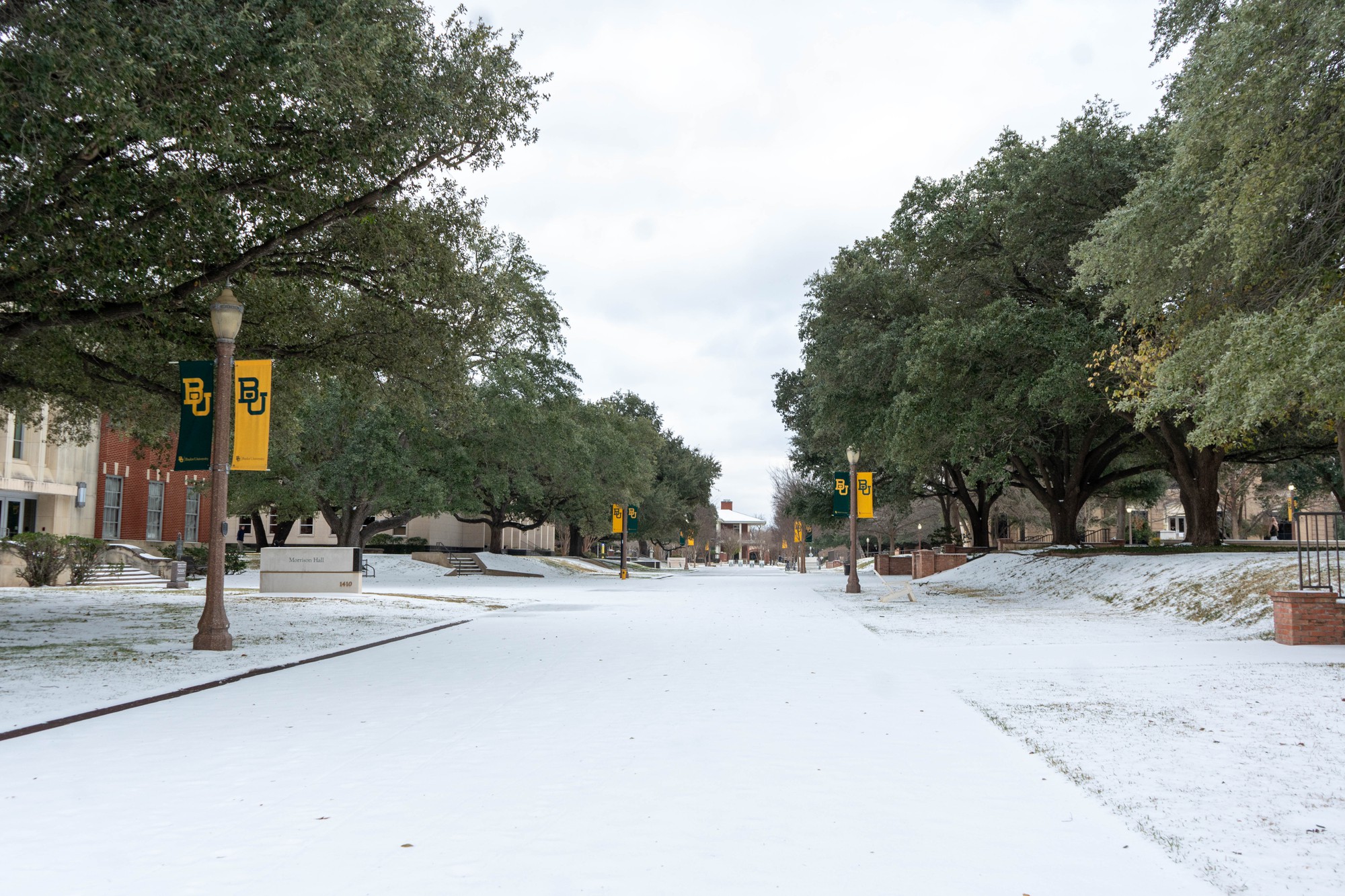
This past weekend students got the treat of being snowed-in, with two snow days gifted to them by the university as the roads were concluded as too dangerous to drive on.
“As the ice started to come down, I realized that it was freezing rain and not snow,” Duffey said. “Given the fact that temperatures are going to drop below freezing for the next two, three days, the roads are really just going to be a big ice rink … and sure enough, that’s exactly what happened.”
Duffey and Prosperi both took advantage of the snow day, winding down and relaxing with friends in the rare Waco weather phenomenon.
“We played a lot of games, watched a lot of movies, we played in the snow, we went sledding on campus; that was fun,” Prosperi said. “Just overall hung out, it was really great and it’s just been fun, friend time.”
Duffey enjoyed seeing a new side of snow days, as the Waco community came outside to enjoy the winter weather.
“It was fun for me to experience something that I’ve always experienced commonly with friends,” Duffey said. “Even though we’re only sledding down the Cashion ramp, it still was way more fun for them because they’ve never experienced it before.”