By Jeffrey Cohen | Sports Writer
It was time for the next step.
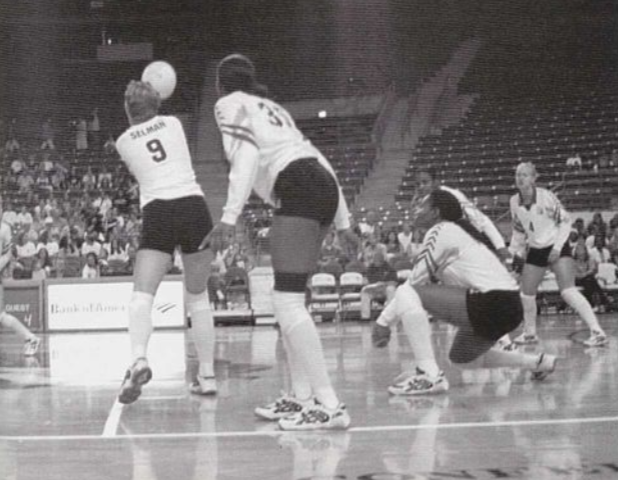
The year was 1999. Eighteen years after joining the NCAA, Baylor volleyball was seeking its first appearance in the national tournament.
“People lay a foundation,” said Brian Hosfeld, who coached the Bears from 1996 to 2003. “My mentality coming from Long Beach State and having one championship there as an assistant … was trying to get to that place at Baylor.”
It took a group with a strong bond and sense of the game to reach the milestone.
“The girls were gritty and they could look at each other and trust what we were all about,” Hosfeld said. “They all had great minds and love for the game and love for the other girls out there.”
While other programs in the recently formed Big 12 seemed to be light-years ahead of Baylor and competing for national championships, the Bears did not back down from the challenge.
“Baylor was getting into the Big 12 as Nebraska and Texas were coming out of playing in the finals,” Hosfeld said. “We didn’t have everything compared to those kinds of programs, but we were expecting to compete.”
They wanted to show the country that they belonged with the teams that had more success and better resources.
“Everybody coming into the program had a chip on their shoulder and wanted to prove that we could play with the big girls,” Hosfeld said. “It came all together in that ‘99 year, where we started beating people that we probably didn’t think we should even be on the court with.”
The Bears found success throughout the season, doing what teams of the past failed to accomplish, leading up to a coveted spot in the tournament.
“There were a lot of firsts that year,” said former Baylor volleyball player Dana Chuha Davis. “That was the first year Baylor volleyball has ever been ranked. It was the first time we’ve ever beaten UT. It was the first time we ever made the NCAA tournament.”
Baylor’s new heights were not by accident, but the product of a team that knew they had the potential to do something the program had never done before.
“Since I got there, we had a list of what we were going to do for the first time in Baylor history,” Hosfeld said. “It was on everybody’s mind to just go out and beat somebody for the first time in school history or do those kinds of things.”
The Bears’ unprecedented success came behind a group of senior leaders guiding sophomores with a year of Division I experience.
“We had a pretty big freshman class coming into 1998, so we were all sophomores at that point, had a year under our belts,” Davis said. “[We] had a little bit of experience and also, we had great leadership from our seniors.”
The senior core held a strong connection with the sophomore group, pushing them to perform and help the team reach lofty expectations.
“We definitely had a ton of senior leadership,” Davis said. “But even though we were underclassmen, there were high expectations, and they knew we could do it.”
As the season progressed and Baylor beat Texas for the first time, the Bears believed that just making the national tournament was not the ultimate goal. They wanted to run the table.
“The group as a whole expected to go more than just, ‘Hey, we’re happy to make the tournament,’” Hosfeld said. “We were going to leave a mark.”
As an at-large bid in the 1999 NCAA tournament, the Bears beat Temple 3-1 in the first round. They ran into No. 1 seed Penn State in the next round, where they were swept by the eventual national champions.
After barely missing the postseason in 2000, Baylor found itself back on the national stage in 2001, when it lost to Colorado State in the first round.
“The trajectory was going definitely in the right direction,” Hosfeld said. “Everything was a fight, trying to upgrade facilities and upgrade assistants’s pay, and it was definitely the beginning of what has come to [be] a great program right now.”
The Baylor volleyball program returned to the tournament in 2009 and 2011. Under head coach Ryan McGuyre, the Bears have since earned a program-record nine consecutive NCAA tournament berths and been ranked in the top 25 for 111 consecutive weeks.