


By Arden Berry | Staff Writer
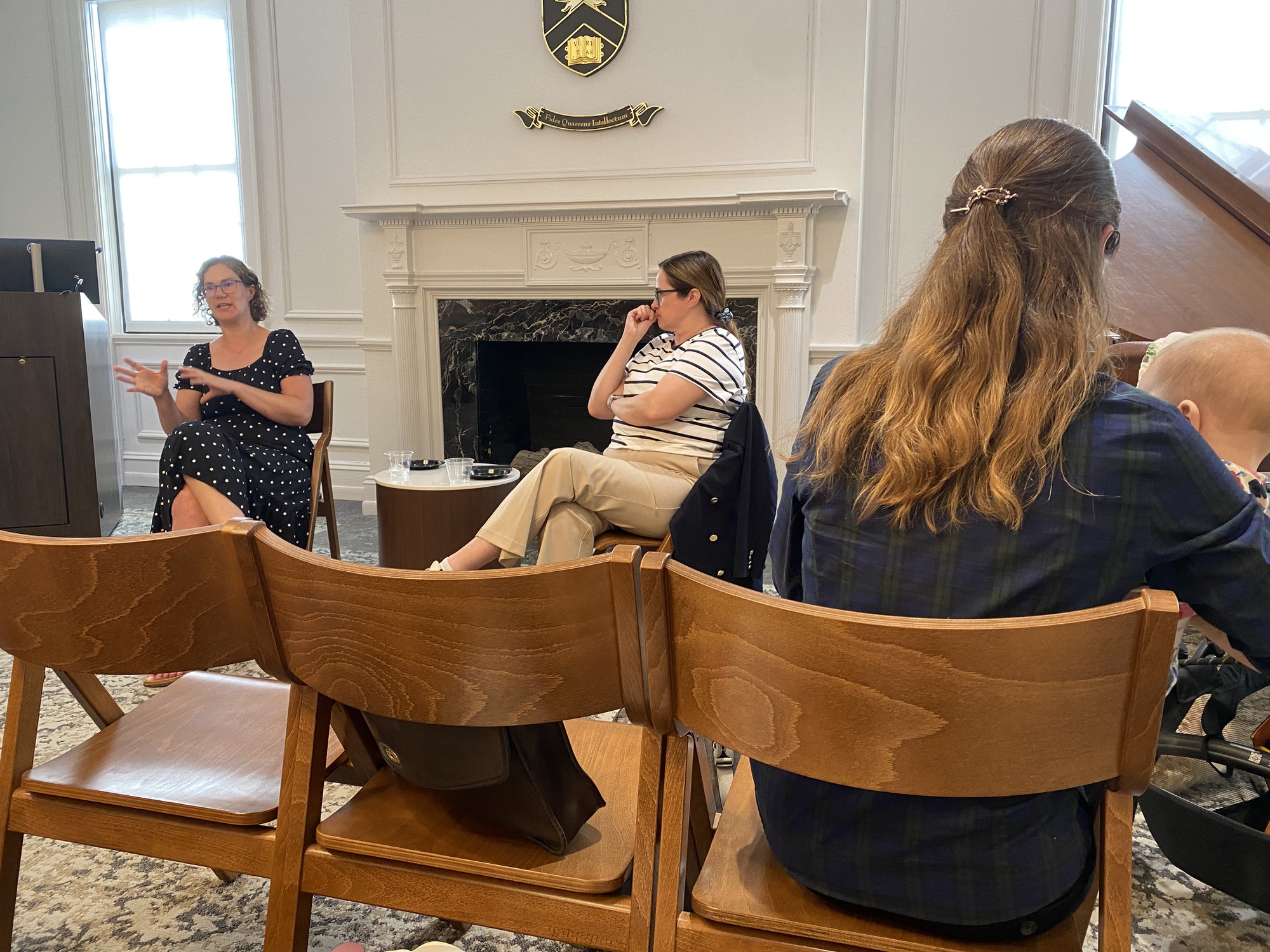
Attendees gathered at Memorial Residence Hall for a discussion surrounding the “library of the mind” and the importance of classic literature for Christians.
Dr. Nadya Williams, author and classicist, and Dr. Sarah-Jane Murray, Great Texts professor and documentary director, met for the first time in-person to discuss how Christian readers are formed by the books they read.
The discussion, titled “Christians Reading Classics: Conversation with Dr. Nadya Williams,” took place on Monday at 2:30 p.m. in the Armes Family Drawing Room at Memorial Residence Hall.
Williams said the main trait specific to Christian readers is that it is “formational” for readers’ character and virtues.
“The question is, ‘What is happening to you as a result of reading a particular book?'” Williams said. “And it’s almost too stressful to think about, but everything you do and everything you read is becoming a part of you.”
Williams said such formational books are placed in a “library of the mind,” with the most formational books being in a front display and the rest of the library forming itself around them.
“In my work, the library of my mind is mostly constructed of Greco-Roman classics,” Williams said. “Everything else is second-tier shelves. I still love other books, and I read a lot of more recent books, but with the Greco-Roman classics, those books allow my inner library a structure that allows me to interpret everything else.”
The books students in the audience said were the most formational in their mind libraries ranged from “Les Misérables” to “1984” and even “Don’t Let the Pigeon Drive the Bus.”
Williams also said students should read and reread more old books to expand their mind libraries.
“For most people, the library of the mind is populated by very recent books,” Williams said. “And what I would say is the conversation expands in really beautiful and productive ways if you read older than 20th century.”
The audience for the discussion included students and alumni from Murray’s Great Texts class, along with a service dog, a baby and two of Williams’ children.
Naples, Fla., sophomore Sam DeStefano said the conversation was an enlightening experience for him.
“It’s both new and old, and [there’s an] importance of really diving into the old and what it really brings for you,” DeStefano said.
Tyler sophomore Reily Ellis said he plans to write his honors thesis on classic works, and the conversation helped him narrow his focus.
“This gave me a lot more direction on how exactly I want to go about that, since there’s a lot of pressure there given the esteemed nature of all these [authors],” Ellis said.
According to Murray, reading a book creates a “portal” that allow conversations with these esteemed authors.
“As we read great books together, they’re really conversations,” Murray said. “[They’re] memories that we construct with people across time and space.”
Williams described reading classics as “conversations with dead people,” citing Virgil as an example.
“Virgil died 2,000 years before I was born — here I am reading his words,” Williams said. “It’s a really strange, emotional moment when you do this for the first time.”
The discussion was informal, with audience members asking questions and sharing ideas throughout.
“The students are very engaged,” Williams said. “You guys are just modeling what a university should be.”
