


By Olivia Turner | Arts & Life Editor, Hannah Webb | Focus Editor
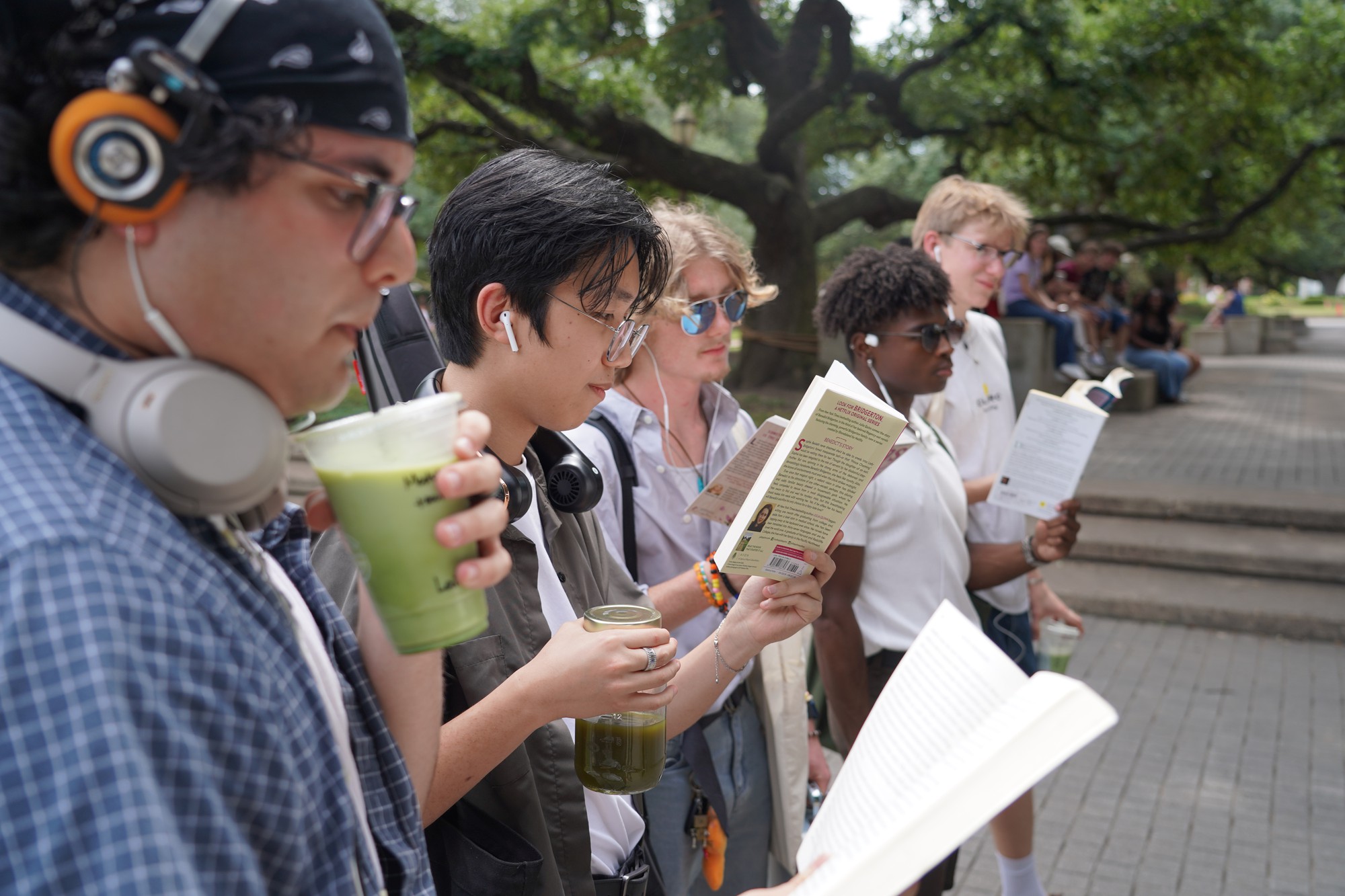
Under the trees in Vera Daniel Plaza by Fountain Mall, student spectators gathered for Baylor’s first annual Performative Male Contest on Friday. Up and down the brick sidewalk, performative male students strutted their stuff for the crowd of over 100 students, bearing wired headphones on their heads, carabiners clipped onto the loops of their baggy jeans and guitars and tote bags slung over their shoulders.
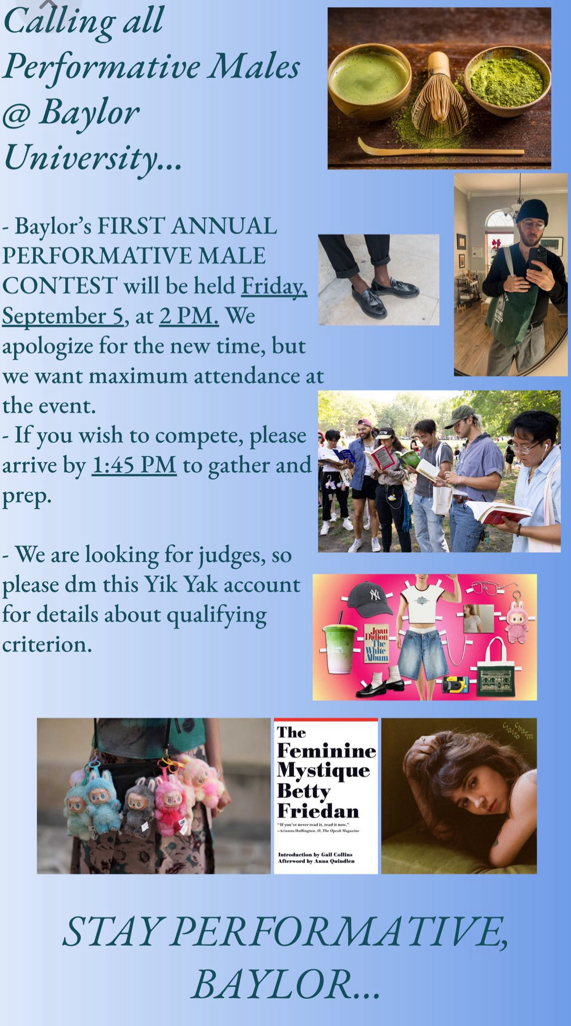
The “performative male” competition trend started on Aug. 3 in Seattle, and eventually spread to other cities like San Francisco, Chicago and New York throughout the rest of the month. These contests feature men who dress and act in ways meant to attract female attention, both ironically and genuinely. Buzz for Baylor’s contest initially generated on YikYak with this poster, created by an anonymous user.
Prior to the competition, three judges introduced each competitor, asked them questions to test their performative-ness and ultimately decided who would take home the title of “Most Performative Male.”
The judges, Austin junior Ally Kellar, San Antonio senior Riley Brown and Kristen Silvacy, were selected by the anonymous creator of the poster.

According to Frederick, Md. senior Leila Harris, an attendee at the competition, one must be “very feminine” in order to qualify as a performative male.
“You have to be a man that women look at and go, ‘I can fix them,’” Harris said.
Another crowd member, Houston senior Alexis Villalon, said the identity of a performative male rests on the music they listen to and the clothes they wear.
“You have to like Rex Orange County, Mitski, Clairo, Frank Ocean and Kali Uchis,” Villalon said. “You have to have either piercings or Doc Martens, wear baggy pants, like matcha or tea and wear headphones.”

While Harris said performative males can be viewed as toxic or obnoxious, she regards them positively because she feels they are more trustworthy than other men.
“They’re usually the funniest guys, not even glazing them,” Harris said. “I’d trust them with my drink.”
Some people have different perceptions about the lifestyle of a performative male, however.
“A performative male is a male who wraps his whole identity by how he is perceived by women in his life,” Baltimore, Md., sophomore Evan Maddox said. “These guys seek to build a persona that validates their ego, based on this approval from women.”
Maddox said he showed up to the contest because he thought the idea was fun and entertaining, but does not believe it is a common identity.
“This identity is few and far between,” Maddox said. “This one scarce identity has been copied numerous times by so many people as a weird search for clout.”

By 2 p.m., the plaza was filled with spectators lining both sides of the walkway, surrounding the five competitors. Phoenix freshman Connor Kaiser was among these participants.
“I can really appreciate women,” Kaiser said. “Everything about them, I love. I treat women really incredible, honestly.”
He mentioned the importance of music taste in the status of a performative male.
“Three years in a row my top artist has been Clairo,” Kaiser said. “Second is Lana Del Rey and then Phoebe Bridgers. I actually have my ‘empowering women beats’ playlist. I made it as a joke three years ago, but it really is a lifestyle.”

Another competitor, Yorba Linda, Calif., junior Jordan Flores, donned a bandana wrapped around his head and a pink, fluffy Labubu on his hip. The way he sees it, everyone is a performer in one way or another.
“I think being a performative male is now just a buzz word,” Flores said. “It’s been thrust upon me because of interests I used to have [that] I would be clowned for, and now they are idealistic. Liking matcha in high school? The name calls? Crazy.”
Despite his aligned interests with his competitors, Flores said he doesn’t truly see himself as a performative male. He said his intentions in participating in the contest were mainly to oversee the other competitors.
“I am absolutely an undercover here,” he said. “I am here to undermine this whole operation because I am a true feminist.”

Two more competitors arrived a few minutes after the first few had already catwalked down the sidewalk, parading their outfits, and endured interrogative questions from the judges and crowd on the nature of their performativeness.
Questioning involved the judges asking competitors their go-to coffee orders, to which answers like extra-sweet matchas and chai lattes were praised by the crowd, and any orders containing oatmilk were booed.
Brown, the main judge, also asked competitors what their performative male fun fact was. Answers ranged from some competitors one-upping each other on how many Clairo and The Marias concerts they’ve attended, to Dallas freshman Ryan Bishop, who said his fun fact was that Homer is the most influential female of all time.
The participants were also asked to demonstrate their talents to prove the sincerity of their performative appearances, such as naming as many songs off a beabadoobee album as possible and proving to the crowd they actually could play the guitars they were toting. Flores, who had an amp attached to his hip and hooked up to his electric guitar played a rendition of “Bags” by Clairo with accompaniment, while another strummed an acoustic version of “Blackbird” by The Beatles.

Judges gave each contestant the opportunity to parade their outfits one last time before choosing the winner. Then, the crowd assisted in the decision by cheering for which competitor they wanted to win. The one who got the loudest cheers and was deemed the official winner was Flores.
“I’ve been training my whole life for this,” Flores said. “I just want to thank all the women in my life — so many, so many women in my life.”
As the winner, Flores received a prize of one dollar, gifted to him by Brown. However, Flores immediately returned the dollar, giving the reason that he would “never take anything from women.”

Waco junior Nathan Lamkin, a bystander, said he enjoyed the competition thoroughly.
“We had some good competitors, and I think it really shows the Baylor community and how tight we are,” Lamkin said.
