

Close Menu
The Baylor Lariat
    Facebook X (Twitter) Instagram YouTube LinkedIn
    Trending
    • Taking off the rose-colored glasses
    • Did we forget concerts are a luxury?
    • Let go; it’ll be OK
    • Music school dean replaced following vote of no confidence, Title IX allegations
    • Student organization ‘Healing Harmonies’ hopes to serve, heal community through power of music
    • ‘Created to Create’: VirtuOSO wins semifinal competition
    • Baylor baseball powers up in 16-7 win over Incarnate Word
    • Baylor track turns the page to outdoor season with early momentum
    • About us
      • Spring 2026 Staff Page
      • Copyright Information
    • Contact
      • Contact Information
      • Letters to the Editor
      • Subscribe to The Morning Buzz
      • Department of Student Media
    • Employment
    • PDF Archives
    • RSS Feeds
    Facebook X (Twitter) Instagram YouTube LinkedIn
    The Baylor LariatThe Baylor Lariat
    Subscribe to the Morning Buzz
    Wednesday, March 25
    • News
      • State and National News
        • State
        • National
      • Politics
        • 2025 Inauguration Page
        • Election Page
      • Homecoming 2025
      • Baylor News
      • Waco Updates
      • Campus and Waco Crime
    • Arts & Life
      • Wedding Edition 2025
      • What to Do in Waco
      • Campus Culture
      • Indy and Belle
      • Leisure and Travel
        • Leisure
        • Travel
          • Baylor in Ireland
      • Student Spotlight
      • Local Scene
        • Small Businesses
        • Social Media
      • Arts and Entertainment
        • Art
        • Fashion
        • Food
        • Literature
        • Music
        • Film and Television
    • Opinion
      • Editorials
      • Points of View
      • Lariat Letters
    • Sports
      • Football
      • Basketball
        • March Madness 2026
        • Men’s Basketball
        • Women’s Basketball
      • Soccer
      • Baseball
      • Softball
      • Volleyball
      • Equestrian
      • Cross Country and Track & Field
      • Acrobatics & Tumbling
      • Tennis
      • Golf
      • Pro Sports
      • Sports Takes
      • Club Sports
    • Lariat TV News
    • Multimedia
      • Video Features
      • Podcasts
        • Don’t Feed the Bears
        • Bear Newscessities
      • Slideshows
    • Sing 2026
    • Lariat 125
    • Advertising
    The Baylor Lariat
    Home»News»Baylor News

    Economics lecture series shows intersection of economics, kidney donors, criminal justice

    Josh SiatkowskiBy Josh SiatkowskiFebruary 19, 2025 Baylor News No Comments4 Mins Read
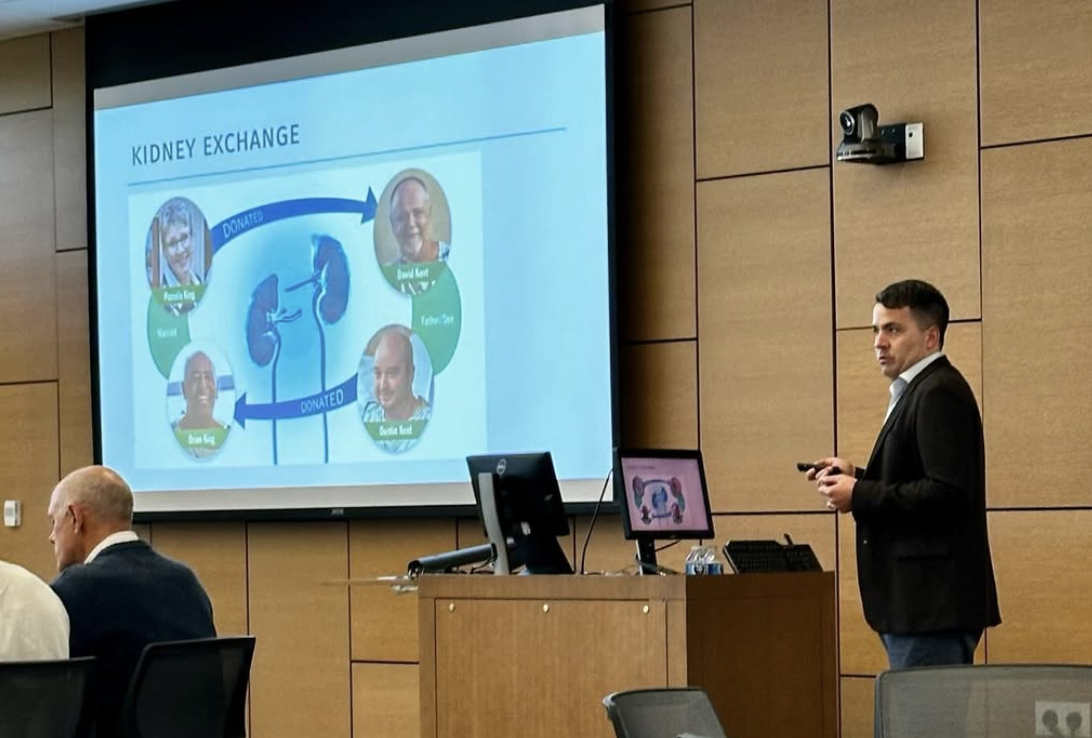
    Economics professor Clayton Featherstone discussed his research on kidney exchange in a November 2023 No Free Lunch. Photo courtesy of Baylor Economics
    Share
    Facebook Twitter LinkedIn Pinterest Email

    By Josh Siatkowski | Staff Writer

    When the term “economics” is in the news, it’s usually followed by talks of inflation, employment or interest rates. But in the Baylor economics department’s “No Free Lunch” lecture series on Wednesday, it showed students and faculty the far-reaching, often surprising applications of the subject.

    When a professor gives a lecture about matching kidney donors with the right patient, one might expect it to be held in the BSB. Similarly, for a lecture on racial bias among jurors, one might look to Sid Richardson for the statistics department. One wouldn’t, however, assume that this research came out of the same department –– and one certainly wouldn’t expect it to come out of the same building that’s home to Rising Roll and endless rows of Patagonia vests.

    But it did. Mark Hoekstra and Clayton Featherstone are both professors in the economics department, which at Baylor, is housed in the Hankamer School of Business. Hoekstra presented his progress on a study of racial bias in grand juries in Texas.

    Contrary to the name, which is inspired by the famous economic principle, “No Free Lunch” attendees dined on sandwiches as Hoekstra shared his research. The project used advanced discrimination tests to see if grand juries discriminate based on race. In simple terms, Hoekstra and his collaborators Suhyeon Oh and Meradee Tangvatcharapong tried to determine if jurors were more harsh when they thought the defendant was Black. Jurors in a grand jury do not see the defendants, so they often infer the defendant’s race based on their name.

    Featherstone presented his research on kidney donors in a fall 2023 “No Free Lunch” event. Featherstone worked alongside institutions that help match kidney transplant patients with the appropriate donors. He made an appearance at this year’s event.

    While the topics made for interesting discussions between students and faculty, it almost seems that the subject of economics has left behind its roots in Adam Smith’s “The Wealth of Nations.” And if you think of economics as just a way to measure the American financial system, it has.

    “An old-timey answer to ‘What is economics?’ is that it’s just understanding how people in institutions deal with scarcity,” Featherstone said.

    But we have moved past that.

    “I don’t think that’s wrong, but more and more, [economics] is being tied together by a sort of toolkit,” Featherstone said. “One of the toolkits is going through and doing careful regression work with data. And the paper that I did with kidneys does a little bit of that.”

    Hoekstra, the racial bias researcher, echoed that.

    “Economists have a set of tools and a way of thinking about problems that give us an advantage in trying to answer a lot of these questions well,” Hoekstra said. “The economics toolkit is a useful toolkit for assessing a lot of questions, including some of those that one might not think of as fundamental economics questions.”

    Using and advancing the “toolkit,” as well as tweaking the original “dealing with scarcity” definition of economics is the reason that the field has become so broad –– and the reason papers on trade and taxation have turned into ones on trials and transplants.

    “The other part of it is always assuming that people are constrained optimizers of some sort,” Featherstone said. “They have an objective, they have some constraints, and they’re doing their best to maximize that objective subject to the constraints. And then it’s a matter of figuring out what the objective is and what the constraints are. So in that sense, why is economics so broad? Because it sets a pretty broad foundation.”

    But the “No Free Lunch” series is not just meant to tout the diversity of economics. There is also a way for students to hear about research in an approachable manner and a way for professors to practice sharing and defending their research.

    One challenge with these lectures, Featherstone said, is that you have to explain the “bare bones” of your research.

    “[Sharing to students] forces you to not speak in jargon,” Featherstone said.

    Students are not the only ones in the room, however. While simplifying their complex research for college kids, professors also must deal with equally complex questions and comments from their colleagues. Though the questions can be hard to answer, especially when trying to simplify reasoning, it’s for the good of the research.

    “As a general rule, having more people think about something is better than relying on how one person thought about something,” Hoekstra said.

    Economics economics department kidney donors lecture series racial bias Research
    Josh Siatkowski
    • X (Twitter)
    • Instagram

    Josh Siatkowski is a junior Business Fellow from Oklahoma City studying finance, economics, professional writing, and data science. He loves writing, skiing, soccer, and more than anything, the Oklahoma City Thunder. After graduation, Josh plans to work in banking.

    Keep Reading

    Music school dean replaced following vote of no confidence, Title IX allegations

    Administration cites internal, external pressures for recent budget decision

    Phi Beta Sigma, Her Campus redefines love with ‘The Art of Loving’

    Baylor celebrates Women’s History Month, female faculty at annual breakfast

    On the ground in Ukraine: How local choices shaped the war

    SAVE America Act may complicate Election Day voting

    Add A Comment

    Comments are closed.

    Recent Posts
    • Taking off the rose-colored glasses March 24, 2026
    • Did we forget concerts are a luxury? March 24, 2026
    About

    The award-winning student newspaper of Baylor University since 1900.

    Articles, photos, and other works by staff of The Baylor Lariat are Copyright © Baylor® University. All rights reserved.

    Subscribe to the Morning Buzz

    Get the latest Lariat News by just Clicking Subscribe!

    Follow the Live Coverage
    Tweets by @bulariat

    Facebook X (Twitter) Instagram YouTube LinkedIn
    • Featured
    • News
    • Sports
    • Opinion
    • Arts and Life
    © 2026 ThemeSphere. Designed by ThemeSphere.

    Type above and press Enter to search. Press Esc to cancel.