


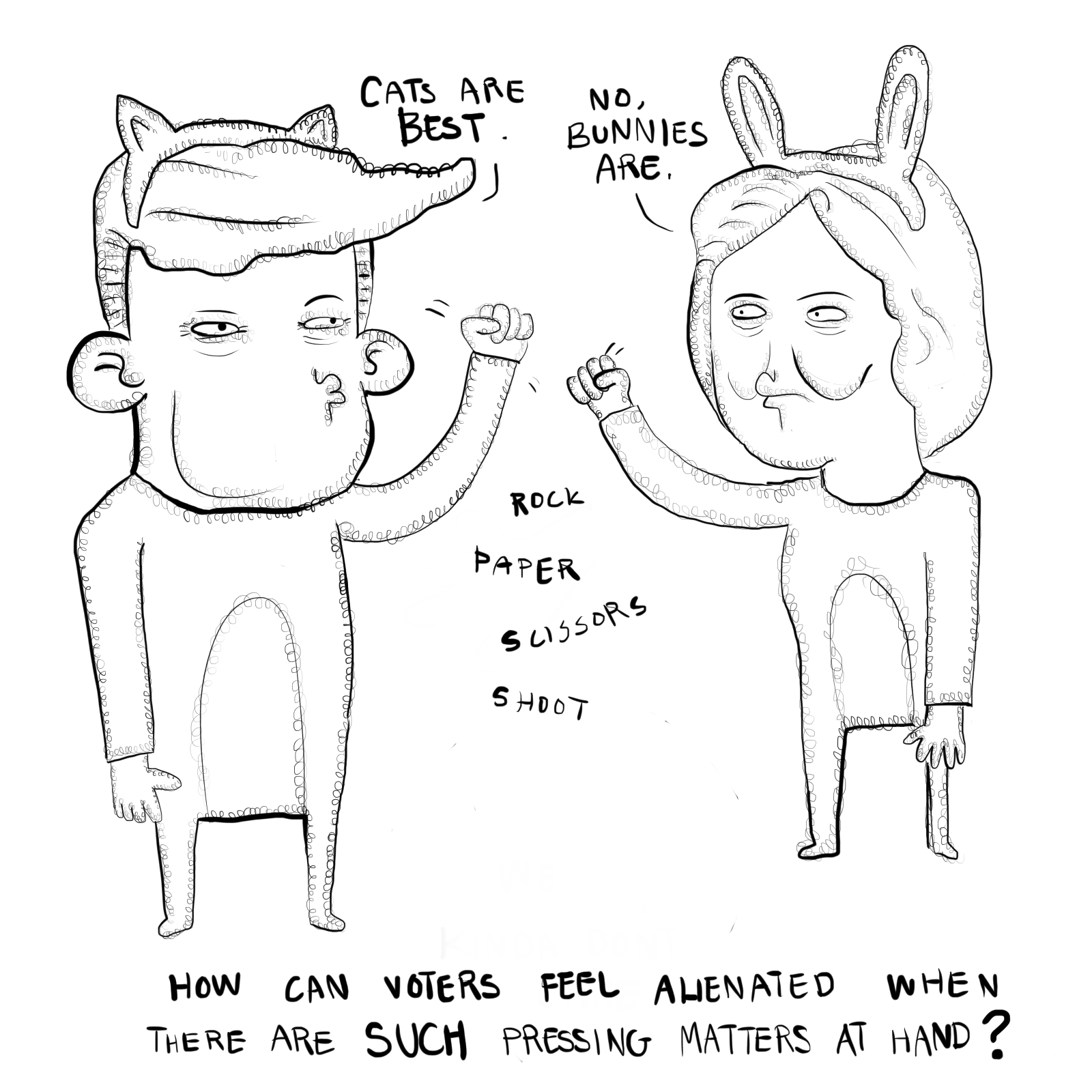
Election Day is looming ever closer, pushing its way into the minds of voters.This is the first presidential election in which the majority of the undergraduate population has been eligible to vote for. With this new experience comes a pressure to begin aligning with a specific party.
The drift from traditional Democratic and Republican standards can lead to an alienation of voters, both young and old alike. The Oxford Journals defines political alienation as “having an attitude of estrangement from the political system, and is conceptualized as falling into two broad categories: political incapability and discontentment.” Incapability is better characterized by an individual who has no choice in the matter, as their environment doesn’t allow for him to make a choice that meets their personal desires. Discontentment is a voluntary state where an individual chooses to disagree with the options presented to him.
Both types of alienation are easily settled into. Students who may feel boxed in or left out by the current election might begin to feel alienated, but instead of working to find ways to connect with those who are more plugged into parties, they allow themselves to succumb to a level of non-participation. By doing so, the alienated move from incapability to discontentment. This decision to ignore civic duty does little to move the student closer to any sense of contentment, instead creating a larger gap in the democratic system.
In this presidential election, finding a party to align with is especially difficult because both candidates are varying on policies that would previously tie them to a party and its votes. However, if a voter is lost on what policies there are to stand by within either party, there are resources and questionnaires to help bring some light to what issues are most important to individuals, and how it might connect to a specific political candidate.
Previous generations have seemed to view party alignment as a one-time decision that must be followed for the duration of their voting life, and this ideology makes the election a point of stress for first-time voters. A stereotype of older generations is that they are highly against change. However, by looking at voting trends of previous elections, it is apparent that adult voters have the ability to, and sometimes do, change party affiliations. Additionally, political members themselves have changed party lines throughout history. Whether this was personal or for campaign reasons, it is not an anomaly. Students are still working to find their career path, continually growing and changing into the leaders of the future. Opinions and stances can and will change, and being afraid to voice the ones you have now will only be detrimental to your ability to express yourself later in life.
According to a study done by Gallup, there has been a 3 to 5 percent decline in people who stand with parties definitively. When”leaners,” or people who identify closest to the parties but are not registered for the party, are added to the equation, the percentage goes up by more than 10 percent in each party.
These findings shine both a positive and negative light on the presidential election. The two members nominated to lead the country in respect to their parties have shown that there is little boundary among party lines. For example, both candidates have had stances on environmental change that either varied throughout the campaign process or blatantly disregarded the party lines. The ability to vote with the candidate’s shifting in mind shows that people are willing to make a choice even if they are not yet willing to tag along with a specific party for an extended period of time.
Young voters have the right to feel alienated, but there is more power behind an educated vote than a misguided choice to remain silent. Alienation in and of itself is a problem, but it is not a strong enough force to keep young voices from making themselves heard.
