
Associated Press
Associated Press
DEPOK, Indonesia — When a 14-year-old girl received a Facebook friend request from an older man she didn’t know, she accepted it out of curiosity. It’s a click she will forever regret, leading to a brutal story that has repeated itself as sexual predators find new ways to exploit Indonesia’s growing obsession with social media.
The junior high student was quickly smitten by the man’s smooth online flattery. They exchanged phone numbers, and his attention increased with rapid-fire texts. He convinced her to meet in a mall, and she found him just as charming in person.
They agreed to meet again. After telling her mom she was going to visit a sick girlfriend on her way to church choir practice, she climbed into the man’s minivan near her home in Depok, on the outskirts of Jakarta.
The man, a 24-year-old who called himself Yogi, drove her an hour to the town of Bogor, West Java, she told The Associated Press in an interview.
There, he locked her in a small room inside a house with at least five other girls ages 14 to 17. She was drugged and raped repeatedly — losing her virginity in the first attack. After one week of torture, her captor told her she was being sold and shipped to the faraway island of Batam, known for its seedy brothels and child sex tourism that cater to men coming by boat from nearby Singapore.
She sobbed hysterically and begged to go home. She was beaten and told to shut up or die.
____
So far this year, 27 of the 129 children reported missing to Indonesia’s National Commission for Child Protection are believed to have been abducted after meeting their captors on Facebook, said the group’s chairman, Arist Merdeka Sirait. One of the 27 has been found dead.
In the month since the Depok girl was found near a bus terminal Sept. 30, there have been at least seven reports of young girls in Indonesia being abducted by people they met on Facebook. Although no solid data exists, police and aid groups that work on trafficking issues say it seems to be a particularly big problem in the Southeast Asian archipelago.
“Maybe Indonesia is kind of a unique country so far. Once the reports start coming in, you will know that maybe it’s not one of the countries, maybe it’s one of a hundred countries,” said Anjan Bose, a program officer who works on child online protection issues at ECPAT International, a nonprofit global network that helps children in 70 countries. “The Internet is such a global medium. It doesn’t differentiate between poor and rich. It doesn’t differentiate between the economy of the country or the culture.”
Websites that track social media say Indonesia has nearly 50 million people signed up for Facebook, making it one of the world’s top users after the U.S. The capital, Jakarta, was recently named the most active Twitter city by Paris-based social media monitoring company Semiocast. In addition, networking groups such as BlackBerry and Yahoo Messenger are wildly popular on mobile phones.
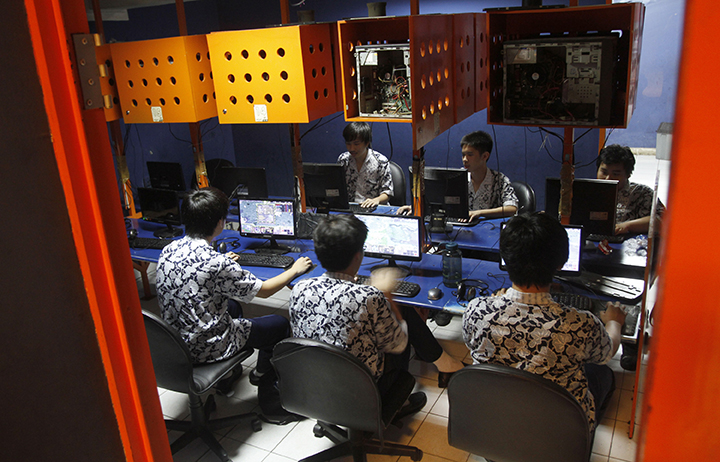
Many young Indonesians, and their parents, are unaware of the dangers of allowing strangers to see their personal information online. Teenagers frequently post photos and personal details such as their home address, phone number, school and hangouts without using any privacy settings — allowing anyone trolling the net to find them and learn everything about them.
“We are racing against time, and the technology frenzy over Facebook is a trend among teenagers here,” Sirait said. “Police should move faster, or many more girls will become victims.”
The 27 Facebook-related abductions reported to the commission this year in Indonesia have already exceed 18 similar cases it received in all of 2011. Overall, the National Task Force Against Human Trafficking said 435 children were trafficked last year, mostly for sexual exploitation.
Many who fight child sex crimes in Indonesia believe the real numbers are much higher. Missing children are often not reported to authorities. Stigma and shame surround sexual abuse in the world’s largest Muslim-majority country, and there’s a widespread belief that police will do nothing to help.
An ECPAT International report estimates that each year, 40,000 to 70,000 children are involved in trafficking, pornography or prostitution in Indonesia, a nation of 240 million where many families remain impoverished.
The U.S. State Department has also warned that more Indonesian girls are being recruited using social media networks. In a report last year, it said traffickers have “resorted to outright kidnapping of girls and young women for sex trafficking within the country and abroad.”
Online child sexual abuse and exploitation are common in much of Asia. In the Philippines, kids are being forced to strip or perform sex acts on live webcams — often by their parents, who are using them as a source of income. Western men typically pay to use the sites.
“In the Philippines, this is the tip of the iceberg. It’s not only Facebook and social media, but it’s also through text messages … especially young, vulnerable people are being targeted,” said Leonarda Kling, regional representative for Terre des Hommes Netherlands, a nonprofit working on trafficking issues. “It’s all about promises. Better jobs or maybe even a nice telephone or whatever. Young people now, you see all the glamour and glitter around you and they want to have the latest BlackBerry, the latest fashion, and it’s also a way to get these things.”
Facebook says its investigators regularly review content on the site and work with authorities, including Interpol, to combat illegal activity. It also has employees around the world tasked with cracking down on people who attempt to use the site for human trafficking.
“We take human trafficking very seriously and, while this behavior is not common on Facebook, a number of measures are in place to counter this activity,” spokesman Andrew Noyes said in an email. He declined to give any details on Facebook’s involvement in trafficking cases reported in Indonesia or elsewhere.
____
The Depok girl, wearing a mask to hide her face as she was interviewed, said she is still shocked that the man she knew for nearly a month turned on her.
“He wanted to buy new clothes for me, and help with school payments. He was different … that’s all,” she said. “I have a lot of contacts through Facebook, and I’ve also exchanged phone numbers. But everything has always gone fine. We were just friends.”
She said that after being kidnapped, she was given sleeping pills and was “mostly unconscious” for her ordeal.
She said she could not escape because a man and another girl stood guard over her.