

Close Menu
The Baylor Lariat
    Facebook X (Twitter) Instagram YouTube LinkedIn
    Trending
    • Hispanic concert in Foster Pavilion rescheduled due to World Cup Final
    • Board of Regents approves nearly $1 billion operating budget, new AI-centered master’s degree
    • Foster Pavilion to host rising country star Braxton Keith
    • Dog days: Q&A with Wacoan that built hot dog social media brand
    • Country legend Willie Nelson returns after 72 years for night of harmonies, hits
    • Students react to ‘very stressful’ Canvas outage ahead of finals
    • Canvas access to be restored, Friday finals moved to online Thursday
    • Baylor delays finals as nationwide Canvas outage impedes studying
    • About us
      • Spring 2026 Staff Page
      • Copyright Information
    • Contact
      • Contact Information
      • Letters to the Editor
      • Subscribe to The Morning Buzz
      • Department of Student Media
    • Employment
    • PDF Archives
    • RSS Feeds
    Facebook X (Twitter) Instagram YouTube LinkedIn
    The Baylor LariatThe Baylor Lariat
    Subscribe to the Morning Buzz
    Wednesday, July 8
    • News
      • State and National News
        • State
        • National
      • Politics
        • 2025 Inauguration Page
        • Election Page
      • Homecoming 2025
      • Baylor News
      • Waco Updates
      • Campus and Waco Crime
    • Arts & Life
      • Wedding Edition 2025
      • What to Do in Waco
      • Campus Culture
      • Indy and Belle
      • Leisure and Travel
        • Leisure
        • Travel
          • Baylor in Ireland
      • Student Spotlight
      • Local Scene
        • Small Businesses
        • Social Media
      • Arts and Entertainment
        • Art
        • Fashion
        • Food
        • Literature
        • Music
        • Film and Television
    • Opinion
      • Editorials
      • Points of View
      • Lariat Letters
    • Sports
      • Football
      • Basketball
        • March Madness 2026
        • Men’s Basketball
        • Women’s Basketball
      • Soccer
      • Baseball
      • Softball
      • Volleyball
      • Equestrian
      • Cross Country and Track & Field
      • Acrobatics & Tumbling
      • Tennis
      • Golf
      • Pro Sports
      • Sports Takes
      • Club Sports
    • Lariat TV News
    • Multimedia
      • Video Features
      • Podcasts
        • Don’t Feed the Bears
        • Bear Newscessities
      • Slideshows
    • Sing 2026
    • Lariat 125
    • Advertising
    The Baylor Lariat
    Home»News»National

    After Sandy, New Yorkers return to find changed city

    Baylor LariatBy Baylor LariatOctober 31, 2012 National No Comments5 Mins Read
    By Collen Long and Erin McClam Associated Press NEW YORK — Stripped of its bustle and mostly cut off from the world, New York was left wondering Tuesday when its particular way of life — carried by subway, lit by skyline and powered by 24-hour deli — would return. Mayor Michael Bloomberg and the power company said it could be the weekend before the lights come on for hundreds of thousands of people plunged into darkness by what was once Hurricane Sandy. Bloomberg said it could also be four or five days before the subway, which suffered the worst damage in its 108-year history, is running again. All 10 of the tunnels that carry New Yorkers under the East River were flooded. Sandy killed 18 people in New York City, the mayor said. The dead included two who drowned in a home and one who was in bed when a tree fell on an apartment. A 23-year-old woman died after stepping into a puddle near a live electrical wire. “This was a devastating storm, maybe the worst that we have ever experienced,” Bloomberg said. For the 8 million people who live here, the city was a different place one day after the storm. In normal times, rituals bring a sense of order to the chaos of life in the nation’s largest city: Stop at Starbucks on the morning walk with the dog, drop the kids off at P.S. 39, grab a bagel. On Tuesday, those rituals were suspended, with little indication when they would come back. Schools were shut for a second day and were closed Wednesday, too. Coffee shops, normally open as close as a block apart, were closed in some neighborhoods. New York found itself less caffeinated and curiously isolated from the world, although by afternoon it had begun to struggle back to life. Some bridges into the city reopened at midday, but the Brooklyn-Battery Tunnel, connecting Brooklyn to Manhattan, and the Holland Tunnel, between New York and New Jersey, remained closed. And service on the three commuter railroads that run between the city and its suburbs was still suspended. Gov. Andrew Cuomo said bus service would be restored at 5 p.m. EDT, on a limited schedule but free. He said he hoped there would be full service on Wednesday, also free. The New York Stock Exchange was closed for a second day, the first time that has happened because of weather since the 19th century, but said it would reopen on Wednesday. Swaths of the city were not so lucky. Consolidated Edison, the power company, said it would be four days before the last of the 337,000 customers in Manhattan and Brooklyn who lost power have electricity again. For the Bronx, Queens, Staten Island and Westchester County, with 442,000 outages, it could take a week, Con Ed said. Floodwater led to explosions that disabled a power substation on Monday night, contributing to the outages. New Yorkers were left without power to charge their iPods and Kindles and Nooks for the subway. Not that there was a subway. People clustered around electrical outlets at a Duane Reade drugstore to power up their phones. At a small market called Hudson Gourmet, in Manhattan’s Greenwich Village, cashiers made change by candlelight and shoppers used flashlights to scour the shelves. Lee Leshen used the light from his phone to make his selections — three boxes of linguine and a can of tomatoes. His power was out, but the gas in his stove worked, so he could cook. He said he almost never cooks but is learning. John Tricoli, his wife, Christine, and their 6-year-old twins spent Monday night holed up in their 11th-floor apartment in one of several lower Manhattan office buildings that were converted to condos in the 2000s and have drawn young families. Once the power went off at 7 p.m., there was a major challenge — no TV. By candlelight, “we colored, we read, we played games — old school,” Christine Tricoli said as the family emerged to go on a walk on Tuesday that started with a trek down 11 flights of stairs. “There was even talking,” she said. The city modified its taxi rules and encouraged drivers to pick up more than one passenger at a time, putting New Yorkers in the otherwise unthinkable position of having to share a yellow cab with a stranger. Livery cabs and black sedans, normally allowed to pick up passengers only by arrangement, were allowed to stop for people hailing rides on the street. The landscape of the city changed in a matter of hours. A fire destroyed as many as 100 houses in a flooded beachfront neighborhood in Queens. Firefighters said the water was chest-high on the street and they had to use a boat to make rescues. In Brooklyn, Faye Schwartz surveyed the damage in her Brooklyn neighborhood, where cars were strewn like leaves, planters were deposited in intersections and green Dumpsters were tossed on their sides. Associated Press
    Share
    Facebook Twitter LinkedIn Pinterest Email
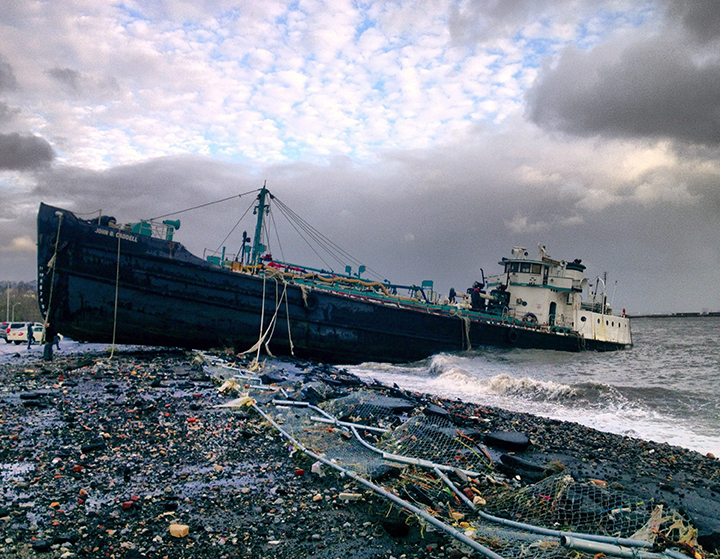
    A 168-foot water tanker, the John B. Caddell, sits on the shore Tuesday morning where it ran aground on Front Street in the Stapleton neighborhood of New York’s Staten Island as a result of superstorm Sandy.
    Associated Press

    By Collen Long

    and Erin McClam

    Associated Press

    NEW YORK — Stripped of its bustle and mostly cut off from the world, New York was left wondering Tuesday when its particular way of life — carried by subway, lit by skyline and powered by 24-hour deli — would return.

    Mayor Michael Bloomberg and the power company said it could be the weekend before the lights come on for hundreds of thousands of people plunged into darkness by what was once Hurricane Sandy.

    Bloomberg said it could also be four or five days before the subway, which suffered the worst damage in its 108-year history, is running again.

    All 10 of the tunnels that carry New Yorkers under the East River were flooded.

    Sandy killed 18 people in New York City, the mayor said. The dead included two who drowned in a home and one who was in bed when a tree fell on an apartment. A 23-year-old woman died after stepping into a puddle near a live electrical wire.

    “This was a devastating storm, maybe the worst that we have ever experienced,” Bloomberg said.

    For the 8 million people who live here, the city was a different place one day after the storm.

    In normal times, rituals bring a sense of order to the chaos of life in the nation’s largest city: Stop at Starbucks on the morning walk with the dog, drop the kids off at P.S. 39, grab a bagel.

    On Tuesday, those rituals were suspended, with little indication when they would come back. Schools were shut for a second day and were closed Wednesday, too.

    Coffee shops, normally open as close as a block apart, were closed in some neighborhoods. New York found itself less caffeinated and curiously isolated from the world, although by afternoon it had begun to struggle back to life.

    Some bridges into the city reopened at midday, but the Brooklyn-Battery Tunnel, connecting Brooklyn to Manhattan, and the Holland Tunnel, between New York and New Jersey, remained closed. And service on the three commuter railroads that run between the city and its suburbs was still suspended.

    Gov. Andrew Cuomo said bus service would be restored at 5 p.m. EDT, on a limited schedule but free. He said he hoped there would be full service on Wednesday, also free.

    The New York Stock Exchange was closed for a second day, the first time that has happened because of weather since the 19th century, but said it would reopen on Wednesday.

    Swaths of the city were not so lucky. Consolidated Edison, the power company, said it would be four days before the last of the 337,000 customers in Manhattan and Brooklyn who lost power have electricity again.

    For the Bronx, Queens, Staten Island and Westchester County, with 442,000 outages, it could take a week, Con Ed said. Floodwater led to explosions that disabled a power substation on Monday night, contributing to the outages.

    New Yorkers were left without power to charge their iPods and Kindles and Nooks for the subway. Not that there was a subway. People clustered around electrical outlets at a Duane Reade drugstore to power up their phones.

    At a small market called Hudson Gourmet, in Manhattan’s Greenwich Village, cashiers made change by candlelight and shoppers used flashlights to scour the shelves.

    Lee Leshen used the light from his phone to make his selections — three boxes of linguine and a can of tomatoes. His power was out, but the gas in his stove worked, so he could cook. He said he almost never cooks but is learning.

    John Tricoli, his wife, Christine, and their 6-year-old twins spent Monday night holed up in their 11th-floor apartment in one of several lower Manhattan office buildings that were converted to condos in the 2000s and have drawn young families. Once the power went off at 7 p.m., there was a major challenge — no TV.

    By candlelight, “we colored, we read, we played games — old school,” Christine Tricoli said as the family emerged to go on a walk on Tuesday that started with a trek down 11 flights of stairs.

    “There was even talking,” she said. The city modified its taxi rules and encouraged drivers to pick up more than one passenger at a time, putting New Yorkers in the otherwise unthinkable position of having to share a yellow cab with a stranger.

    Livery cabs and black sedans, normally allowed to pick up passengers only by arrangement, were allowed to stop for people hailing rides on the street. The landscape of the city changed in a matter of hours. A fire destroyed as many as 100 houses in a flooded beachfront neighborhood in Queens. Firefighters said the water was chest-high on the street and they had to use a boat to make rescues.

    In Brooklyn, Faye Schwartz surveyed the damage in her Brooklyn neighborhood, where cars were strewn like leaves, planters were deposited in intersections and green Dumpsters were tossed on their sides.


    Baylor Lariat

    Keep Reading

    Board of Regents approves nearly $1 billion operating budget, new AI-centered master’s degree

    Foster Pavilion to host rising country star Braxton Keith

    Students react to ‘very stressful’ Canvas outage ahead of finals

    Canvas access to be restored, Friday finals moved to online Thursday

    Baylor delays finals as nationwide Canvas outage impedes studying

    Student research findings emphasize importance of deep friendships

    Add A Comment

    Comments are closed.

    Recent Posts
    • Hispanic concert in Foster Pavilion rescheduled due to World Cup Final June 22, 2026
    • Board of Regents approves nearly $1 billion operating budget, new AI-centered master’s degree May 21, 2026
    About

    The award-winning student newspaper of Baylor University since 1900.

    Articles, photos, and other works by staff of The Baylor Lariat are Copyright © Baylor® University. All rights reserved.

    Subscribe to the Morning Buzz

    Get the latest Lariat News by just Clicking Subscribe!

    Follow the Live Coverage
    Tweets by @bulariat

    Facebook X (Twitter) Instagram YouTube LinkedIn
    • Featured
    • News
    • Sports
    • Opinion
    • Arts and Life
    © 2026 ThemeSphere. Designed by ThemeSphere.

    Type above and press Enter to search. Press Esc to cancel.